Search

Thermo Scientific™
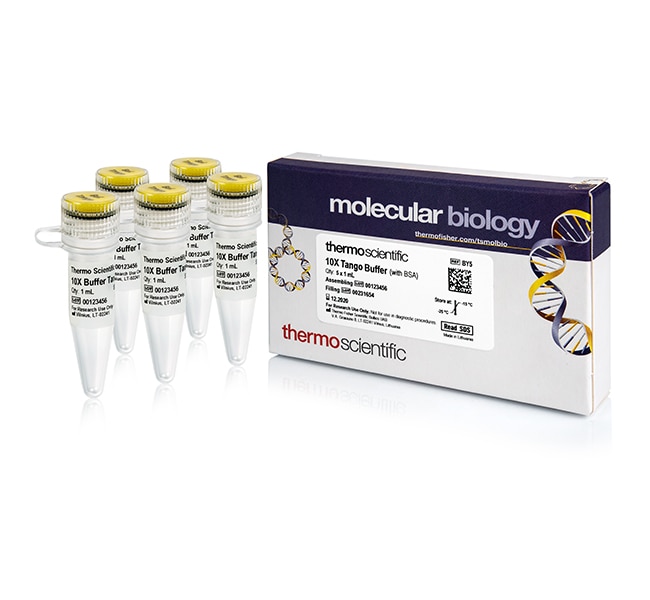
Tampon Tango (10X)
Le tampon Thermo Scientific 10X Y garantit les conditions de réaction optimales pour les enzymes de restriction et est prémélangéAfficher plus
| Référence | Quantité |
|---|---|
| BY5 | 5 x 1,0 ml |
Référence BY5
Prix (EUR)
21,65
キャンペーン価格
24,17Économisez 2,52 (10%)
Each
Quantité:
5 x 1,0 ml
Prix (EUR)
21,65
キャンペーン価格
24,17Économisez 2,52 (10%)
Each
Le tampon Thermo Scientific 10X Y garantit les conditions de réaction optimales pour les enzymes de restriction et est prémélangé avec de la BSA pour une meilleure stabilité. Notre système à cinq tampons garantit des conditions de réaction optimales pour chaque enzyme de restriction. Ce système comprend des tampons 10X B (bleu), G (vert), O (orange), R (rouge) et Tango (jaune). Toutes les enzymes de restriction sont fournies dans des tubes à code couleur pour indiquer le tampon de réaction recommandé. Le tampon recommandé et/ou le tampon Tango universel sont fournis avec chaque enzyme.
Le tampon Tango a été conçu pour les digestions doubles d’ADN avec des enzymes de restriction classiques. Pour de plus amples informations, consultez l’outil Thermo Scientific DoubleDigest.
Pour garantir des performances constantes, les tampons d’enzymes de restriction Thermo Scientific contiennent de la BSA, ce qui améliore la stabilité de nombreuses enzymes et lie les contaminants éventuellement présents dans les préparations d’ADN. Plusieurs cycles de congélation / décongélation des tampons ne provoquent pas de précipitation de la BSA.
Les enzymes de restriction Thermo Scientific présentent 100 % de leur activité certifiée dans le tampon recommandé. Cependant, certaines enzymes nécessitent des additifs pour atteindre l’activité à 100 %. Par exemple, AjuI, Alfl, BdaI, BplI, BseMII, FaqI, Eco57I, Eco57Ml, Hin4I et Tsol nécessitent une S-adénosylméthionine, qui est fournie avec l’enzyme, tandis que AarI et BveI nécessitent un oligonucléotide (également fourni avec l’enzyme). Esp3l nécessite du DTT.
Le tampon Tango a été conçu pour les digestions doubles d’ADN avec des enzymes de restriction classiques. Pour de plus amples informations, consultez l’outil Thermo Scientific DoubleDigest.
Pour garantir des performances constantes, les tampons d’enzymes de restriction Thermo Scientific contiennent de la BSA, ce qui améliore la stabilité de nombreuses enzymes et lie les contaminants éventuellement présents dans les préparations d’ADN. Plusieurs cycles de congélation / décongélation des tampons ne provoquent pas de précipitation de la BSA.
Les enzymes de restriction Thermo Scientific présentent 100 % de leur activité certifiée dans le tampon recommandé. Cependant, certaines enzymes nécessitent des additifs pour atteindre l’activité à 100 %. Par exemple, AjuI, Alfl, BdaI, BplI, BseMII, FaqI, Eco57I, Eco57Ml, Hin4I et Tsol nécessitent une S-adénosylméthionine, qui est fournie avec l’enzyme, tandis que AarI et BveI nécessitent un oligonucléotide (également fourni avec l’enzyme). Esp3l nécessite du DTT.
Usage exclusivement réservé à la recherche. Ne pas utiliser pour des procédures de diagnostic.
Spécifications
Type de produitTampon Tango
Quantité5 x 1,0 ml
Concentration10X
Gamme de produitsTango
Catégorie de rechercheClonage traditionnel
Unit SizeEach