Search


Citations et références (18)
Invitrogen™
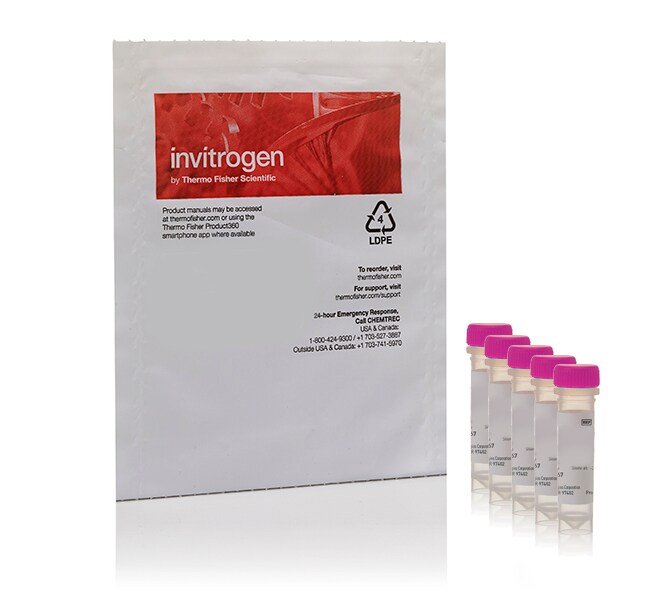
CellROX™ Orange Reagent, for oxidative stress detection
Nouvelle sonde fluorogénique pour mesurer le stress oxydatif dans les cellules vivantes
| Référence | Quantité |
|---|---|
| C10443 | 5 x 50 μl |
Référence C10443
Prix (EUR)
666,00
Each
Quantité:
5 x 50 μl
Prix (EUR)
666,00
Each
Le réactif orange CellROX™ est une nouvelle sonde fluorogénique pour la mesure du stress oxydatif dans des cellules vivantes. Ce colorant perméant aux cellules est non fluorescent à l’état réduit et présente une fluorescence orange brillante lors de son oxydation par des dérivés réactifs de l’oxygène (DRO), avec des valeurs maximales d’absorption/émission ∼ 545/565 nm. Bien que ce réactif ne soit pas fixable au formaldéhyde, il peut être multiplexé avec d'autres sondes vivantes compatibles avec les cellules telles que GFP, CellEvent™ Caspase 3/7 Green, Image-iT™ DEAD Green, Green et Deep Red MitoTracker™ colorants et NucBlue™ .
Le™ réactif CellROX Orange est compatible avec diverses plateformes, telles que la microscopie par fluorescence traditionnelle, le screening à haute teneur (HCS) et la cytométrie en flux. Ce réactif est également compatible avec le cytomètre Tali™ basé sur l’image.
De plus, le™ réactif orange CellROX est :
• Compatible avec d’autres sondes de cellules vivantes, y compris le GFP, et peut être ajouté directement aux milieux de croissance contenant du sérum
• fournis comme stable, Solution DMSO prête à l’emploi avec un protocole simple compatible avec les flux de travaux standard en microscopie par fluorescence
• Fournie en cinq flacons à usage unique contenant suffisamment de réactif total pour cinq plaques de 96 puits ou 100 lamelles
La contrainte oxydative résulte d’un déséquilibre entre la production d’espèces d’oxygène réactives (ROS) et la capacité des cellules à les venger. Les DRO jouent un rôle important dans la progression de plusieurs maladies, dont l’inflammation, l’athérosclérose, le vieillissement et les troubles dégénératifs liés à l’âge.
Usage exclusivement réservé à la recherche. Non destiné à des fins thérapeutiques ou diagnostiques humaines ou animales.
Le™ réactif CellROX Orange est compatible avec diverses plateformes, telles que la microscopie par fluorescence traditionnelle, le screening à haute teneur (HCS) et la cytométrie en flux. Ce réactif est également compatible avec le cytomètre Tali™ basé sur l’image.
De plus, le™ réactif orange CellROX est :
• Compatible avec d’autres sondes de cellules vivantes, y compris le GFP, et peut être ajouté directement aux milieux de croissance contenant du sérum
• fournis comme stable, Solution DMSO prête à l’emploi avec un protocole simple compatible avec les flux de travaux standard en microscopie par fluorescence
• Fournie en cinq flacons à usage unique contenant suffisamment de réactif total pour cinq plaques de 96 puits ou 100 lamelles
La contrainte oxydative résulte d’un déséquilibre entre la production d’espèces d’oxygène réactives (ROS) et la capacité des cellules à les venger. Les DRO jouent un rôle important dans la progression de plusieurs maladies, dont l’inflammation, l’athérosclérose, le vieillissement et les troubles dégénératifs liés à l’âge.
Usage exclusivement réservé à la recherche. Non destiné à des fins thérapeutiques ou diagnostiques humaines ou animales.
Usage exclusivement réservé à la recherche. Ne pas utiliser pour des procédures de diagnostic.
Spécifications
CouleurOrange
Concentration2.5 mM stabilized solution in DMSO
À utiliser avec (équipement)Imaging, HCS, Cytometer
FormatCongelé
Quantité5 x 50 μl
Méthode de détectionLive Cell Imaging
Excitation/Emission545/565 nm
IndicatorOxidative stress
Gamme de produitsCellROX
Unit SizeEach
Contenu et stockage
Store at ≤–20°C. Protect from light and desiccate.
Foire aux questions (FAQ)
What dyes can I use to detect reactive oxygen species (ROS) in my bacteria?
I am trying to label my cells with a reactive oxygen species (ROS) indicator dye, but I am not seeing a significant difference in signal. What could be happening?
Citations et références (18)
Citations et références
Abstract
MicroRNA-27 (miR-27) Targets Prohibitin and Impairs Adipocyte Differentiation and Mitochondrial Function in Human Adipose-derived Stem Cells.
Journal:
PubMed ID:24133204
Prohibitin (PHB) has been reported to play a crucial role in adipocyte differentiation and mitochondrial function. However, the regulative mechanism of PHB during adipogenesis remains unclear. In this study, we determined that the levels of both microRNA (miR)-27a and miR-27b were down-regulated following adipogenic induction of human adipose-derived stem cells,
Mitohormesis in Hypothalamic POMC Neurons Mediates Regular Exercise-Induced High-Turnover Metabolism.
Journal:Cell Metab
PubMed ID:33535098
Anti-inflammatory effect of strawberry extract against LPS-induced stress in RAW 264.7 macrophages.
Journal:Food Chem Toxicol
PubMed ID:28130090
'A common denominator in the pathogenesis of most chronic inflammatory diseases is the involvement of oxidative stress, related to ROS production by all aerobic organisms. Dietary antioxidants from plant foods represent an efficient strategy to counteract this condition. The aim of the present study was to evaluate the protective effects
Targeting Breast Cancer Stem Cell State Equilibrium through Modulation of Redox Signaling.
Journal:Cell Metab
PubMed ID:29972798
Integrative Omics Analyses Reveal Epigenetic Memory in Diabetic Renal Cells Regulating Genes Associated With Kidney Dysfunction.
Journal:Diabetes
PubMed ID:32747424