Search


Citations et références (30)
Invitrogen™
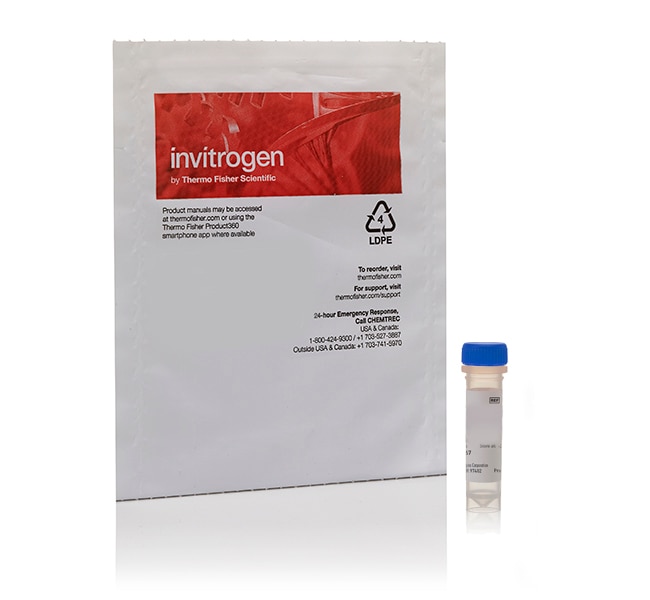
CellLight™ Mitochondria-GFP, BacMam 2.0
Les mitochondries-GFP CellLight™, BacMam 2.0, offrent un moyen facile de marquer les mitochondries avec la protéine verte fluorescente (GFP) dansAfficher plus
| Référence | Quantité |
|---|---|
| C10600 | 1 flacon |
Référence C10600
Prix (EUR)
636,65
Online exclusive
692,00Économisez 55,35 (8%)
Each
Quantité:
1 flacon
Prix (EUR)
636,65
Online exclusive
692,00Économisez 55,35 (8%)
Each
Les mitochondries-GFP CellLight™, BacMam 2.0, offrent un moyen facile de marquer les mitochondries avec la protéine verte fluorescente (GFP) dans les cellules vivantes. Il vous suffit d’ajouter le réactif à vos cellules et de laisser incuber pendant une nuit. Les cellules sont prêtes à être observées au matin.
Vous souhaitez marquer d’autres structures cellulaires ? En savoir plus sur les outils de marquage des protéines fluorescentes CellLight™
Cette construction prête à l’emploi est transfectée dans des cellules à l’aide de la technologie BacMam 2.0, où elle exprime les GFP fusionnées à la séquence principale de l’alpha pyruvate deshydrogénase E1. Vous pouvez observer le comportement des mitochondries-GFP dans des cellules vivantes indépendamment du potentiel de la membrane mitochondriale et marquer des cellules vivantes avec plusieurs colorants de suivi ou de traçage afin d’identifier des processus cellulaires dynamiques.
Les cellules exprimant les constructions CellLight™ peuvent également être fixées avec du formaldéhyde pour l’imagerie multiplexée à l’aide de techniques immunocytochimiques.
La technologie CellLight™ est :
• Rapide et pratique : ajoutez simplement le réactif CellLight™ à vos cellules, laissez incuber pendant la nuit et imagez ; ou stocker les cellules congelées et prêtes pour essai pour une utilisation ultérieure
• Très efficace : jusqu’à 90 % de transduction d’un large éventail de lignées cellulaires de mammifères, notamment des cellules primaires, des cellules souches et des neurones
• Flexible : effectuez la cotransduction de plusieurs réactifs BacMam pour des expériences multiplexes ou des études de colocalisation ; contrôlez rigoureusement les niveaux d’expression simplement en variant la dose
• Moins toxique : Les réactifs CellLight™ ne se répliquent pas dans les cellules de mammifères et conviennent à la manipulation de niveau de sécurité biologique (BSL) 1
Technologie BacMam
Les mitochondries-GFP CellLight™, BacMam 2.0, sont une construction de fusion de la séquence principale de l’alpha pyruvate deshydrogénase E1 et de l’emGFP, fournissant un ciblage précis et spécifique des mitochondries-GFP cellulaires. Cette construction de fusion est conditionnée dans le virus d’insecte baculovirus, qui ne se réplique pas dans les cellules humaines et qui est désigné comme pouvant être utilisé en toute sécurité dans la plupart des laboratoires appliquant le niveau de sécurité biologique (BSL) 1. La technologie BacMam garantit que la plupart des types de cellules de mammifères sont transduits / transfectés avec une haute efficacité et une toxicité minimale. Cette transfection transitoire peut être détectée après une incubation d’une nuit, et ce pendant cinq jours maximum, offrant suffisamment de temps pour réaliser la plupart des analyses cellulaires dynamiques. Comme toute technique de transfection / transduction, la méthode BacMam ne transfecte / transduit pas toutes les cellules avec la même efficacité, ce qui la rend peu adaptée à des études de population cellulaire ou à une imagerie / numération automatisée. Les réactifs CellLight™ conviennent parfaitement aux expériences où la colocalisation cellulaire ou infracellulaire est nécessaire, ou aux études de la fonction cellulaire qui requièrent une résolution spéciale.
Vous souhaitez marquer d’autres structures cellulaires ? En savoir plus sur les outils de marquage des protéines fluorescentes CellLight™
Cette construction prête à l’emploi est transfectée dans des cellules à l’aide de la technologie BacMam 2.0, où elle exprime les GFP fusionnées à la séquence principale de l’alpha pyruvate deshydrogénase E1. Vous pouvez observer le comportement des mitochondries-GFP dans des cellules vivantes indépendamment du potentiel de la membrane mitochondriale et marquer des cellules vivantes avec plusieurs colorants de suivi ou de traçage afin d’identifier des processus cellulaires dynamiques.
Les cellules exprimant les constructions CellLight™ peuvent également être fixées avec du formaldéhyde pour l’imagerie multiplexée à l’aide de techniques immunocytochimiques.
La technologie CellLight™ est :
• Rapide et pratique : ajoutez simplement le réactif CellLight™ à vos cellules, laissez incuber pendant la nuit et imagez ; ou stocker les cellules congelées et prêtes pour essai pour une utilisation ultérieure
• Très efficace : jusqu’à 90 % de transduction d’un large éventail de lignées cellulaires de mammifères, notamment des cellules primaires, des cellules souches et des neurones
• Flexible : effectuez la cotransduction de plusieurs réactifs BacMam pour des expériences multiplexes ou des études de colocalisation ; contrôlez rigoureusement les niveaux d’expression simplement en variant la dose
• Moins toxique : Les réactifs CellLight™ ne se répliquent pas dans les cellules de mammifères et conviennent à la manipulation de niveau de sécurité biologique (BSL) 1
Technologie BacMam
Les mitochondries-GFP CellLight™, BacMam 2.0, sont une construction de fusion de la séquence principale de l’alpha pyruvate deshydrogénase E1 et de l’emGFP, fournissant un ciblage précis et spécifique des mitochondries-GFP cellulaires. Cette construction de fusion est conditionnée dans le virus d’insecte baculovirus, qui ne se réplique pas dans les cellules humaines et qui est désigné comme pouvant être utilisé en toute sécurité dans la plupart des laboratoires appliquant le niveau de sécurité biologique (BSL) 1. La technologie BacMam garantit que la plupart des types de cellules de mammifères sont transduits / transfectés avec une haute efficacité et une toxicité minimale. Cette transfection transitoire peut être détectée après une incubation d’une nuit, et ce pendant cinq jours maximum, offrant suffisamment de temps pour réaliser la plupart des analyses cellulaires dynamiques. Comme toute technique de transfection / transduction, la méthode BacMam ne transfecte / transduit pas toutes les cellules avec la même efficacité, ce qui la rend peu adaptée à des études de population cellulaire ou à une imagerie / numération automatisée. Les réactifs CellLight™ conviennent parfaitement aux expériences où la colocalisation cellulaire ou infracellulaire est nécessaire, ou aux études de la fonction cellulaire qui requièrent une résolution spéciale.
Usage exclusivement réservé à la recherche. Ne pas utiliser pour des procédures de diagnostic.
Spécifications
CouleurVert
Méthode de détectionFluorescence
Type de colorantGFP (EmGFP)
ÉmissionVisible
Gamme de longueur d’onde d’excitation488 / 510
À utiliser avec (équipement)Microscope confocal, microscope à fluorescence
FormeLiquide
Gamme de produitsCellLight
Quantité1 flacon
Conditions d’expéditionGlace humide
TechniqueIntensité de fluorescence
Type d’étiquetteProtéine fluorescente
Type de produitMitochondrie
Sub Cellular LocalizationMitochondrie
Unit SizeEach
Contenu et stockage
Conserver entre 2°C et 6°C, à l’abri de la lumière. Ne pas congeler.
Foire aux questions (FAQ)
How can I increase the transduction efficiency with the BacMam 2.0 reagents such as the the CellLight and Premo products?
Is there any way to preserve the CellLights labeling beyond 5 days?
Are the CellLights products toxic to cells?
For how long will the CellLights products label my cells?
What cell types can the CellLights products be used with?
Citations et références (30)
Citations et références
Abstract
Standardized mitochondrial analysis gives new insights into mitochondrial dynamics and OPA1 function.
Journal:Int J Biochem Cell Biol
PubMed ID:22433900
'Mitochondria form dynamic tubular networks through processes of fission and fusion. Defect in mitochondrial dynamics lead to various pathologies, including several common and some rare neurodegenerative disorders. OPA1 and MFN2 are two key players in mitochondrial fusion associated with Autosomal Dominant Optic Atrophy and Charcot Marie Tooth neuropathy type 2A
Ketamine induces toxicity in human neurons differentiated from embryonic stem cells via mitochondrial apoptosis pathway.
Journal:Curr Drug Saf
PubMed ID:22873495
'Ketamine is widely used for anesthesia in pediatric patients. Growing evidence indicates that ketamine causes neurotoxicity in a variety of developing animal models. Our understanding of anesthesia neurotoxicity in humans is currently limited by difficulties in obtaining neurons and performing developmental toxicity studies in fetal and pediatric populations. It may
Energy metabolism in human pluripotent stem cells and their differentiated counterparts.
Journal:PLoS One
PubMed ID:21698063
'BACKGROUND: Human pluripotent stem cells have the ability to generate all cell types present in the adult organism, therefore harboring great potential for the in vitro study of differentiation and for the development of cell-based therapies. Nonetheless their use may prove challenging as incomplete differentiation of these cells might lead
Nitrite activates protein kinase A in normoxia to mediate mitochondrial fusion and tolerance to ischaemia/reperfusion.
Journal:
PubMed ID:24081164
'Nitrite (NO2(-)), a dietary constituent and nitric oxide (NO) oxidation product, mediates cardioprotection after ischaemia/reperfusion (I/R) in a number of animal models when administered during ischaemia or as a pre-conditioning agent hours to days prior to the ischaemic episode. When present during ischaemia, the reduction of nitrite to bioactive NO
Inhibition of AMP-activated protein kinase a (AMPKa) by doxorubicin accentuates genotoxic stress and cell death in mouse embryonic fibroblasts and cardiomyocytes: role of p53 and SIRT1.
Journal:J Biol Chem
PubMed ID:22267730
'Doxorubicin, an anthracycline antibiotic, is widely used in cancer treatment. Doxorubicin produces genotoxic stress and p53 activation in both carcinoma and non-carcinoma cells. Although its side effects in non-carcinoma cells, especially in heart tissue, are well known, the molecular targets of doxorubicin are poorly characterized. Here, we report that doxorubicin