Search


Citations et références (6)
Invitrogen™
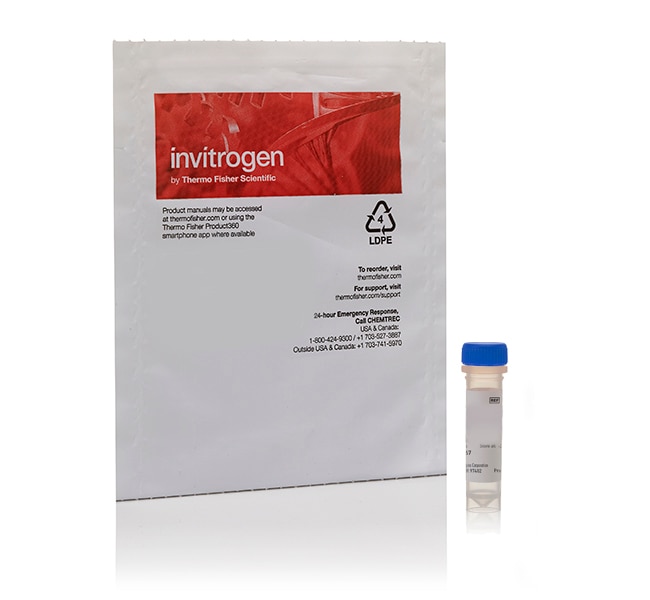
CellLight™ Plasma Membrane-CFP, BacMam 2.0
CellLight™ membrane plasmique-CFP, BacMam 2.0, fournit une façon simple de marquer la membrane plasmique avec une protéine bleue fluorescente (CFP)Afficher plus
| Référence | Quantité |
|---|---|
| C10606 | 1 flacon, 1 flacon |
Référence C10606
Prix (EUR)
692,00
Each
Quantité:
1 flacon, 1 flacon
Prix (EUR)
692,00
Each
CellLight™ membrane plasmique-CFP, BacMam 2.0, fournit une façon simple de marquer la membrane plasmique avec une protéine bleue fluorescente (CFP) dans des cellules vivantes. Il vous suffit d’ajouter le réactif à vos cellules et de laisser incuber pendant une nuit. Les cellules sont prêtes à être observées au matin.
Vous souhaitez marquer d’autres structures cellulaires ? En savoir plus sur les outils de marquage des protéines fluorescentes CellLight™
Cette construction prête à l’emploi est transfectée dans des cellules à l’aide de la technologie BacMam 2.0, où elle exprime la CFP fusionnée à la séquence de myristolyation / palmitoylation à partir de la Lck tyrosine kinase. Vous pouvez observer le comportement membrane plasmique-CFP dans les cellules vivantes sans coloration des membranes internes et également utiliser plusieurs colorants de suivi ou de traçage pour représenter des processus cellulaires dynamiques.
Les cellules exprimant les constructions CellLight™ peuvent également être fixées avec du formaldéhyde pour une imagerie multiplexée à l’aide de techniques immunocytochimiques.
La technologie CellLight™ est :
• Rapide et pratique : ajoutez simplement le réactif CellLight™ à vos cellules, laissez incuber pendant la nuit et imagez ; ou stocker les cellules congelées et prêtes pour essai pour une utilisation ultérieure
• Très efficace : jusqu’à 90 % de transduction d’un large éventail de lignées cellulaires de mammifères, notamment des cellules primaires, des cellules souches et des neurones
• Flexible : effectuez la cotransduction de plusieurs réactifs BacMam pour des expériences multiplexes ou des études de colocalisation ; contrôlez rigoureusement les niveaux d’expression simplement en variant la dose
• Moins toxique : Les réactifs CellLight™ ne se répliquent pas dans les cellules de mammifères et conviennent pour une manipulation de niveau de biosécurité (BSL) 1
La technologie BacMam
CellLight™ Membrane plasmique-CFP, BacMam 2.0, est une construction de fusion de la séquence de myristolyation / palmitoylation à partir de la Lck tyrosine kinase et CFP, fournissant un ciblage précis et spécifique membrane plasmique-CFP cellulaire. Cette construction de fusion est conditionnée dans le virus d’insecte baculovirus, qui ne se réplique pas dans les cellules humaines et qui est désigné comme pouvant être utilisé en toute sécurité dans la plupart des laboratoires appliquant le niveau de sécurité biologique (BSL) 1. La technologie BacMam garantit que la plupart des types de cellules de mammifères sont transduits / transfectés avec une haute efficacité et une toxicité minimale. Cette transfection transitoire peut être détectée après une incubation d’une nuit, et ce pendant cinq jours maximum, offrant suffisamment de temps pour réaliser la plupart des analyses cellulaires dynamiques. Comme toute technique de transfection / transduction, la méthode BacMam ne transfecte / transduit pas toutes les cellules avec la même efficacité, ce qui la rend peu adaptée à des études de population cellulaire ou à une imagerie / numération automatisée. Les réactifs CellLight™ conviennent parfaitement aux expériences où la colocalisation cellulaire ou infracellulaire est nécessaire, ou aux études de la fonction cellulaire qui requièrent une résolution spéciale.
Vous souhaitez marquer d’autres structures cellulaires ? En savoir plus sur les outils de marquage des protéines fluorescentes CellLight™
Cette construction prête à l’emploi est transfectée dans des cellules à l’aide de la technologie BacMam 2.0, où elle exprime la CFP fusionnée à la séquence de myristolyation / palmitoylation à partir de la Lck tyrosine kinase. Vous pouvez observer le comportement membrane plasmique-CFP dans les cellules vivantes sans coloration des membranes internes et également utiliser plusieurs colorants de suivi ou de traçage pour représenter des processus cellulaires dynamiques.
Les cellules exprimant les constructions CellLight™ peuvent également être fixées avec du formaldéhyde pour une imagerie multiplexée à l’aide de techniques immunocytochimiques.
La technologie CellLight™ est :
• Rapide et pratique : ajoutez simplement le réactif CellLight™ à vos cellules, laissez incuber pendant la nuit et imagez ; ou stocker les cellules congelées et prêtes pour essai pour une utilisation ultérieure
• Très efficace : jusqu’à 90 % de transduction d’un large éventail de lignées cellulaires de mammifères, notamment des cellules primaires, des cellules souches et des neurones
• Flexible : effectuez la cotransduction de plusieurs réactifs BacMam pour des expériences multiplexes ou des études de colocalisation ; contrôlez rigoureusement les niveaux d’expression simplement en variant la dose
• Moins toxique : Les réactifs CellLight™ ne se répliquent pas dans les cellules de mammifères et conviennent pour une manipulation de niveau de biosécurité (BSL) 1
La technologie BacMam
CellLight™ Membrane plasmique-CFP, BacMam 2.0, est une construction de fusion de la séquence de myristolyation / palmitoylation à partir de la Lck tyrosine kinase et CFP, fournissant un ciblage précis et spécifique membrane plasmique-CFP cellulaire. Cette construction de fusion est conditionnée dans le virus d’insecte baculovirus, qui ne se réplique pas dans les cellules humaines et qui est désigné comme pouvant être utilisé en toute sécurité dans la plupart des laboratoires appliquant le niveau de sécurité biologique (BSL) 1. La technologie BacMam garantit que la plupart des types de cellules de mammifères sont transduits / transfectés avec une haute efficacité et une toxicité minimale. Cette transfection transitoire peut être détectée après une incubation d’une nuit, et ce pendant cinq jours maximum, offrant suffisamment de temps pour réaliser la plupart des analyses cellulaires dynamiques. Comme toute technique de transfection / transduction, la méthode BacMam ne transfecte / transduit pas toutes les cellules avec la même efficacité, ce qui la rend peu adaptée à des études de population cellulaire ou à une imagerie / numération automatisée. Les réactifs CellLight™ conviennent parfaitement aux expériences où la colocalisation cellulaire ou infracellulaire est nécessaire, ou aux études de la fonction cellulaire qui requièrent une résolution spéciale.
Usage exclusivement réservé à la recherche. Ne pas utiliser pour des procédures de diagnostic.
Spécifications
CouleurBleu, Bleu
Méthode de détectionFluorescence, Fluorescent
Type de colorantCFP (protéine fluorescente cyan)
ÉmissionVisible
Gamme de longueur d’onde d’excitation435⁄485
À utiliser avec (équipement)Microscope confocal, microscope à fluorescence, Microscope confocal, microscope à fluorescence
FormeLiquide
Gamme de produitsCellLight
Quantité1 flacon, 1 flacon
Conditions d’expéditionGlace humide
TechniqueIntensité de fluorescence
Type d’étiquetteProtéine fluorescente
Type de produitMembrane plasmique
SubCellular LocalizationMembrane plasmique
Unit SizeEach
Contenu et stockage
Conserver entre 2°C et 6°C, à l’abri de la lumière. Ne pas congeler.
Foire aux questions (FAQ)
How can I increase the transduction efficiency with the BacMam 2.0 reagents such as the the CellLight and Premo products?
Is there any way to preserve the CellLights labeling beyond 5 days?
Are the CellLights products toxic to cells?
For how long will the CellLights products label my cells?
What cell types can the CellLights products be used with?
Citations et références (6)
Citations et références
Abstract
Relocalization of junctional adhesion molecule A during inflammatory stimulation of brain endothelial cells.
Journal:Mol Cell Biol
PubMed ID:22733993
'Junctional adhesion molecule A (JAM-A) is a unique tight junction (TJ) transmembrane protein that under basal conditions maintains endothelial cell-cell interactions but under inflammatory conditions acts as a leukocyte adhesion molecule. This study investigates the fate of JAM-A during inflammatory TJ complex remodeling and paracellular route formation in brain endothelial
Improved throughput traction microscopy reveals pivotal role for matrix stiffness in fibroblast contractility and TGF-ß responsiveness.
Journal:Am J Physiol Lung Cell Mol Physiol
PubMed ID:22659883
'Lung fibroblast functions such as matrix remodeling and activation of latent transforming growth factor-ß1 (TGF-ß1) are associated with expression of the myofibroblast phenotype and are directly linked to fibroblast capacity to generate force and deform the extracellular matrix. However, the study of fibroblast force-generating capacities through methods such as traction
Exosomes reflect the hypoxic status of glioma cells and mediate hypoxia-dependent activation of vascular cells during tumor development.
Journal:Proc Natl Acad Sci U S A
PubMed ID:23589885
'Hypoxia, or low oxygen tension, is a major regulator of tumor development and aggressiveness. However, how cancer cells adapt to hypoxia and communicate with their surrounding microenvironment during tumor development remain important questions. Here, we show that secreted vesicles with exosome characteristics mediate hypoxia-dependent intercellular signaling of the highly malignant
Baculovirus-mediated gene transfer into mammalian cells.
Journal:Proc Natl Acad Sci U S A
PubMed ID:8637876
This paper describes the use of the baculovirus Autographa californica multiple nuclear polyhedrosis virus (AcMNPV) as a vector for gene delivery into mammalian cells. A modified AcMNPV virus was prepared that carried the Escherichia coli lacZ reporter gene under control of the Rous sarcoma virus promoter and mammalian RNA processing
BacMam technology and its application to drug discovery.
Journal:Expert Opin Drug Discov
PubMed ID:23488908
The recombinant baculovirus/insect cell system was firmly established as a leading method for recombinant protein production when a new potential use for these viruses was revealed in 1995. It was reported that engineered recombinant baculoviruses could deliver functional expression cassettes to mammalian cell types; a system which has come to