Search


Citations et références (207)
Invitrogen™
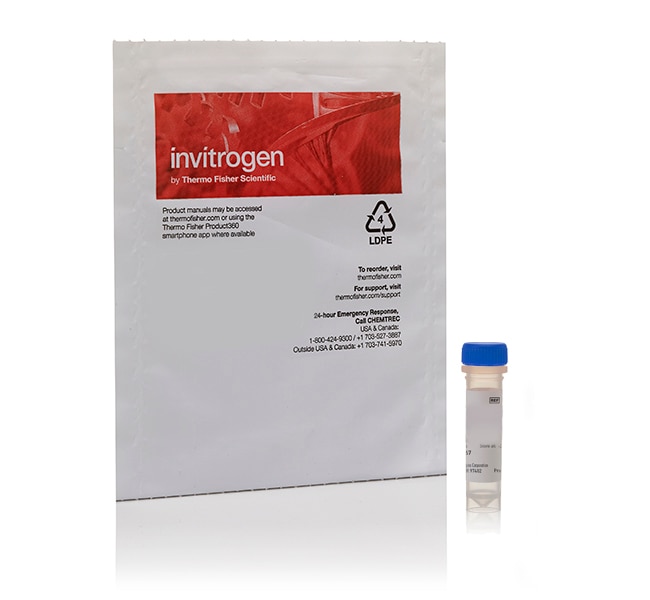
Sondes fluorescentes CellTracker™
Colorant fluorescent bien adapté pour la surveillance du mouvement ou de la localisation cellulaire
Have Questions?
Modifier l'affichage

| Référence | Quantité | Type de colorant |
|---|---|---|
| C2925 | 1mg | CellTracker Vert CMFDA |
| C2110 | 5 mg | CellTracker™ Bleu CMAC |
| C2111 | 5 mg | CellTracker™ Bleu CMHC |
| C12881 | 5 mg | CellTracker bleu CMF2HC |
| C34565 | 20 x 15 μg | Autre(s) étiquette(s) ou colorant(s) |
| C7025 | 20 x 50 μg | CellTracker Vert CMFDA |
| C2102 | 5 mg | Colorants BODIPY |
| C34551 | 20 x 50 μg | CellTracker orange CMRA |
| C2927 | 1 mg | CellTracker Orange CMTMR |
| C34552 | 20 x 50 μg | CellTracker™ Rouge CMTPX |
| C10094 | 5 x 0,1 mg | ThiolTracker™ Violet |
Référence C2925
Prix (EUR)
573,65
Precio exclusivo en nuestra web
610,00Économisez 36,35 (6%)
Each
Quantité:
1mg
Type de colorant:
CellTracker Vert CMFDA
Prix (EUR)
573,65
Precio exclusivo en nuestra web
610,00Économisez 36,35 (6%)
Each
Cell movement and location studies require specialized probes that are nontoxic to living cells and well retained, allowing for multigenerational tracking. The CellTracker fluorescent probes are available in a range of fluorescent colors to match instrument lasers and filters, and to accommodate co-staining with antibodies or other cell analysis probes. These dyes are excellent tools for monitoring cell movement, location, proliferation, migration, chemotaxis, and invasion.
- Ce colorant est bien retenu, ce qui permet le suivi multigénérationnel des mouvements cellulaires.
- Les spectres d’excitation / émission verts (492/517 nm maximum) sont optimaux pour le multiplexage avec des colorants fluorescents rouges et des protéines
- Facile à utiliser: enlevez le milieu, ajoutez le colorant, laissez incuber pendant 30 minutes et imagez les cellules
- Rétention du signal fluorescent de >72 heures (typiquement de trois à six générations)
- Faible cytotoxicité : n’affecte pas la viabilité ni la prolifération.
- Conçu pour traverser librement les membranes cellulaires jusqu’aux cellules, où ils sont transformés en produits de réaction imperméable aux membranes cellulaires.
- Le colorant est transféré aux cellules filles mais pas aux cellules adjacentes dans une population.
- Stable, non toxique aux concentrations de fonctionnement, bien retenu par les cellules et fluorescence très lumineuse à un pH physiologique
Adhérence cellulaire, analyse cellulaire, prolifération cellulaire, traçage et suivi des cellules, viabilité cellulaire et cytotoxicité, viabilité cellulaire, prolifération et fonction, imagerie cellulaire, tests de toxicologie cellulaire, chimiotaxie et migration cellulaire, détection et développement de médicaments, traçage cellulaire général, détection de glutathion, analyse à haute densité (HCS), immunofluorescence (IF), coloration et détection de cellules par immunofluorescence, homéostasie et signalisation ionique, suivi microbien, stress nitro-oxydatif, tests ADME/Tox basés sur la cible, détection du pH.
Usage exclusivement réservé à la recherche. Ne pas utiliser pour des procédures de diagnostic.
Spécifications
CouleurGreen
DescriptionCellTracker™ Green CMFDA Dye, 1 mg
Type de colorantCellTracker Vert CMFDA
Émission517 nm
Gamme de longueur d’onde d’excitation492 nm
FormeDry Powder
Gamme de produitsCellTracker
Quantité1mg
Type de réactifComposés de suivi cellulaire, réactifs de marquage cellulaire
Conditions d’expéditionTempérature ambiante, Température ambiante
Type d’étiquetteAutres marqueurs ou colorants
Type de produitColorant
SubCellular LocalizationCytoplasm
Unit SizeEach
Contenu et stockage
Conserver au congélateur (-5 et -30°C).
Foire aux questions (FAQ)
I want to do a cell migration study for around 4 hours and need to fluorescently label the cells with a dye. What do you recommend?
Is DAPI a good live-cell nuclear label?
I want to label the nuclei of live cells and track them over time. Can I use DAPI for this?
I labeled my cells with Calcein, AM, but when I imaged the next day, there was no fluorescence from Calcein. Why?
Can the CellTracker dyes be fixed?
Citations et références (207)
Citations et références
Abstract
In situ image analysis of interactions between normal human keratinocytes and fibroblasts cultured in three-dimensional fibrin gels.
Journal:Biomaterials
PubMed ID:16510181
A point mutation in the binding subunit of a retroviral envelope protein arrests virus entry at hemifusion.
Journal:J Virol
PubMed ID:14671127
The transmembrane subunits of viral envelope proteins are thought to perform all of the functions required for membrane fusion during entry of enveloped viruses. However, changes in a conserved SPHQ motif near the N terminus of the receptor binding subunit of a murine leukemia virus (MLV) envelope protein block infection
Intercellular spreading of Porphyromonas gingivalis infection in primary gingival epithelial cells.
Journal:Infect Immun
PubMed ID:16369027
'Porphyromonas gingivalis, an important periodontal pathogen, is an effective colonizer of oral tissues. The organism successfully invades, multiplies in, and survives for extended periods in primary gingival epithelial cells (GECs). It is unknown whether P. gingivalis resides in the cytoplasm of infected cells throughout the infection or can spread to
Increased apical insertion of the multidrug resistance protein 2 (MRP2/ABCC2) in renal proximal tubules following gentamicin exposure.
Journal:J Pharmacol Exp Ther
PubMed ID:16757538
'Multidrug resistance protein (MRP) 2 (MRP2; ABCC2), an organic anion transporter apically expressed in liver, kidney, and intestine, plays an important protective role through facilitating the efflux of potentially toxic compounds. We hypothesized that upon a toxic insult, MRP2 is up-regulated in mammalian kidney, thereby protecting the tissue from damage.
Apoptosis of adherent cells by recruitment of caspase-8 to unligated integrins.
Journal:J Cell Biol
PubMed ID:11684710
'Integrin-mediated adhesion promotes cell survival in vitro, whereas integrin antagonists induce apoptosis of adherent cells in vivo. Here, we demonstrate that cells adherent within a three-dimensional extracellular matrix undergo apoptosis due to expression of unligated integrins, the beta subunit cytoplasmic domain, or its membrane proximal sequence KLLITIHDRKEF. Integrin-mediated death requires