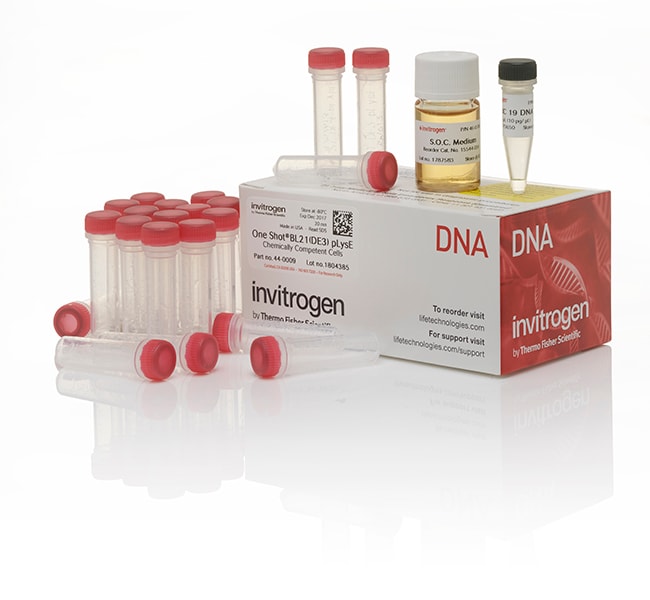
One Shot&trade; BL21(DE3)pLysE Chemically Competent <i>E. coli</i>
Invitrogen™

One Shot™ BL21(DE3)pLysE Chemically Competent E. coli

Les cellules E. coli BL21(DE3)pLysE sont idéales pour une utilisation avec des vecteurs d’expression basés sur le promoteur T7. ToutAfficher plus
Have Questions?
RéférenceQuantité
C65650321 x 50 μl
Référence C656503
Prix (EUR)
428,65
Online Exclusive
471,00
Économisez 42,35 (9%)
Each
Quantité:
21 x 50 μl
Prix (EUR)
428,65
Online Exclusive
471,00
Économisez 42,35 (9%)
Each
Les cellules E. coli BL21(DE3)pLysE sont idéales pour une utilisation avec des vecteurs d’expression basés sur le promoteur T7. Tout comme les cellules E. coli BL21(DE3)pLysS, les cellules BL21(DE3)pLysE transportent le lambda lysogène DE3. De plus, les cellules BL21(DE3)pLysE contiennent le plasmide pLysE qui exprime constitutivement le lysozyme T7. Le lysozyme T7 réduit l’expression basale des gènes cibles en inhibant l’ARN polymérase T7. Le plasmide pLysE dans les cellules BL21(DE3)pLysE exprime des niveaux plus élevés de lysozyme T7 que le plasmide pLyss dans les cellules BL21(DE3)pLysS.
La souche BL21(DE3)pLysE permet de contrôler de manière plus strict l’ARN polymérase T7 nécessaire lorsque la protéine recombinante qui doit être exprimée est toxique.
Usage exclusivement réservé à la recherche. Ne pas utiliser pour des procédures de diagnostic.
Spécifications
Résistance aux antibiotiques des bactériesYes (Chloramphenicol)
Sélection bleue / blancheNon
Clonage d’ADN méthyléNon
Contient l’épisome FAbsence d’épisome F’
Compatibilité à haut débitNon compatible avec le haut débit (manuel)
Améliore la qualité des plasmidesNon
Improves Protein StabilityYes (lon, ompT)
Improves RNA StabilityYes (pLysE)
Préparation de l’ADN non méthyléYes (dcm)
Gamme de produitsOne Shot
Type de produitCellule compétente
Quantité21 x 50 μl
Réduit la recombinaisonNon
Conditions d’expéditionDry Ice
Résistant au phage T1 (tonA)Non
Toxic ProteinsNo
Niveau d’efficacité de la transformationEfficacité du sous-clonage (10^6-10^7 cfu⁄ µg)
FormatTube
AccélérateurT7
EspècesE. coli
Unit SizeEach
Contenu et stockage
• BL21 Star (DE3)pLysE Chemically Competent E. coli (21 x 50 μL); store at –80°C
• pUC19 DNA (1 x 50 μL); store at –20°C
• S.O.C. Medium (6 mL); store at 4°C or room temperature

Foire aux questions (FAQ)

My gene of interest is toxic to bacterial cells. Are there any precautions you can suggest?

Several precautions may be taken to prevent problems resulting from basal level expression of a toxic gene of interest. These methods all assume that the T7-based or Champion-based expression plasmid has been correctly designed and created.

- Propagate and maintain your expression plasmid in a strain that does not contain T7 RNA polymerase (i.e., DH5α).
- If using BL21 (DE3) cells, try growing cells at room temperature rather than 37 degrees C for 24-48 hr.
- Perform a fresh transformation using a tightly regulated E. coli strain, such as BL21-AI cells.
- After following the transformation protocol, plate the transformation reaction on LB plates containing 100 µg/mL ampicillin and 0.1% glucose. The presence of glucose represses basal expression of T7 RNA polymerase.
- Following transformation of BL21-AI cells, pick 3 or 4 transformants and inoculate directly into fresh LB medium containing 100 µg/mL ampicillin or 50 µg/mL carbenicillin (and 0.1% glucose, if desired). When the culture reaches an OD600 of 0.4, induce expression of the recombinant protein by adding L-arabinose to a final concentration of 0.2%.
- When performing expression experiments, supplement the growth medium with 0.1% glucose in addition to 0.2% arabinose.
- Try a regulated bacterial expression system such as our pBAD system.

Find additional tips, troubleshooting help, and resources within our Protein Expression Support Center.

I'm trying to express my protein using a bacterial expression system. How do I know if I'm seeing degradation of my protein or if what I’m seeing is codon usage bias?

Typically, if you see 1-2 dominant bands, translation stopped prematurely due to codon usage bias. With degradation, you usually see a ladder of bands. With degradation, you can try using a protease inhibitor and add it to the lysis buffer to help prevent degradation. If degradation is the issue, a time point experiment can be done to determine the best time to harvest the cells.

Find additional tips, troubleshooting help, and resources within our Protein Expression Support Center.

I'm trying to express my protein using a bacterial expression system and am getting inclusion bodies. What should I do?

If you are having a solubility issue, try to decrease the temperature or decrease the amount of IPTG used for induction. You can also try a different, more stringent cell strain for expression. Adding 1% glucose to the bacterial culture medium during expression can also help.

Find additional tips, troubleshooting help, and resources within our Protein Expression Support Center.

I'm getting low protein yield from my bacterial expression system. What can I do to improve this?

- Inoculate from fresh bacterial cultures, since higher protein yields are generally obtained from a fresh bacterial colony.

- Check the codon usage in the recombinant protein sequence for infrequently used codons. Replacing the rare codons with more commonly used codons can significantly increase expression levels. For example, the arginine codons AGG and AGA are used infrequently by E. coli, so the level of tRNAs for these codons is low.

- Add protease inhibitors, such as PMSF, to buffers during protein purification. Use freshly made PMSF, since PMSF loses effectiveness within 30 min of dilution into an aqueous solution.

- If you are using ampicillin for selection in your expression experiments, you may be experiencing plasmid instability due to the absence of selective conditions. This occurs as the ampicillin is destroyed by β-lactamase or hydrolyzed under the acidic media conditions generated by bacterial metabolism. You may want to substitute carbenicillin for ampicillin in your transformation and expression experiments.

- The recombinant protein may be toxic to bacterial cells. Try a tighter regulation system for competent cell expression such as BL21-AI. You may also consider trying a different expression system such as the pBAD system.

Find additional tips, troubleshooting help, and resources within our Protein Expression Support Center.

My cells are growing very slowly, and I'm not getting any protein expression from my baterial expression system. What can I do to fix this?

This typically occurs when your gene of interest is toxic. Try using a tighter regulation system, such as BL21 (DE3) (pLysS) or BL21 (DE3) (pLysE), or BL21(AI).

Find additional tips, troubleshooting help, and resources within our Protein Expression Support Center.

Citations et références (1)

Citations et références
Abstract
A novel group of oleosins is present inside the pollen of Arabidopsis.
Authors: Kim Hyun Uk; Hsieh Kai; Ratnayake Chandra; Huang Anthony H C;
Journal:J Biol Chem
PubMed ID:11929861
In plants, subcellular triacylglycerol granules in seeds (oil bodies) and floral tapetum (tapetosomes) are stabilized by amphipathic structural protein called oleosin. We hereby report a novel group of oleosins that is present inside the pollen of Arabidopsis thaliana. We have used the conserved sequence of oleosins to locate, via the ... More