Search

Invitrogen™
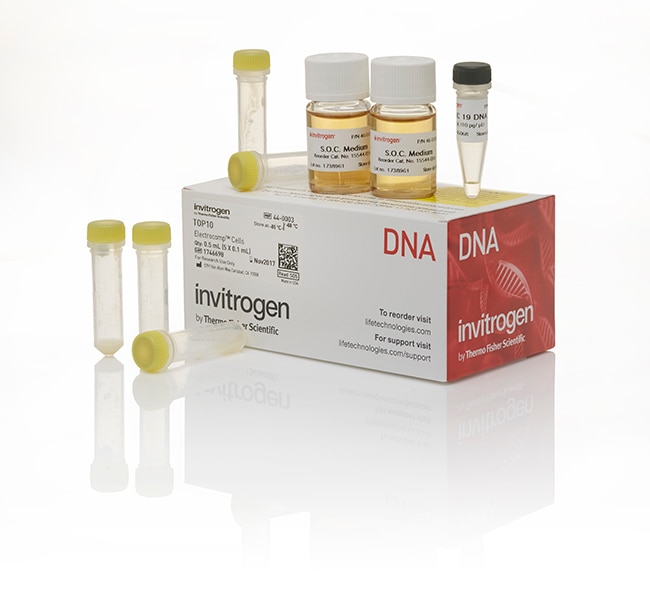
TOP10 Electrocomp™ Kit
Les cellules E. coli TOP10 sont fournies à une efficacité de transformation de 1 × 10¹⁰ cfu/µg d’ADN superenroulé etAfficher plus
Have Questions?
Modifier l'affichage

| Référence | Quantité |
|---|---|
| C66455 | 5 x 100 μl |
| C66411 | 10 x 100 μl |
Référence C66455
Prix (EUR)
342,65
Online Exclusive
353,00Économisez 10,35 (3%)
Each
Quantité:
5 x 100 μl
Prix (EUR)
342,65
Online Exclusive
353,00Économisez 10,35 (3%)
Each
Les cellules E. coli TOP10 sont fournies à une efficacité de transformation de 1 × 10¹⁰ cfu/µg d’ADN superenroulé et sont idéales pour le clonage hautement efficace et la propagation plasmidique. Elles permettent une réplication stable d’un nombre élevé de copies de plasmides.
Le génotype des cellules TOP10 est similaire à la souche DH10B™ et offre les caractéristiques suivantes :
• hsdR pour la transformation efficace de l’ADN non méthylé à partir d’amplifications par PCR
• mcrA pour une transformation efficace de l’ADN méthylé à partir de préparations génomiques
• lacZΔM15 pour la sélection des couleurs bleu / blanc des clones recombinants
• endA1 pour des préparations plus propres de l’ADN et de meilleurs résultats dans les applications en aval en raison de l’élimination de la digestion non spécifique par endonucléase I
• recA1 pour une fréquence réduite de recombinaison non spécifique dans l’ADN cloné
Des kits TOP10 One Shot™ sont disponibles avec les cellules chimiquement compétentes ou électrocompétentes desE. coli pour répondre à vos besoins spécifiques de transformation. Les E. coli TOP10 sont également disponibles au format MultiShot™ à haut débit.
Remarque : Ce kit contient suffisamment de cellules électrocompétentes pour 12 réactions de 40 µl ou 25 réactions de 20 µl. Veuillez consulter le manuel du produit pour obtenir des recommandations sur l’échelle de réaction.
Génotype :
F- mcrA Δ(mrr-hsdRMS-mcrBC) φ80lacZΔM15 ΔlacX74 recA1 araD139 Δ(ara-leu)7697 galU galK rpsL endA1 nupG
Le génotype des cellules TOP10 est similaire à la souche DH10B™ et offre les caractéristiques suivantes :
• hsdR pour la transformation efficace de l’ADN non méthylé à partir d’amplifications par PCR
• mcrA pour une transformation efficace de l’ADN méthylé à partir de préparations génomiques
• lacZΔM15 pour la sélection des couleurs bleu / blanc des clones recombinants
• endA1 pour des préparations plus propres de l’ADN et de meilleurs résultats dans les applications en aval en raison de l’élimination de la digestion non spécifique par endonucléase I
• recA1 pour une fréquence réduite de recombinaison non spécifique dans l’ADN cloné
Des kits TOP10 One Shot™ sont disponibles avec les cellules chimiquement compétentes ou électrocompétentes desE. coli pour répondre à vos besoins spécifiques de transformation. Les E. coli TOP10 sont également disponibles au format MultiShot™ à haut débit.
Remarque : Ce kit contient suffisamment de cellules électrocompétentes pour 12 réactions de 40 µl ou 25 réactions de 20 µl. Veuillez consulter le manuel du produit pour obtenir des recommandations sur l’échelle de réaction.
Génotype :
F- mcrA Δ(mrr-hsdRMS-mcrBC) φ80lacZΔM15 ΔlacX74 recA1 araD139 Δ(ara-leu)7697 galU galK rpsL endA1 nupG
Usage exclusivement réservé à la recherche. Ne pas utiliser pour des procédures de diagnostic.
Spécifications
Résistance aux antibiotiques des bactériesYes (Streptomycin)
Sélection bleue / blancheOui
Clonage d’ADN méthyléOui
Clonage d’ADN instableNe convient pas au clonage d’ADN instable
Contient l’épisome FNo
Compatibilité à haut débitNon compatible avec le haut débit (manuel)
Améliore la qualité des plasmidesOui
PlasmidePeut être utilisé pour les plasmides > 20 kb
Préparation de l’ADN non méthyléNon adapté à la préparation de l’ADN non méthylé
Gamme de produitsElectrocomp
Type de produitKit d’électroporateur
Quantité5 x 100 μl
Réduit la recombinaisonOui
Conditions d’expéditionDry Ice
Résistant au phage T1 (tonA)Non
Niveau d’efficacité de la transformationHaute efficacité (> 10^9 cfu⁄µg)
FormatTube
EspècesE. coli
Unit SizeEach
Contenu et stockage
• 5 x 100μL TOP10 Electrocomp E. coli
• 50 μL pUC19 vector (10 pg/μL)
Store at –80°C.
• S.O.C. Medium (15 mL)
Store at room temperature.
• 50 μL pUC19 vector (10 pg/μL)
Store at –80°C.
• S.O.C. Medium (15 mL)
Store at room temperature.