Search

Invitrogen™
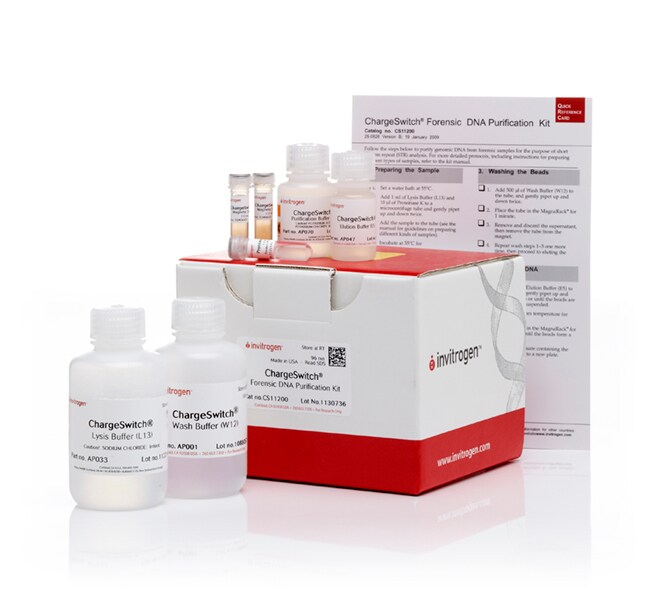
ChargeSwitch™ Forensic DNA Purification Kit
Sensibilité maximale aux échantillons de mauvaise qualité ou dégradés• Utilisation entièrement validée avec les analyses STR (répétition d’un seul tandem)•Afficher plus
Have Questions?
Modifier l'affichage

| Référence | Nbre de réactions |
|---|---|
| CS11200 | 100 préparations |
| CS1120010 également connu sous le numéro CS11200-10 | 960 préparations |
Référence CS11200
Prix (EUR)
562,00
Each
Nbre de réactions:
100 préparations
Prix (EUR)
562,00
Each
Sensibilité maximale aux échantillons de mauvaise qualité ou dégradés
• Utilisation entièrement validée avec les analyses STR (répétition d’un seul tandem)
• Optimisé pour un traitement manuel rapide ou entièrement automatisé des échantillons
Le kit de purification d’ADN médico-légal ChargeSwitch™ offre une sensibilité et une robustesse maximales. Ce kit est conçu pour être compatible avec tous les types d’échantillons médico-légaux présents sur des scènes de crimes, à des fins de profilage STR. Le kit comprend tous les réactifs nécessaires pour le nombre de préparations répertoriés et nécessite l’utilisation d’accessoires magnétiques. Reportez-vous au chapitre Accessoires (chapitre 6) pour sélectionner le meilleur accessoire magnétique adapté à vos besoins.
• Utilisation entièrement validée avec les analyses STR (répétition d’un seul tandem)
• Optimisé pour un traitement manuel rapide ou entièrement automatisé des échantillons
Le kit de purification d’ADN médico-légal ChargeSwitch™ offre une sensibilité et une robustesse maximales. Ce kit est conçu pour être compatible avec tous les types d’échantillons médico-légaux présents sur des scènes de crimes, à des fins de profilage STR. Le kit comprend tous les réactifs nécessaires pour le nombre de préparations répertoriés et nécessite l’utilisation d’accessoires magnétiques. Reportez-vous au chapitre Accessoires (chapitre 6) pour sélectionner le meilleur accessoire magnétique adapté à vos besoins.
Usage exclusivement réservé à la recherche. Ne pas utiliser pour des procédures de diagnostic.
Spécifications
À utiliser avec (application)Médecine légale
Compatibilité à haut débitCompatible avec le haut débit
Nbre de réactions100 préparations
Gamme de produitsChargeSwitch
Type de produitKit de purification d’ADN médico-légal
Quantité100 préparations
Type d’échantillonÉchantillon médico-légal
Conditions d’expéditionTempérature ambiante
CibleADN génomique
Heure du test15 min
FormatKit
Isolation TechnologyChimie ChargeSwitch™
Unit SizeEach
Contenu et stockage
Tous les composants des kits de purification d’ADN médico-légal ChargeSwitch™ sont expédiés à température ambiante. Dès réception, conserver la protéinase K à 4“C. Conserver tous les autres composants à température ambiante. La stabilité de tous les composants est garantie pendant 6 mois lorsque ceux-ci sont correctement stockés.
Composants :
Tampon de lyse ChargeSwitch™ (L13)
Microbilles magnétiques ChargeSwitch™
Proteinase K (20 mg/ml dans 50 mM de Tris-HCl, pH 8,5, 5 mM de CaCl2, 50 % de glycérol)
Tampon de purification ChargeSwitch™ (N5)
Tampon de lavage ChargeSwitch™ (W12)
Tampon d’élution ChargeSwitch™ (E5 ; 10 mM de Tris-HCl, pH 8,5)
Composants :
Tampon de lyse ChargeSwitch™ (L13)
Microbilles magnétiques ChargeSwitch™
Proteinase K (20 mg/ml dans 50 mM de Tris-HCl, pH 8,5, 5 mM de CaCl2, 50 % de glycérol)
Tampon de purification ChargeSwitch™ (N5)
Tampon de lavage ChargeSwitch™ (W12)
Tampon d’élution ChargeSwitch™ (E5 ; 10 mM de Tris-HCl, pH 8,5)