Search


Citations et références (8)
Invitrogen™
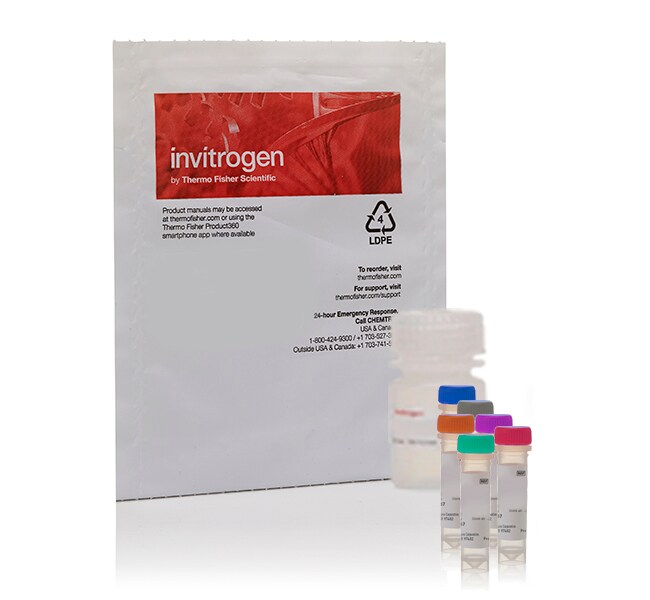
EnzChek™ Myeloperoxidase (MPO) Activity Assay Kit
La myéloperoxydase (MPO) est une peroxydase unique qui, en plus de son activité de peroxydation, catalyse également la conversion duAfficher plus
| Référence | Quantité |
|---|---|
| E33856 | 1 Kit |
Référence E33856
Prix (EUR)
1 226,00
Each
Quantité:
1 Kit
Prix (EUR)
1 226,00
Each
La myéloperoxydase (MPO) est une peroxydase unique qui, en plus de son activité de peroxydation, catalyse également la conversion du peroxyde d’hydrogène (H2O2) et du chlorure (Cl-) en acide hypochloreux (HOCl). Le kit de dosage d’activité de la myéloperoxydase EnzChek™ (MPO) fournit des dosages pour la détermination des activités de chloration et de peroxydation du MPO en solution et dans les lysats cellulaires. Pour la détection de la chloration, le kit comprend la fluorescéine (APF) non fluorescente 3'-(p-aminophényl), qui est clivée de façon sélective par l’hypochlorite (-OCl) pour produire de la fluorescéine. La peroxydation est détectée à l’aide d’un réactif ultrared Amplex™ non fluorescent (A36006), qui est oxydé par les intermédiaires rédox générés par H2O2MPO-I et MPO-II pour former un produit fluorescent. Le kit de dosage d'activité de la myéloperoxydase EnzChek™ peut être utilisé pour détecter ces activités à température ambiante en continu sur une large plage dynamique (1,5 à 200 ng/ml). La vitesse (30 minutes), la sensibilité et la facilité de mélange et de lecture font de ce kit un outil idéal pour mesurer les activités de l’OPM et pour le screening à haut débit pour les inhibiteurs spécifiques à l’OPM.
Usage exclusivement réservé à la recherche. Ne pas utiliser pour des procédures de diagnostic.
Spécifications
Méthode de détectionIntensité de fluorescence
Quantité1 Kit
Conditions d’expéditionGlace humide, Glace
Propriétés du substratsubstrat chimique, substrat chimique
Enzyme cibleMyéloperoxydase, Myéloperoxydase
À utiliser avec (application)Dosage de l’activité de la myéloperoxydase (MPO)
Gamme de produitsEnzChek
Type de produitDosage de la myéloperoxydase (MPO)
Unit SizeEach
Contenu et stockage
Conserver au réfrigérateur (2–8°C) et à l’abri de la lumière.
Foire aux questions (FAQ)
What is the dynamic range of the EnzChek Myeloperoxidase (MPO) Activity Assay Kit (Cat. No. E33856)?
What can interfere with the EnzChek Myeloperoxidase (MPO) Activity assay?
Citations et références (8)
Citations et références
Abstract
Endothelial CYP epoxygenase overexpression and soluble epoxide hydrolase disruption attenuate acute vascular inflammatory responses in mice.
Journal:FASEB J
PubMed ID:21059750
Cytochrome P-450 (CYP)-derived epoxyeicosatrienoic acids (EETs) possess potent anti-inflammatory effects in vitro. However, the effect of increased CYP-mediated EET biosynthesis and decreased soluble epoxide hydrolase (sEH, Ephx2)-mediated EET hydrolysis on vascular inflammation in vivo has not been rigorously investigated. Consequently, we characterized acute vascular inflammatory responses to endotoxin in transgenic
G-CSF treatment of severe congenital neutropenia reverses neutropenia but does not correct the underlying functional deficiency of the neutrophil in defending against microorganisms.
Journal:Blood
PubMed ID:17311988
'The treatment of children affected by severe congenital neutropenia (SCN) with G-CSF strongly reduces the risk of sepsis by reversing neutropenia. However, SCN patients who respond to the treatment with the growth factor still have an elevated risk of succumbing to sepsis. Because the disease is usually caused by heterozygous
Targeted deletion of tumor suppressor PTEN augments neutrophil function and enhances host defense in neutropenia-associated pneumonia.
Journal:Blood
PubMed ID:19286998
'Neutropenia and related infections are the most important dose-limiting toxicities in anticancer chemotherapy and radiotherapy. In this study, we explored a new strategy for augmenting host defense in neutropenia-related pneumonia. Phosphatidylinositol-3,4,5-trisphosphate (PtdIns(3,4,5)P(3)) signaling in neutrophils was elevated by depleting PTEN, a phosphatidylinositol 3''-phosphatase that hydrolyzes PtdIns(3,4,5)P(3). In myeloid-specific PTEN knockout
Inflammation-induced, 3'UTR-dependent translational inhibition of Hsp70 mRNA impairs intestinal homeostasis.
Journal:Am J Physiol Gastrointest Liver Physiol
PubMed ID:19299581
'Although the inducible heat shock protein 70 (Hsp70) is essential for maintaining intestinal homeostasis in colitis, it is translationally downregulated in inflamed colonic mucosa, paradoxically rendering the gut more susceptible to injury. We examined the basis for this process by analyzing the role of untranslated regions (UTR) of Hsp70 mRNA
Functional consequence of positive selection revealed through rational mutagenesis of human myeloperoxidase.
Journal:Mol Biol Evol
PubMed ID:22355012
'Myeloperoxidase (MPO) is a member of the mammalian heme peroxidase (MHP) multigene family. Whereas all MHPs oxidize specific halides to generate the corresponding hypohalous acid, MPO is unique in its capacity to oxidize chloride at physiologic pH to produce hypochlorous acid (HOCl), a potent microbicide that contributes to neutrophil-mediated host