Search


Citations et références (10)
Invitrogen™
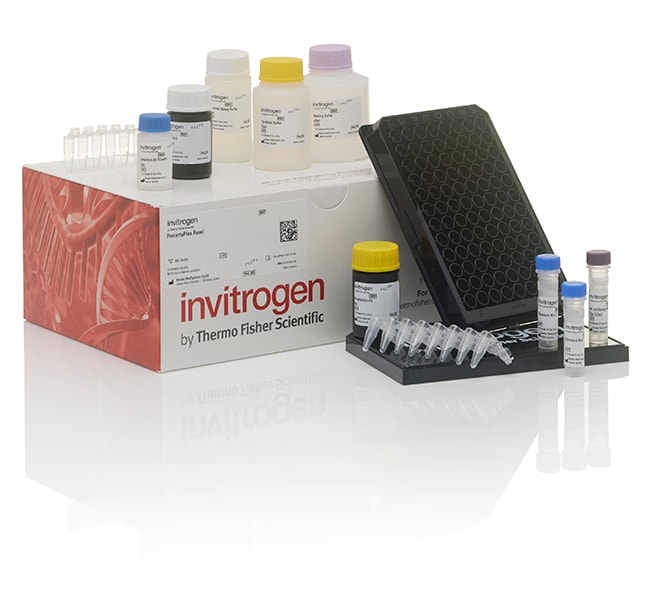
ProcartaPlex™ Human Immuno-Oncology Checkpoint Panel 1, 14plex
Le panneau 1 Human Immuno-Oncology Checkpoint 14-Plex ProcartaPlex permet la recherche sur le cancer en analysant 14 cibles protéiques à l’aide de la technologie Luminex xMAP.
| Référence | Quantité |
|---|---|
| EPX14A-15803-901 | 96 dosages |
Référence EPX14A-15803-901
Prix (EUR)
3 700,00
Each
Quantité:
96 dosages
Prix (EUR)
3 700,00
Each
Le panneau 1 Human Immuno-Oncology Checkpoint 14-Plex ProcartaPlex permet la recherche sur le cancer en analysant 14 cibles protéiques à l’aide de la technologie Luminex xMAP. Ce panel permet la détection simultanée des formes solubles de protéines qui jouent un rôle crucial dans la régulation des lymphocytes T, conduisant soit à l’épuisement soit à la stimulation des lymphocytes T, modifiant ainsi la réponse immunitaire antitumorale. L’analyse de ces biomarqueurs solubles pourrait aider à faire la lumière sur la biologie des voies. Il complète le panneau 2 Immuno-Oncology Checkpoint 14-Plex ProcartaPlex (réf EPX140-15815-901) et le panel 3 Immuno-Oncology Checkpoint 9-Plex ProcartaPlex (réf. EPX090-15820-901) qui fournit 23 cibles protéiques supplémentaires dans le même domaine de recherche.
Les panneaux préconfigurés ProcartaPlex sont largement testés pour la combinabilité, l’interférence et la réactivité croisée des analyses afin de fournir le plus haut niveau de validation et de précision. Tous les panneaux ProcartaPlex sont fournis avec les réactifs nécessaires pour effectuer le dosage.
Liste de cibles [région de microbille] :
Stimulation immunitaire : CD27 [27], CD28 [15], CD137 (4-1BB) [26], GITR [57], HVEM [36]
Inhibiteur immunitaire : BTLA [52], CD80 [61], CD152 (CTLA4) [33], IDO [46], LAG-3 [47], PD-1 [65], PD-L1 [66], PD-L2 [67], TIM-3 [14]
À propos des dosages ProcartaPlex pour la plateforme Luminex
Les immunodosages ProcartaPlex sont basés sur les principes d’un ELISA de type sandwich, avec l’utilisation de deux anticorps hautement spécifiques se liant à différents épitopes d’une protéine pour quantifier simultanément toutes les cibles protéiques à l’aide d’un instrument Luminex. Les dosages multiplex ProcartaPlex nécessitent seulement seulement 25 μl de plasma ou de sérum, ou 50 μl de surnageant de culture cellulaire, et seulement quatre heures pour obtenir les résultats analysés.
Caractéristiques :
• Résultats reproductibles et fiables — validés en panneau selon la norme la plus élevée de l’industrie, avec des tests de combinabilité des cibles protéiques et de réactivité croisée
• Plus de résultats par échantillonneur — permet de réaliser simultanément plusieurs cibles protéiques dans un seul échantillon de 25 – 50 μl
• Plate-forme de multiplexage à haute référence avec la technologie bien établie Luminex, pour la détection et la quantification des protéines
Les dosages ProcartaPlex utilisent Luminex xMAP (profilage multianalyte) Technologie pour la détection et la quantification simultanées de jusqu’à 80 cibles protéiques dans un seul échantillon de 25–50 μl — de plasma, de sérum, de surnageant de culture cellulaire et d’autres liquides corporels.
Les microbilles Luminex dans le dosage ProcartaPlex sont colorées en interne avec des proportions précises de fluorophores rouges et IR pour créer des signatures uniques de façon spectrale qui peuvent être identifiées par les systèmes de détection Luminex xMAP (par exemple Luminex 200, FLEXMAP 3D et MAGPIX). Comme le dosage ELISA sandwich, le dosage ProcartaPlex utilise des paires d’anticorps appariées pour identifier la protéine d’intérêt. Dans un dosage multiplexé, chaque microbille unique de façon spectrale est marquée avec des anticorps spécifiques pour une seule protéine cible et les protéines liées sont identifiées avec des anticorps biotinylés et de la streptavidine–R-phycoérythrine (RPE). La conjugaison d’anticorps spécifiques d'une protéine à une microbille distincte permet d’analyser plusieurs cibles dans un seul puits.
La différence la plus significative entre un dosage ProcartaPlex et un dosage ELISA est que l’anticorps de capture du dosage ProcartaPlex est conjugué à une microbille et n’est pas adsorbé par un des puits de la microplaque. Ainsi, les réactifs de dosage ProcartaPlex flottent librement dans la solution.
Usage exclusivement réservé à la recherche. Ne pas utiliser pour des procédures de diagnostic.
Spécifications
Plage de dosageVoir le certificat d’analyse
Sensibilité du dosageVoir le certificat d’analyse
Méthode de détectionFluorescent
À utiliser avec (équipement)Instruments Luminex™
FormatKit multiplex
Gamme de produitsProcartaPlex
Type d’échantillonSérum, plasma, surnageants de culture cellulaire (SCC), Plasma, Cell Culture Supernatants
Volume d’échantillonSérum, plasma : 25 μl, surnageant de culture cellulaire : 50 μlitres
Conditions d’expéditionGlace humide
CombinabilityCombinable
Type de produitPanneau multiplex
Quantité96 dosages
Research AreaImmunology, Oncology
EspècesHumaine
Unit SizeEach
Contenu et stockage
- 2 flacons de mélange étalon humain L (lyophilisé)
- 1 flacon de mélange de microbilles de capture (1X)
- 1 flacon de mélange d’anticorps de détection biotinylé (50 X)
- 1 flacon de tampon de lecture (1X)
- 1 flacon de tampon de lavage (10X)
- 1 flacon de streptavidine-PE (1X)
- 1 flacon de tampon de dosage universel (1X)
- 1 flacon de diluant d’anticorps de détection (1X)
- Barrettes de 8 tubes
- Film adhésif
- Plaque 96 puits à fond plat, noire
- Stocker de 2°C à 8°C
Foire aux questions (FAQ)
What is the size of the Luminex beads you currently use?
I am interested in performing Luminex assays using BioSource kits, and I have a Luminex xMAP system. Besides the kits and system, what other reagents and equipment will I need?
Do the Luminex beads require special care in handling?
Why would the Luminex acquisition software display "Sample Empty" messages during analysis?
What are the Luminex beads made of?
Citations et références (10)
Citations et références
Abstract
Immune monitoring of trabectedin therapy in refractory soft tissue sarcoma patients - the IMMUNYON study.
Journal:Frontiers in immunology
PubMed ID:40007535
Soft tissue sarcomas (STS) encompass over 50 histologic subtypes, representing more than 1% of solid tumors. Standard treatments include surgical resection and therapies such as anthracyclines or trabectedin for advanced cases, though challenges persist due to the tumor microenvironmentâs complexity and limited immune profiling data. This study evaluates Trabectedin therapy
Soluble lymphocyte activation gene-3 (sLAG3) and CD4/CD8 ratio dynamics as predictive biomarkers in patients undergoing immune checkpoint blockade for solid malignancies.
Journal:British Journal of Cancer
PubMed ID:38233492
The search for biomarkers to identify suitable candidates for immune checkpoint inhibitor (ICI) therapy remains ongoing. We evaluate how soluble levels of the next generation immune checkpoint Lymphocyte Activation Gene-3 (sLAG-3) and its association with circulating T lymphocyte subsets could pose as a novel biomarker to predict outcome to ICI
3D microfluidic ex vivo culture of organotypic tumor spheroids to model immune checkpoint blockade.
Journal:Lab Chip
PubMed ID:30183789
Microfluidic culture has the potential to revolutionize cancer diagnosis and therapy. Indeed, several microdevices are being developed specifically for clinical use to test novel cancer therapeutics. To be effective, these platforms need to replicate the continuous interactions that exist between tumor cells and non-tumor cell elements of the tumor microenvironment
PD-L1 is expressed on human platelets and is affected by immune checkpoint therapy.
Journal:Oncotarget
PubMed ID:29937998
Cancer immunotherapy has been revolutionised by drugs that enhance the ability of the immune system to detect and fight tumors. Immune checkpoint therapies that target the programmed death-1 receptor (PD-1), or its ligand (PD-L1) have shown unprecedented rates of durable clinical responses in patients with various cancer types. However, there
Soluble immune checkpoint-related proteins as predictors of tumor recurrence, survival, and T cell phenotypes in clear cell renal cell carcinoma patients.
Journal:J Immunother Cancer
PubMed ID:31783776
Immune checkpoint inhibitors have achieved unprecedented success in cancer immunotherapy. With the exception of a few candidate biomarkers, the prognostic role of soluble immune checkpoint-related proteins in clear cell renal cell cancer (ccRCC) patients is largely uninvestigated.