Search


Citations et références (5)
Invitrogen™
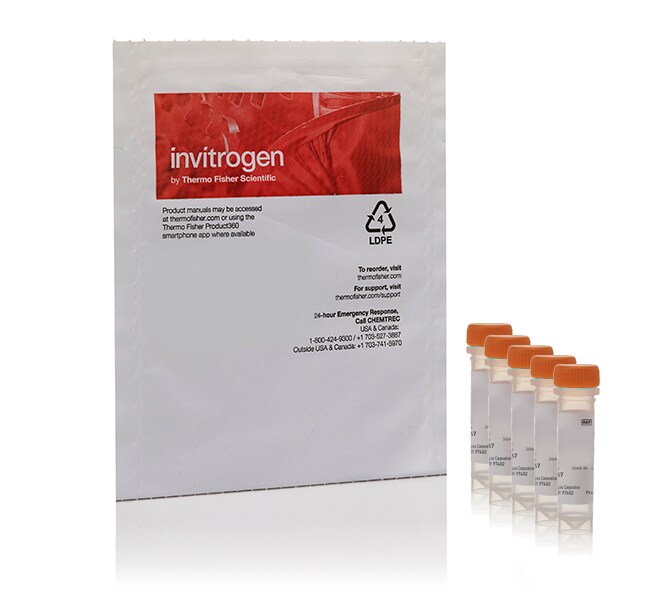
Réactif TMRM (indicateur de potentiel de membrane mitochondriale) Image-iT™
Les membranes mitochondriales saines maintiennent une différence de potentiel électrique entre l’intérieur et l’extérieur d’un organite, appelée potentiel de laAfficher plus
| Référence | Quantité |
|---|---|
| I34361 | 5 x 100 μl |
Référence I34361
Prix (EUR)
220,65
Online exclusive
259,00Économisez 38,35 (15%)
Each
Quantité:
5 x 100 μl
Prix (EUR)
220,65
Online exclusive
259,00Économisez 38,35 (15%)
Each
Les membranes mitochondriales saines maintiennent une différence de potentiel électrique entre l’intérieur et l’extérieur d’un organite, appelée potentiel de la membrane. L’ester méthylique de tétraméthylrhodamine (TMRM) est un colorant perméant aux cellules qui s’accumule dans les mitochondries actives avec des potentiels de la membrane intacts. Si les cellules sont saines et ont des mitochondries qui fonctionnent, le signal sera lumineux. En cas de perte du potentiel de la membrane mitochondriale, l’accumulation de TMRM cessera et le signal sera faible ou disparaîtra. Le signal TMRM peut être détecté par microscopie par fluorescence, cytométrie en flux, tri cellulaire, criblage à haut débit et analyse à haute teneur.
• Pour l’étude dynamique à cellules vivantes du potentiel de la membrane mitochondriale (non fixable)
• Détectable avec un ensemble de filtres RFP/TRITC (pic d’absorbance : 548 nm, pic d’émission : 574 nm)
• Multiplexable avec des colorants d’émission verts, rouge profond, violets et bleus, tels que GFP, DAPI, Hoechst, HCS LipidTOX et le rouge profond LysoTracker
• Pour l’étude dynamique à cellules vivantes du potentiel de la membrane mitochondriale (non fixable)
• Détectable avec un ensemble de filtres RFP/TRITC (pic d’absorbance : 548 nm, pic d’émission : 574 nm)
• Multiplexable avec des colorants d’émission verts, rouge profond, violets et bleus, tels que GFP, DAPI, Hoechst, HCS LipidTOX et le rouge profond LysoTracker
Usage exclusivement réservé à la recherche. Ne pas utiliser pour des procédures de diagnostic.
Spécifications
Quantité5 x 100 μl
Conditions d’expéditionGlace
CouleurOrange
Gamme de produitsMolecular Probes
Type de produitRéactif
Unit SizeEach
Contenu et stockage
Stocker au congélateur (entre -5°C et -30°C) à l’abri de la lumière.
Foire aux questions (FAQ)
For a final staining solution, we can add TMRM directly into cell growth medium. Can this media contain serum?
How is TMRM different from the MitoTracker dyes?
What is included in the Image-iT TMRM Reagent (Cat No. I34361)?
Citations et références (5)
Citations et références
Abstract
miR-450a Acts as a Tumor Suppressor in Ovarian Cancer by Regulating Energy Metabolism.
Journal:Cancer Res
PubMed ID:31101765
'Dysregulation of miRNA expression is associated with multiple diseases, including cancers, in which small RNAs can have either oncogenic or tumor suppressive functions. Here we investigated the potential tumor suppressive function of miR-450a, one of the most significantly downregulated miRNAs in ovarian cancer. RNA-seq analysis of the ovarian cancer cell
Ursodeoxycholic acid protects against cisplatin-induced acute kidney injury and mitochondrial dysfunction through acting on ALDH1L2.
Journal:Free Radic Biol Med
PubMed ID:32004633
'Mitochondrial dysfunction plays an important role in acute kidney injury (AKI). Thus, the agents improving the mitochondrial function could be beneficial for treating AKI. Ursodeoxycholic acid (UDCA) has been demonstrated to prevent mitochondrial dysfunction under pathology, however, its role in AKI and the underlying mechanism remain unknown. This study aimed
Targeting mitochondria-associated membranes as a potential therapy against endothelial injury induced by hypoxia.
Journal:J Cell Biochem
PubMed ID:31241212
Mitochondrial dysfunction plays a principal role in hypoxia-induced endothelial injury, which is involved in hypoxic pulmonary hypertension and ischemic cardiovascular diseases. Recent studies have identified mitochondria-associated membranes (MAMs) that modulate mitochondrial function under a variety of pathophysiological conditions such as high-fat diet-mediated insulin resistance, hypoxia reoxygenation-induced myocardial death, and hypoxia-evoked vascular smooth
Barrier-to-Autointegration Factor 1 Protects against a Basal cGAS-STING Response.
Journal:mBio
PubMed ID:32156810
Although the pathogen recognition receptor pathways that activate cell-intrinsic antiviral responses are well delineated, less is known about how the host regulates this response to prevent sustained signaling and possible immune-mediated damage. Using a genome-wide CRISPR-Cas9 screening approach to identify host factors that modulate interferon-stimulated gene (ISG) expression, we identified
Mitochondrial Pyruvate Carrier 1 Promotes Peripheral T Cell Homeostasis through Metabolic Regulation of Thymic Development.
Journal:Cell Rep
PubMed ID:32130894
Metabolic pathways regulate T cell development and function, but many remain understudied. Recently, the mitochondrial pyruvate carrier (MPC) was identified as the transporter that mediates pyruvate entry into mitochondria, promoting pyruvate oxidation. Here we find that deleting Mpc1, an obligate MPC subunit, in the hematopoietic system results in a specific reduction