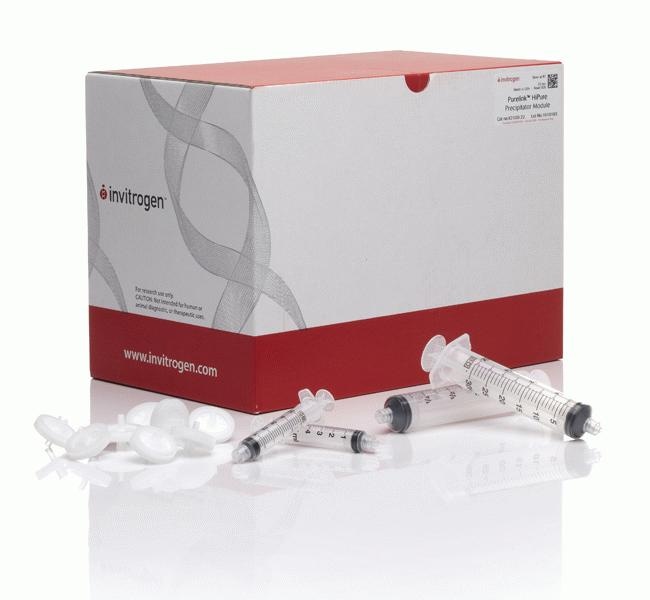
PureLink™ HiPure Precipitator Module
Invitrogen™

PureLink™ HiPure Precipitator Module

Le précipitateur PureLink™ HiPure permet de rapidement, simplement et efficacement dessaler et concentrer l’ADN plasmidique isolé par le biais d’uneAfficher plus
Have Questions?
Modifier l'affichagebuttonViewtableView
RéférenceQuantité
K21002225 préparations
K21002110 préparations
Référence K210022
Prix (EUR)
285,00
Each
Quantité:
25 préparations
Prix (EUR)
285,00
Each
Le précipitateur PureLink™ HiPure permet de rapidement, simplement et efficacement dessaler et concentrer l’ADN plasmidique isolé par le biais d’une chromatographie par échange anionique. La méthode traditionnelle de précipitation de l’ADN plasmidique isolé par échange anionique, impliquant une précipitation d’isopropanol suivie d’une centrifugation et d’un séchage de l’ADN, demande beaucoup de temps et de travail. L’utilisation du précipitateur PureLink™ HiPure permet de concentrer l’ADN plasmidique en 5 minutes, ce qui rend inutile toute étape de centrifugation et réduit le risque de perte de granulés d’ADN lors de l’élimination du surnageant. La récupération est > 80 %, ce qui fait que l’ADN plasmidique résultant est prêt à être utilisé dans les applications les plus difficiles telles que la transfection.
Usage exclusivement réservé à la recherche. Ne pas utiliser pour des procédures de diagnostic.
Spécifications
Type de produit finalADN plasmide
À utiliser avec (application)Séquençage de nouvelle génération, transfection, clonage, séquençage, transformation, marquage des acides nucléiques, PCR, transcription in vitro
Compatibilité à haut débitNon compatible avec des cadences élevées (manuel)
Échelle de préparation> 200 µg d’ADN plasmidique (à grande échelle)
Gamme de produitsPureLink
Type de produitModule de précipitateur
Quantité25 préparations
Type d’échantillonCulture bactérienne
Conditions d’expéditionTempérature ambiante
CibleADN plasmide
Heure du test5 min
FormatSeringue
Isolation TechnologyColonne d’échange d’anions
Unit SizeEach
Contenu et stockage
Le module de précipitateur PureLink™ HiPure comprend des précipitateurs HiPure et des seringues de 5 et 30 ml. Conserver tous les composants à température ambiante.

Foire aux questions (FAQ)

My plasmid yield was lower than expected. What could be the cause?

There are several reasons lower yields can occur:

-Make sure the binding of the plasmid is being done at RT. Temperature affects the pH of the binding solution.

-Make sure all other solutions are also warmed to RT for optimal yield.

-Verify that the centrifugation immediately following the neutralization step was not done at 4 degrees C. If it was, the supernatant MUST be warmed to RT before loading onto the column.

-The 1:1:1 ratio of buffers (Resuspension/Lysis/Precipitation) has not been kept precisely. A surplus of solution E3 will exceed the optimal salt concentration for DNA binding, thus leading to decreased DNA yield.

-Low-copy number plasmids give lower yields.

-If all of the medium was not removed at the cell harvesting step, the pH of the subsequent step can be affected and reduce yield.

-The cell pellet was not thoroughly resuspended before lysis.

-The purified DNA pellet was overdried after isopropanol precipitation and ethanol wash making it difficult to resuspend the pellet. Air dry only.

-Pellets can be easily lost during the alcohol precipitation and wash steps. It is best to pipette off the alcohol solutions rather than pouring them off, as the pellets tend to be slippery.

-After lysis and neutralization, the lysate is not homogeneous. After addition of solutions (Resuspension/Lysis/Precipitation buffers), cells must be mixed thoroughly by inverting the tubes until a homogeneous phase is obtained. Otherwise, cells will not be lysed completely and the plasmid DNA will stick to bacterial debris. In the case of bigger bacterial cell pellets, more vigorous shaking may be required to achieve homogeneity. However, do NOT vortex, as vortexing will release chromosomal DNA.

I did not recover any DNA. Why?

The DNA pellet from precipitation with isopropanol is easily dislodged when washing with 70% ethanol. It is best to remove the isopropanol supernatant and the ethanol wash by pipetting. Be careful not to shoot the washing buffer directly onto the pellet. Instead, allow the washing buffer to run over the pellet. Regardless of which manufacturer's miniprep kit you use, washing the pellet can be challenging because it is so small.

What is the binding capacity of the PureLink HiPure Precipitator?

The binding capacity of the PureLink HiPure Precipitator is 2 mg.

Can I use the PureLink HiPure Precipitator with other anion exchange kits?

For best results, we recommend the use of the PureLink HiPure Precipitators with our PureLink HiPure Plasmid Filter Maxiprep/Midiprep Kit or PureLink HiPure Plasmid Maxiprep/Midiprep kit. However, PureLink HiPure Precipitator can be used with an equivalent anion exchange plasmid purification kit. We do offer the PureLink HiPure Precipitator as a stand-alone product (Cat. Nos. K210021 and K210022).

Can the PureLink HiPure Precipitator be re-used?

It is not recommended. We cannot guarantee the yield or the quality of the DNA from a re-used Precipitator.