Search


Citations et références (6)
Invitrogen™
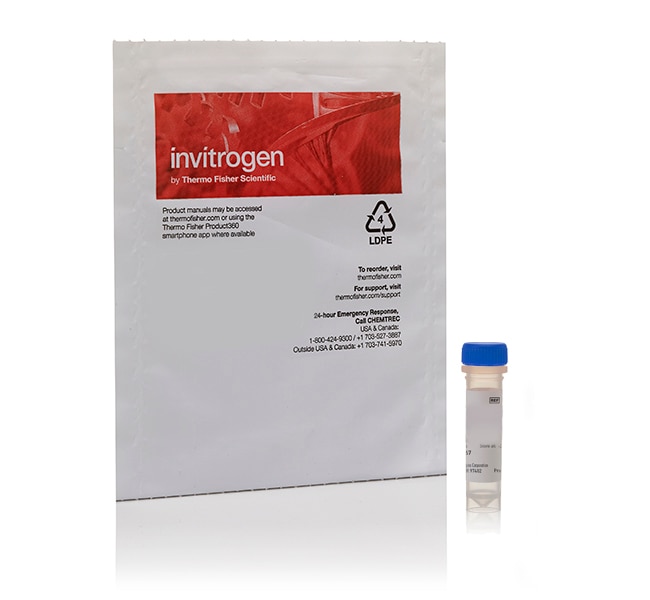
Lipopolysaccharides from Salmonella Minnesota, Alexa Fluor™ 488 conjugate
Ce conjugué brillant et vert fluorescent Alexa Fluor 488 peut être utilisé pour suivre les processus de liaison, de transportAfficher plus
| Référence | Quantité |
|---|---|
| L23356 | 100 μg |
Référence L23356
Prix (EUR)
397,00
Each
Quantité:
100 μg
Prix (EUR)
397,00
Each
Ce conjugué brillant et vert fluorescent Alexa Fluor 488 peut être utilisé pour suivre les processus de liaison, de transport et d’internalisation des cellules lipopolysaccharides.
Usage exclusivement réservé à la recherche. Ne pas utiliser pour des procédures de diagnostic.
Spécifications
Méthode de détectionFluorescence
Type de colorantColorants Alexa Fluor
Excitation / émission495/519
Quantité100 μg
Conditions d’expéditionTempérature ambiante
Gamme de produitsAlexa Fluor
Type de produitConjugué lipopolysaccharide
Unit SizeEach
Contenu et stockage
Stocker au congélateur (entre -5 et -30°C) à l’abri de la lumière.
Citations et références (6)
Citations et références
Abstract
Surfactant protein A directly interacts with TLR4 and MD-2 and regulates inflammatory cellular response. Importance of supratrimeric oligomerization.
Journal:J Biol Chem
PubMed ID:16754682
'The purpose of the current study was to examine the binding of pulmonary surfactant protein A (SP-A) to TLR4 and MD-2, which are critical signaling receptors for lipopolysaccharides (LPSs). The direct binding of SP-A to the recombinant soluble form of extracellular TLR4 domain (sTLR4) and MD-2 was detected using solid-phase
Activation of innate immunity in the CNS triggers neurodegeneration through a Toll-like receptor 4-dependent pathway.
Journal:Proc Natl Acad Sci U S A
PubMed ID:12824464
Innate immunity is an evolutionarily ancient system that provides organisms with immediately available defense mechanisms through recognition of pathogen-associated molecular patterns. We show that in the CNS, specific activation of innate immunity through a Toll-like receptor 4 (TLR4)-dependent pathway leads to neurodegeneration. We identify microglia as the major lipopolysaccharide (LPS)-responsive
Lipopolysaccharide (LPS) labeled with Alexa 488 hydrazide as a novel probe for LPS binding studies.
Journal:Cytometry
PubMed ID:11084617
BACKGROUND: Lipopolysaccharide (LPS) comprises the outer cell wall of all gram-negative bacteria. It consists of an oligosaccharide core and lipid A. All LPS-induced biological responses are lipid A-dependent. Once released, LPS triggers a host systemic inflammatory response that leads to septic shock. Binding studies have helped to reveal some of
The toll-like receptor TLR4 is necessary for lipopolysaccharide-induced oligodendrocyte injury in the CNS.
Journal:J Neurosci
PubMed ID:11923412
The immediate or innate immune response is the first line of defense against diverse microbial pathogens and requires the expression of recently discovered toll-like receptors (TLRs). TLR4 serves as a specific receptor for lipopolysaccharide (LPS) and is localized on the surface of a subset of mammalian cells. Although innate immunity
Lipopolysaccharide Is Cleared from the Circulation by Hepatocytes via the Low Density Lipoprotein Receptor.
Journal:PLoS One
PubMed ID:27171436