Search


Citations et références (12)
Invitrogen™
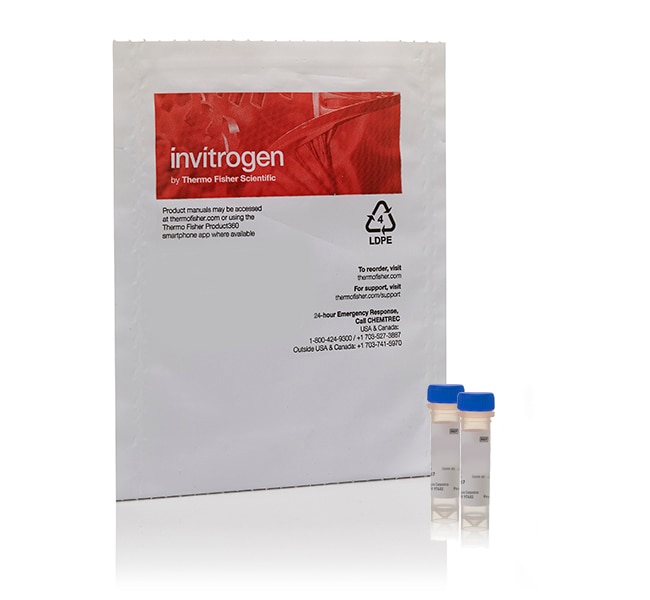
LIVE/DEAD™ Yeast Viability Kit
Le kit de viabilité des levures LIVE/DEAD® combine une nouvelle sonde fluorescente à deux couleurs pour la viabilité des levures,Afficher plus
| Référence | Quantité |
|---|---|
| L7009 | 1 kit |
Référence L7009
Prix (EUR)
1 002,00
Each
Quantité:
1 kit
Prix (EUR)
1 002,00
Each
Le kit de viabilité des levures LIVE/DEAD® combine une nouvelle sonde fluorescente à deux couleurs pour la viabilité des levures, FUN® 1, avec un réactif de marquage de surface fongique fluorescent, Calcofluor® White M2R. L’intégrité de la membrane plasmique et la fonction métabolique des champignons sont nécessaires pour convertir la coloration intracellulaire fluorescente jaune-vert du FUN® 1 en structures intravacuolaires rouge-orange ; le Calcofluor White M2R marque la chitine de la paroi cellulaire avec une fluorescence bleue, quel que soit l’état métabolique.
Usage exclusivement réservé à la recherche. Ne pas utiliser pour des procédures de diagnostic.
Spécifications
Type de celluleCellules de levure
DescriptionKit de viabilité des levures LIVE/DEAD™
Méthode de détectionFluorescence, Fluorescent
Type de colorantAutre(s) étiquette(s) ou colorant(s)
FormatTube(s), plaque de 96 puits, lame(s), Tube(s), plaque à 96 puits, lame(s)
Quantité1 kit
Conditions d’expéditionTempérature ambiante
CouleurJaune-vert, rouge-orange, bleu
Emission530, 620, 500, 550 nm
Excitation Wavelength Range485, 450 nm
À utiliser avec (application)Test de viabilité
À utiliser avec (équipement)Microscope à fluorescence, fluoromètre, cytomètre en flux, lecteur de microplaques, Microscope à fluorescence, Fluorimètre, Cytomètre en flux, Lecteur de microplaques
Gamme de produitsLIVE/DEAD
Type de produitKit de viabilité des levures
Unit SizeEach
Contenu et stockage
Conserver au congélateur (entre -5°C et -30°C) et à l’abri de la lumière.
Foire aux questions (FAQ)
Which species of yeast/fungi can I use with the LIVE/DEAD Yeast Viability Kit?
How do I prepare dead cell controls for LIVE/DEAD cell viability assays?
Can FUN 1 stained cells be examined by flow cytometry?
Live, metabolically active fungi transport FUN 1 into vacuoles to give a red-shifted fluorescence versus green/yellow fluorescence in the nucleus and cytoplasm of dead or metabolically-inactive cells. Is this a reliable indicator of fungal viability?
Citations et références (12)
Citations et références
Abstract
In vitro growth and analysis of Candida biofilms.
Journal:Nat Protoc
PubMed ID:19180075
'Evaluation of fungal biofilm formation can be performed using several techniques. In this protocol, we describe methods used to form Candida biofilms on three different medical device substrates (denture strips, catheter disks and contact lenses) to quantify them and to evaluate their architecture and drug susceptibility. Biofilm formation involves adhesion
Mechanistic aspects in the generation of apparent ultrahigh efficiencies for colloidal (microbial) electrokinetic separations.
Journal:Anal Chem
PubMed ID:12433083
'Under specific experimental conditions, the electrokinetic separation of certain microorganisms can produce peaks of very high apparent efficiencies (approximately 10(6)-10(10) theoretical plates/m). This is unusual in that no deliberate focusing mechanism was employed. To investigate this process further, the separation was monitored in real time using a charge-coupled device (CCD)
Pleiotropic effects of HIV-1 protein R (Vpr) on morphogenesis and cell survival in fission yeast and antagonism by pentoxifylline.
Journal:Virology
PubMed ID:9657945
'Expression of HIV-1 Vpr causes cell cycle G2 arrest, change in cell shape, and cell death over a large evolutionary distance ranging from human to yeast cells. As a step toward understanding these highly conserved Vpr functions, we have examined the effect of Vpr on cytoskeletal elements and the viability
Mechanism of fluconazole resistance in Candida albicans biofilms: phase-specific role of efflux pumps and membrane sterols.
Journal:Infect Immun
PubMed ID:12874310
'Candida albicans biofilms are formed through three distinct developmental phases and are associated with high fluconazole (FLU) resistance. In the present study, we used a set of isogenic Candida strains lacking one or more of the drug efflux pumps Cdr1p, Cdr2p, and Mdr1p to determine their role in FLU resistance
Adaptation of FUN-1 and Calcofluor white stains to assess the ability of viable and nonviable yeast to adhere to and be internalized by cultured mammalian cells.
Journal:J Microbiol Methods
PubMed ID:15369865
'The FUN-1 and Calcofluor white stains can be used in concert to assess the ability of viable and nonviable yeast to adhere to, and be internalized by, host mammalian cells in vitro. With this method, only extracellular yeast stain with Calcofluor, dead yeast cells have diffuse cytoplasmic yellow-green fluorescence, and