Search

Invitrogen™
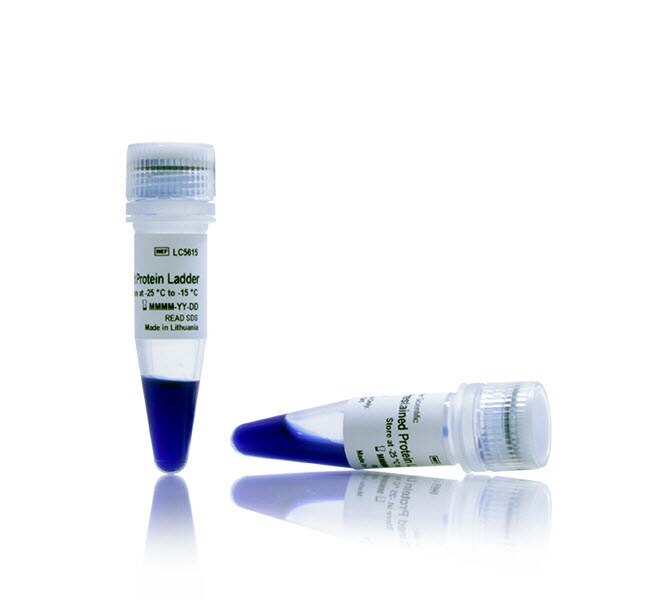
iBright™ Prestained Protein Ladder
L’échelle de protéines précolorée iBright contient douze protéines recombinantes, dix protéines (11 à 250 kDa) colorées en bleu et marquéesAfficher plus
Have Questions?
Modifier l'affichage

| Référence | Quantité |
|---|---|
| LC5615 | 2 x 250 μl |
| LC5615X4 | 8 x 250 μL |
Référence LC5615
Prix (EUR)
295,65
Online Exclusive
328,00Économisez 32,35 (10%)
Each
Quantité:
2 x 250 μl
Prix (EUR)
295,65
Online Exclusive
328,00Économisez 32,35 (10%)
Each
L’échelle de protéines précolorée iBright contient douze protéines recombinantes, dix protéines (11 à 250 kDa) colorées en bleu et marquées au fluor pour la visualisation fluorescente directe et proche de l’IR (NIR) et le dimensionnement des protéines, et deux protéines (30 kDa et 80 kDa) non colorées contenant des sites de liaison aux IgG pour lier les anticorps primaires et secondaires utilisés pour la détection chimiluminescente et fluorescente de la protéine cible. L’échelle de protéines est fournie dans un format prêt à l’emploi à charger directement sur les gels ; nul besoin de la chauffer, de la réduire ou d’ajouter un tampon d’échantillon avant de l’utiliser.
Découvrez et comparez tous les autres étalons et échelles de protéines ›
Caractéristiques du produit
• Visualisation fluorescente : détection de 10 protéines colorées en utilisant un laser rouge de 670 nm ou le canal de 700 nm d’un système d’acquisition par fluorescence
• Confirmation du transfert Western : détection de deux protéines non colorées (30 kDa et 80 kDa) à l’aide du système de détection de la protéine cible
Applications
• Transfert Western : détection des deux bandes non colorées grâce à la méthode de détection utilisée pour la protéine cible. Compatible avec les substrats chimiluminescents et les anticorps secondaires fluorescents.
• Dimensionnement des protéines sur gels SDS-polyacrylamide, visualisation des protéines pendant l’électrophorèse, le transfert et l’imagerie de fluorescence (dix bandes colorées en bleu)
• Estimation de la taille des protéines : dimensionnement des protéines sur gels SDS-polyacrylamide et transfert Western à l’aide d’un système d’acquisition par fluorescence dans l’IR proche
Découvrez et comparez tous les autres étalons et échelles de protéines ›
Caractéristiques du produit
• Visualisation fluorescente : détection de 10 protéines colorées en utilisant un laser rouge de 670 nm ou le canal de 700 nm d’un système d’acquisition par fluorescence
• Confirmation du transfert Western : détection de deux protéines non colorées (30 kDa et 80 kDa) à l’aide du système de détection de la protéine cible
Applications
• Transfert Western : détection des deux bandes non colorées grâce à la méthode de détection utilisée pour la protéine cible. Compatible avec les substrats chimiluminescents et les anticorps secondaires fluorescents.
• Dimensionnement des protéines sur gels SDS-polyacrylamide, visualisation des protéines pendant l’électrophorèse, le transfert et l’imagerie de fluorescence (dix bandes colorées en bleu)
• Estimation de la taille des protéines : dimensionnement des protéines sur gels SDS-polyacrylamide et transfert Western à l’aide d’un système d’acquisition par fluorescence dans l’IR proche
Usage exclusivement réservé à la recherche. Ne pas utiliser pour des procédures de diagnostic.
Spécifications
Méthode de détectionSystème de détection colorimétrique, par fluorescence dans le proche IR et défini par l’utilisateur (2 bandes)
Compatibilité du gelGels midi Novex™, mini-gels Novex™, gels Novex™ Tris-Glycine, gels NuPAGE™ Bis-Tris, gels NuPAGE™, gels NuPAGE™ MES, gels NuPAGE™ MOPS, gels NuPAGE™ Tris-Acétate, gels Precise™ Tris-Glycine, gels SDS-PAGE, gels Precise™ Tris-HEPES
Poids moléculaire250, 130, 95, 80, 70, 55, 43, 34, 30, 26, 15, 11 kDa
Quantité2 x 250 μl
Prêt à chargerOui
Conditions d’expéditionNeige carbonique
CouleurBlue
Number of Markers12
Gamme de produitsiBright
Type de produitÉchelle de protéines
Plage de dimensions11 à 250 kDa
System TypeTransfert Western, SDS-PAGE
Unit SizeEach
Contenu et stockage
Tampon de stockage :62,5 mM de Tris-H3PO4 (pH 7,5 à 25°C), 1 mM d’EDTA, 2 % de SDS (p/v), 10 mM de DTT, 1 mM de NaN3 et 33 % de glycérol
Dès réception, conserver à –20°C.Le produit est expédié sur de la glace.
Dès réception, conserver à –20°C.Le produit est expédié sur de la glace.