Search


Citations et références (4)
Invitrogen™
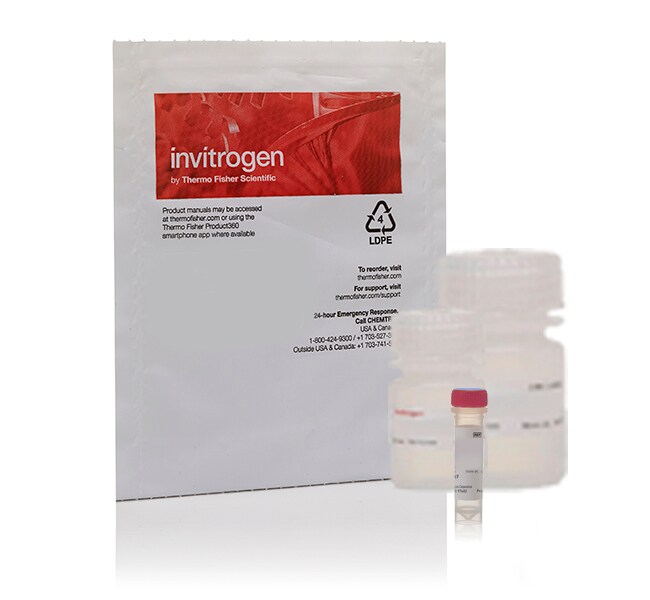
Measure-IT™ High-Sensitivity Nitrite Assay Kit
Les kits de dosage Measure-iT™ offrent un confort d’ajout-lecture et une évolutivité à haut débit pour l’analyse quantitative du nitrite,Afficher plus
| Référence | Quantité |
|---|---|
| M36051 | 1 kit |
Référence M36051
Prix (EUR)
814,00
Each
Quantité:
1 kit
Prix (EUR)
814,00
Each
Les kits de dosage Measure-iT™ offrent un confort d’ajout-lecture et une évolutivité à haut débit pour l’analyse quantitative du nitrite, du thiol et du plomb / cadmium. Le kit d’analyse de nitrite à haute sensibilité Measure-iT™ offre une reproductibilité solide sur une large gamme de quantification, ainsi qu’une excellente tolérance des contaminants d’échantillons courants. Le dosage est linéaire de 20 à 500 pmoles de nitrite, ce qui le rend jusqu’à 50 fois plus sensible que les dosages colorimétriques basés sur le réactif Griess. Le kit comprend une norme de quantification des nitrites et un protocole optimisé pour une application basée sur des microplaques.
Usage exclusivement réservé à la recherche. Ne pas utiliser pour des procédures de diagnostic.
Spécifications
Quantité1 kit
Gamme de produitsMeasure-IT
Type de produitNitrite Assay Kit
Unit SizeEach
Citations et références (4)
Citations et références
Abstract
The intracellular environment of human macrophages that produce nitric oxide promotes growth of mycobacteria.
Journal:
PubMed ID:23774601
Nitric oxide (NO) is a diffusible radical gas produced from the activity of nitric oxide synthase (NOS). NOS activity in murine macrophages has a protective role against mycobacteria through generation of reactive nitrogen intermediates (RNIs). However, the production of NO by human macrophages has remained unclear due to the lack
Comparison of in vitro human endothelial cell response to self-expanding stent deployment in a straight and curved peripheral artery simulator.
Journal:J R Soc Interface
PubMed ID:23365191
Haemodynamic forces have a synergistic effect on endothelial cell (EC) morphology, proliferation, differentiation and biochemical expression profiles. Alterations to haemodynamic force levels have been observed at curved regions and bifurcations of arteries but also around struts of stented arteries, and are also known to be associated with various vascular pathologies.
A small molecule deubiquitinase inhibitor increases localization of inducible nitric oxide synthase to the macrophage phagosome and enhances bacterial killing.
Journal:Infect Immun
PubMed ID:21911458
Macrophages are key mediators of antimicrobial defense and innate immunity. Innate intracellular defense mechanisms can be rapidly regulated at the posttranslational level by the coordinated addition and removal of ubiquitin by ubiquitin ligases and deubiquitinases (DUBs). While ubiquitin ligases have been extensively studied, the contribution of DUBs to macrophage innate
Nitric oxide mediates T cell cytokine production and signal transduction in histidine decarboxylase knockout mice.
Journal:J Immunol
PubMed ID:17982051
Histamine is a key regulator of the immune system. Several lines of evidence suggest the role of histamine in T cell activation and accelerated Th1 immune response is a hallmark of histidine decarboxylase knockout (HDC-KO) mice, with a complete lack of endogenously produced histamine. According to our previous work, T