Search

Invitrogen™
Bolt™ Bis-Tris Welcome Pack, 12%
Le Welcome Pack Bolt fournit tous les gels et tampons Bolt dont vous avez besoin pour commencer à utiliser la mini cuve à gel.
Have Questions?
Modifier l'affichage

| Référence | Puits |
|---|---|
| NW0012B | 12 puits |
| NW0012A | 10 puits |
| NW0012C | 15 puits |
Référence NW0012B
Prix (EUR)
824,00
Each
Puits:
12 puits
Prix (EUR)
824,00
Each
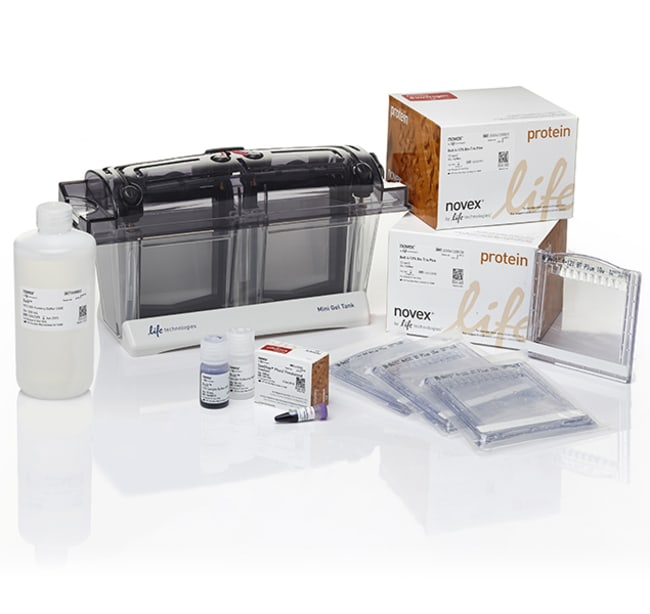
Le pack de bienvenue Bolt fournit tous les gels et tampons Bolt dont vous avez besoin pour commencer à utiliser la mini cuve à gel. La mini-cuve à gel est compatible avec les gels Novex, les gels NuPAGE et les gels Bis-Tris Plus Bolt. Chaque mini cuve à gel peut accueillir jusqu’à deux gels par cycle. La conception unique de la cuve permet le chargement pratique des gels côte à côte et une meilleure visualisation pendant l’utilisation. Les conditions optimisées utilisant une tension constante permettent de réaliser un cycle avec les gels Bis-Tris Plus Bolt en 35 minutes environ.
Contenu du pack de bienvenue :
• Mini cuve à gel (A25977)
• Gels Bis-Tris Plus Bolt (2 boîtes, 20 gels)
• Tampon de charge MES Bolt, 20X (B0002)
• Tampon d’échantillon LDS Bolt, 4X (B0007)
• Agent de réduction d’échantillons Bolt, 10X (B0009)
• Échelle de protéines précolorées PageRuler Plus, 10 à 250 kDa (26619)
À propos de la mini cuve à gel
La mini cuve à gel est compatible avec les gels Novex, les gels NuPAGE et les gels Bis-Tris Plus Bolt. Chaque mini cuve à gel peut accueillir jusqu’à deux gels par cycle. La conception unique de la cuve permet le chargement pratique des gels côte à côte et une meilleure visualisation pendant l’utilisation. Les conditions optimisées utilisant une tension constante permettent de réaliser un cycle avec les gels Bis-Tris Plus Bolt en 35 minutes environ. Les temps de cycle peuvent varier selon les conditions de tampon et les alimentations utilisées.
À propos des gels Bis-Tris Plus Bolt
Les gels Bis-Tris Plus Bolt sont des gels de polyacrylamide précoulés conçus pour une séparation optimale de vos protéines de petite et moyenne dimension dans des conditions de dénaturation. Les gels Bis-Tris Plus Bolt sont conçus pour offrir des performances de gel homogènes et fournir un environnement de pH neutre qui minimise les modifications protéiques. Les gels Bolt sont idéaux pour l’analyse et le transfert Western et toutes les autres techniques où l’intégrité des protéines est essentielle. Vous pouvez également utiliser les gels Bolt pour obtenir des résultats optimaux répondant à vos besoins quotidiens en termes de séparation de protéines. Les gels Bis-Tris Plus Bolt sont fournis en quatre concentrations de polyacrylamide : Formats à puits multiples et à gradient de 8, 10, 12 et 4 - 12 %. Les gels Bis-Tris Bolt sont dotés de puits en forme de biseau, qui peuvent facilement charger jusqu’à deux fois plus de volume d’échantillon, permettant ainsi la détection de protéines dans des échantillons très dilués ou la visualisation de protéines à faible abondance.
Pour transférer vos protéines vers une membrane, nous vous recommandons d’utiliser le tampon de transfert Bolt (BT0006) pour tout transfert humide standard à l’aide du mini module de transfert (B1000). Alternativement, vous pouvez effectuer un transfert rapide semi-sec à l’aide du buvard d’alimentation Invitrogen ou un transfert rapide sec avec le dispositif de transfert de gel iBlot 2 (IB21001).
For Research Use Only. Not for use in diagnostic procedures.
Spécifications
À utiliser avec (équipement)Mini-cuve à gel Mini Gel Tank
Gel Thickness1,0 mm
Quantité1 Welcome Pack
Conditions d’expéditionHomologué pour l’expédition à température ambiante et sur glace humide
Pourcentage de gel12 %
Dimensions de gelMini
Type de gelBis-Tris
Gamme de produitsBolt WedgeWell
Plage de séparation3,5 à 80 kDa
Puits12 puits
Unit SizeEach