Search


Citations et références (2)
Invitrogen™
Pacific Orange™ and Pacific Blue™ Antibody Labeling Kits
Les kits de marquage d’anticorps lient spécifiquement de petites quantités d’anticorps aux colorants Pacific Orange ou Pacific Blue excitables par la lumière violette. Marquez facilement jusqu’à 100 μg d’anticorps par réaction, avec 5 réactions par kit.
Have Questions?
Modifier l'affichage

| Référence | Excitation / émission | Couleur |
|---|---|---|
| P30014 | 405/551 | Pacific Orange |
| P30013 | 410/455 | Pacific Blue |
Référence P30014
Prix (EUR)
974,00
Each
Excitation / émission:
405/551
Couleur:
Pacific Orange
Prix (EUR)
974,00
Each
Les kits de marquage d’anticorps Pacific Orange et Pacific Blue permettent de fixer un marqueur fluorescent excitable à la lumière violette sur les anticorps (jusqu’à 100 μg par réaction). Chaque kit contient suffisamment de colorant pour cinq réactions.
Un anticorps primaire marqué directement avec un fluorophore produit souvent une moindre fluorescence de fond et une faible liaison non spécifique. Des anticorps primaires du même isotype ou dérivés des mêmes espèces peuvent être multiplexés s’ils sont directement marqués avec des fluorophores compatibles. L’utilisation simultanée des colorants Pacific Blue et Pacific Orange permet d’exciter les deux colorants à la même longueur d’onde tout en distinguant leurs émissions.
Les kits de marquage d’anticorps Pacific Orange et Pacific Blue permettent de marquer de petites quantités d’anticorps avec un colorant violet excitable à la lumière (jusqu’à 100 µg d’anticorps par réaction). De petites quantités d’autres protéines (>40 kDa) peuvent également être marquées à l’aide de ces kits.
Caractéristiques de ces kits de marquage d’anticorps
• Maxima d’excitation et d’émission du Pacific Blue : 410/455 nm
• Maxima d’excitation et d’émission du Pacific Orange : 405/551 nm
• Les protéines marquées sont généralement prêtes à être utilisées en 90 minutes (∼temps de manipulation : 15 minutes)
• Optimisé pour le marquage à petite échelle de toute protéine de >40 kDa
• Les protéines stabilisantes doivent être retirées de l’échantillon avant le marquage
• Purifié à l’aide de filtres à centrifuger pratiques
• Inclut des instructions détaillées pour déterminer le degré de marquage (DOL)
Ces kits contiennent tout ce dont vous avez besoin pour effectuer cinq réactions de marquage distinctes et pour purifier les conjugués obtenus. Les conjugués conviennent parfaitement à diverses applications, notamment la cytométrie en flux, la microscopie par fluorescence, l’immunohistochimie, la détection primaire, les essais ELISA, l’immunocytochimie, la méthode FISH et bien plus. Nous sommes certifiés ISO 9001:2000.
For Research Use Only. Not for use in diagnostic procedures.
Spécifications
CouleurPacific Orange
Méthode de détectionFluorescent, Fluorescence, Fluorescent, Fluorescence
Excitation / émission405/551
Type d’étiquetteColorants Pacific
Balance d’étiquetage100 μg
Gamme de produitsPacific Orange
Type de produitKit de marquage d’anticorps
Quantité5 réactions
Conditions d’expéditionTempérature ambiante
Suffisant pour5 Reactions
Réactivité chimiqueAmine
Labeling TargetAnticorps, Protéines
Marqueur ou colorantPacific Orange, Pacific Orange
SolubilitéDMSO (diméthylsulfoxyde)
Unit SizeEach
Contenu et stockage
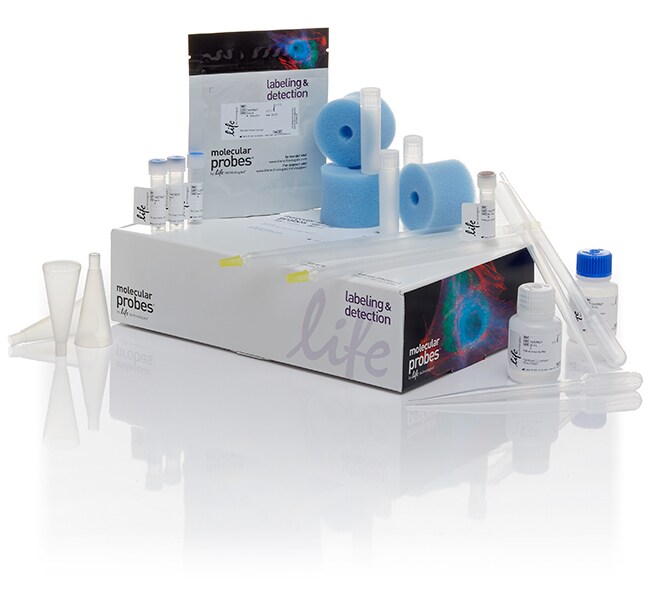
Le kit de marquage d’anticorps Pacific Orange™ est fourni avec 5 flacons de colorant réactif, du bicarbonate de sodium, de la résine de purification, des colonnes de centrifugation et des tubes de prélèvement.
Conserver entre 2 et 8°C, à l’abri de la lumière. Le composant A peut être stocké entre -20°C et 8°C.
Conserver entre 2 et 8°C, à l’abri de la lumière. Le composant A peut être stocké entre -20°C et 8°C.
Foire aux questions (FAQ)
What formulation of antibody should I use for conjugation for small animal in vivo imaging?
What is degree of labeling (DOL)?
Citations et références (2)
Citations et références
Abstract
Lytic immune synapse function requires filamentous actin deconstruction by Coronin 1A.
Journal:
PubMed ID:24760828
'Lytic immune effector function depends upon directed secretion of cytolytic granules at the immunological synapse (IS) and requires dynamic rearrangement of filamentous (F)-actin. Coronin 1A (Coro1A) is the hematopoietic-specific member of the Coronin family of actin regulators that promote F-actin disassembly. Here, we show that Coro1A is required for natural
Perinucleolar relocalization and nucleolin as crucial events in the transcriptional activation of key genes in mantle cell lymphoma.
Journal:
PubMed ID:24452204
'In mantle cell lymphoma (MCL), one allele of the cyclin D1 (Ccnd1) gene is translocated from its normal localization on chromosome 11 to chromosome 14. This is considered as the crucial event in the transformation process of a normal naive B-cell; however, the actual molecular mechanism leading to Ccnd1 activation