Search


Citations et références (14)
Invitrogen™
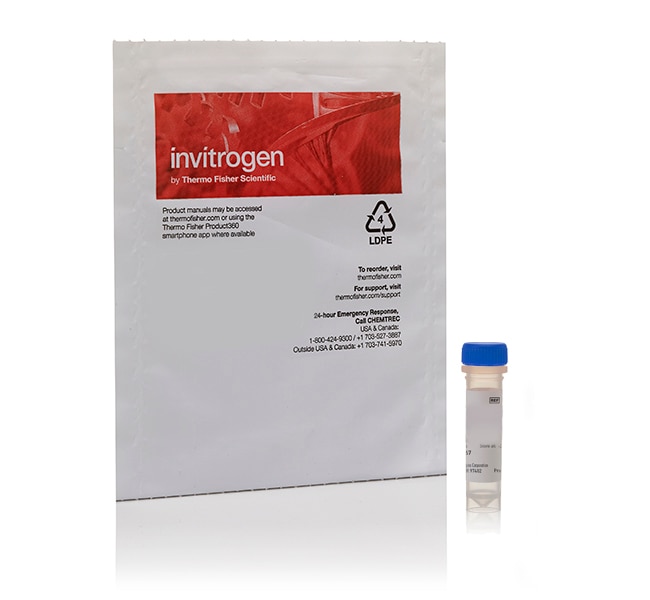
Qdot™ 605 ITK™ Carboxyl Quantum Dots
Les points quantiques de carboxyle Qdot™ 605 ITK™ sont le matériau de départ idéal pour la préparation de conjugués personnalisésAfficher plus
| Référence | Quantité |
|---|---|
| Q21301MP | 250 µl |
Référence Q21301MP
Prix (EUR)
547,65
Precio exclusivo en nuestra web
730,00Économisez 182,35 (25%)
Each
Quantité:
250 µl
Prix (EUR)
547,65
Precio exclusivo en nuestra web
730,00Économisez 182,35 (25%)
Each
Les points quantiques de carboxyle Qdot™ 605 ITK™ sont le matériau de départ idéal pour la préparation de conjugués personnalisés nécessitant une charge élevée de biomolécules. Ces matériaux sont mis en fonction par des carboxylates et peuvent être couplés à des groupes amines de protéines et à des oligonucléotides modifiés en utilisant la condensation médiée de l’EDC. Les revêtements de ces sondes fournissent plus de sites de liaison que nos points amino quantiques Qdot™ ITK™ mais ne possèdent pas de marqueurs PEG qui aident à prévenir les interactions non spécifiques. Ces matériaux peuvent être conjugués à des marqueurs bi-fonctionnels X-PEG-amine pour une réactivité personnalisée et une spécificité supérieure. Nos points quantiques de carboxyle Qdot™ ITK™ sont fournis sous forme de solutions de 8 µm et sont disponibles dans les 9 couleurs de sondes Qdot™.
Caractéristiques importantes des points quantiques de carboxyle Qdot™ ITK™ :
• Le point quantique de carboxyle Qdot™ 605 ITK™ a des maxima d’émission ∼ 605 nm
• Fluorescence extrêmement photostable et brillante
• Excité de façon efficace par des sources d’excitation en ligne unique
• Émission étroite, grand déplacements de Stokes
• Disponible en plusieurs couleurs
• Applications de marquage et de suivi idéales
Propriétés des nanocristaux Qdot™
Les sondes Qdot™ sont idéales pour les applications d’imagerie et d’étiquetage nécessitant des signaux fluorescents lumineux et/ou un suivi en temps réel. Uniques parmi les réactifs fluorescents, les neuf couleurs disponibles des sondes Qdot™ peuvent être simultanément excitées par une seule source lumineuse (UV à bleu-vert). Cette propriété rend ces réactifs excellents pour les applications de multiplexage économiques et pratiques. Les étiquettes Qdot™ sont basées sur la nanotechnologie des semi-conducteurs et sont similaires à celles des protéines de taille moyenne.
À propos des réactifs du kit d’outils des innovateurs Qdot™ ITK™
Ces sondes Qdot™ ITK™ sont idéales pour les chercheurs qui souhaitent préparer des conjugués spécifiques (non stockés) pour leurs applications et qui ont besoin d’une fonctionnalité de conjugaison personnalisable.
D’autres formes de nanocristaux Qdot™ sont disponibles
En plus de la forme dérivée au carboxyle, nous proposons des points quantiques Qdot™ ITK™ avec des modifications d’hydrocarbures aminés et aliphatiques. Nous avons également développé une large gamme de conjugués de nanocristaux et de kits de marquage Qdot™. Étudiez les propriétés des nanocristaux Qdot™ ou lisez la section 6.6 — nanocristaux Qdot™ du guide Molecular Probes™ pour en découvrir davantage.
Usage exclusivement réservé à la recherche. Non destiné à des fins thérapeutiques ou diagnostiques humaines ou animales.
Caractéristiques importantes des points quantiques de carboxyle Qdot™ ITK™ :
• Le point quantique de carboxyle Qdot™ 605 ITK™ a des maxima d’émission ∼ 605 nm
• Fluorescence extrêmement photostable et brillante
• Excité de façon efficace par des sources d’excitation en ligne unique
• Émission étroite, grand déplacements de Stokes
• Disponible en plusieurs couleurs
• Applications de marquage et de suivi idéales
Propriétés des nanocristaux Qdot™
Les sondes Qdot™ sont idéales pour les applications d’imagerie et d’étiquetage nécessitant des signaux fluorescents lumineux et/ou un suivi en temps réel. Uniques parmi les réactifs fluorescents, les neuf couleurs disponibles des sondes Qdot™ peuvent être simultanément excitées par une seule source lumineuse (UV à bleu-vert). Cette propriété rend ces réactifs excellents pour les applications de multiplexage économiques et pratiques. Les étiquettes Qdot™ sont basées sur la nanotechnologie des semi-conducteurs et sont similaires à celles des protéines de taille moyenne.
À propos des réactifs du kit d’outils des innovateurs Qdot™ ITK™
Ces sondes Qdot™ ITK™ sont idéales pour les chercheurs qui souhaitent préparer des conjugués spécifiques (non stockés) pour leurs applications et qui ont besoin d’une fonctionnalité de conjugaison personnalisable.
D’autres formes de nanocristaux Qdot™ sont disponibles
En plus de la forme dérivée au carboxyle, nous proposons des points quantiques Qdot™ ITK™ avec des modifications d’hydrocarbures aminés et aliphatiques. Nous avons également développé une large gamme de conjugués de nanocristaux et de kits de marquage Qdot™. Étudiez les propriétés des nanocristaux Qdot™ ou lisez la section 6.6 — nanocristaux Qdot™ du guide Molecular Probes™ pour en découvrir davantage.
Usage exclusivement réservé à la recherche. Non destiné à des fins thérapeutiques ou diagnostiques humaines ou animales.
Usage exclusivement réservé à la recherche. Ne pas utiliser pour des procédures de diagnostic.
Spécifications
Réactivité chimiqueAmine
Concentration8 μM
Émission605
Marqueur ou colorantQdot™ 605
Type de produitPoint quantique
Quantité250 µl
Groupement de réactifsAcide carboxylique
Conditions d’expéditionTempérature ambiante
Type d’étiquetteNanocristaux Qdot
Gamme de produitsITK, Qdot
Unit SizeEach
Contenu et stockage
Conserver au réfrigérateur (2–8°C).
Foire aux questions (FAQ)
How large are the Qdot nanocrystals?
What is the best way to remove white precipitate from my ITK Qdot nanocrystals?
I see a white precipitate in my ITK Qdot nanocrystals; should I be concerned?
Why do my Qdot nanocrystals appear to be blinking?
My Qdot nanocrystals were brightly fluorescent before I mounted my samples; now I'm seeing a loss of fluorescence. Why is this happening?
Citations et références (14)
Citations et références
Abstract
Binding of muscimol-conjugated quantum dots to GABAC receptors.
Journal:J Am Chem Soc
PubMed ID:17147380
'Functionalization of highly fluorescent CdSe/ZnS core-shell nanocrystals (quantum dots, qdots) is an emerging technology for labeling cell surface proteins. We have synthesized a conjugate consisting of approximately 150-200 muscimols (a GABA receptor agonist) covalently joined to the qdot via a poly(ethylene glycol) (PEG) linker (approximately 78 ethylene glycol units) and
Fluorescent cell barcoding in flow cytometry allows high-throughput drug screening and signaling profiling.
Journal:Nat Methods
PubMed ID:16628206
'Flow cytometry allows high-content, multiparameter analysis of single cells, making it a promising tool for drug discovery and profiling of intracellular signaling. To add high-throughput capacity to flow cytometry, we developed a cell-based multiplexing technique called fluorescent cell barcoding (FCB). In FCB, each sample is labeled with a different signature,
Water-soluble quantum dots for multiphoton fluorescence imaging in vivo.
Journal:Science
PubMed ID:12775841
'The use of semiconductor nanocrystals (quantum dots) as fluorescent labels for multiphoton microscopy enables multicolor imaging in demanding biological environments such as living tissue. We characterized water-soluble cadmium selenide-zinc sulfide quantum dots for multiphoton imaging in live animals. These fluorescent probes have two-photon action cross sections as high as 47,000
The dynamic control of kiss-and-run and vesicular reuse probed with single nanoparticles.
Journal:Science
PubMed ID:19213879
'Vesicular secretion of neurotransmitter is essential for neuronal communication. Kiss-and-run is a mode of membrane fusion and retrieval without the full collapse of the vesicle into the plasma membrane and de novo regeneration. The importance of kiss-and-run during efficient neurotransmission has remained in doubt. We developed an approach for loading
Targeted tumor cell internalization and imaging of multifunctional quantum dot-conjugated immunoliposomes in vitro and in vivo.
Journal:Nano Lett
PubMed ID:18712930
'Targeted drug delivery systems that combine imaging and therapeutic modalities in a single macromolecular construct may offer advantages in the development and application of nanomedicines. To incorporate the unique optical properties of luminescent quantum dots (QDs) into immunoliposomes for cancer diagnosis and treatment, we describe the synthesis, biophysical characterization, tumor