Search


Citations et références (18)
Invitrogen™
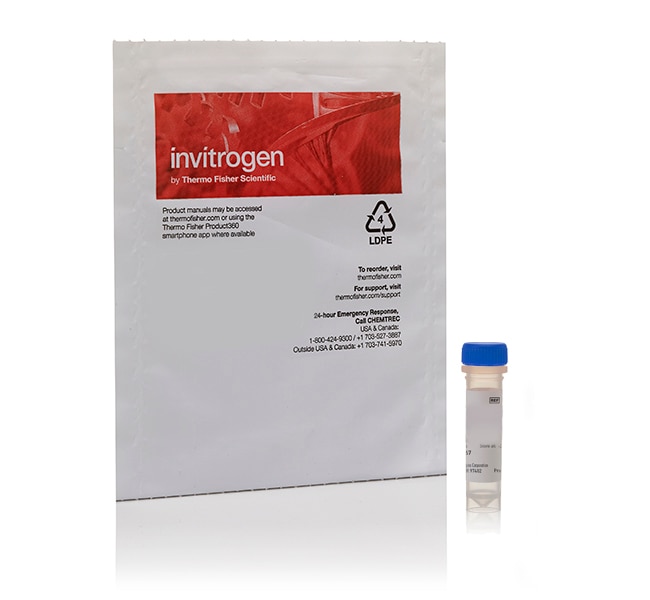
Qdot™ 655 ITK™ Carboxyl Quantum Dots
Les points quantiques de carboxyle Qdot™ 655 ITK™ sont le matériau de départ idéal pour la préparation de conjugués personnalisésAfficher plus
| Référence | Quantité |
|---|---|
| Q21321MP | 250 µl |
Référence Q21321MP
Prix (EUR)
784,00
Each
Quantité:
250 µl
Prix (EUR)
784,00
Each
Les points quantiques de carboxyle Qdot™ 655 ITK™ sont le matériau de départ idéal pour la préparation de conjugués personnalisés nécessitant une charge élevée de biomolécules. Ces matériaux sont mis en fonction par des carboxylates et peuvent être couplés à des groupes amines de protéines et à des oligonucléotides modifiés en utilisant la condensation médiée de l’EDC. Les revêtements de ces sondes fournissent plus de sites de liaison que nos points amino quantiques Qdot™ ITK™ mais ne possèdent pas de marqueurs PEG qui aident à prévenir les interactions non spécifiques. Ces matériaux peuvent être conjugués à des marqueurs bi-fonctionnels X-PEG-amine pour une réactivité personnalisée et une spécificité supérieure. Nos points quantiques de carboxyle Qdot™ ITK™ sont fournis sous forme de solutions de 8 μm et sont disponibles dans les 9 couleurs de sondes Qdot™.
Caractéristiques importantes des points quantiques de carboxyle Qdot™ ITK™ :
• Le point quantique de carboxyle Qdot™ 655 ITK™ a des maxima d’émission ∼ 655 nm
• Fluorescence extrêmement photostable et brillante
• Excité de façon efficace par des sources d’excitation en ligne unique
• Émission étroite, grand déplacements de Stokes
• Disponible en plusieurs couleurs
• Applications de marquage et de suivi idéales
Propriétés des nanocristaux Qdot™
Les sondes Qdot™ sont idéales pour les applications d’imagerie et d’étiquetage nécessitant des signaux fluorescents lumineux et/ou un suivi en temps réel. Uniques parmi les réactifs fluorescents, les neuf couleurs disponibles des sondes Qdot™ peuvent être simultanément excitées par une seule source lumineuse (UV à bleu-vert). Cette propriété rend ces réactifs excellents pour les applications de multiplexage économiques et pratiques. Les étiquettes Qdot™ sont basées sur la nanotechnologie des semi-conducteurs et sont similaires à celles des protéines de taille moyenne.
À propos des réactifs du kit d’outils des innovateurs Qdot™ ITK™
Ces sondes Qdot™ ITK™ sont idéales pour les chercheurs qui souhaitent préparer des conjugués spécifiques (non stockés) pour leurs applications et qui ont besoin d’une fonctionnalité de conjugaison personnalisable.
D’autres formes de nanocristaux Qdot™ sont disponibles
En plus de la forme dérivée au carboxyle, nous proposons des points quantiques Qdot™ ITK™ avec des modifications d’hydrocarbures aminés et aliphatiques. Nous avons également développé une large gamme de conjugués de nanocristaux et de kits de marquage Qdot™. Étudiez les propriétés des nanocristaux Qdot™ ou lisez la section 6.6 — nanocristaux Qdot™ du guide Molecular Probes™ pour en découvrir davantage.
Usage exclusivement réservé à la recherche. Non destiné à des fins thérapeutiques ou diagnostiques humaines ou animales.
Caractéristiques importantes des points quantiques de carboxyle Qdot™ ITK™ :
• Le point quantique de carboxyle Qdot™ 655 ITK™ a des maxima d’émission ∼ 655 nm
• Fluorescence extrêmement photostable et brillante
• Excité de façon efficace par des sources d’excitation en ligne unique
• Émission étroite, grand déplacements de Stokes
• Disponible en plusieurs couleurs
• Applications de marquage et de suivi idéales
Propriétés des nanocristaux Qdot™
Les sondes Qdot™ sont idéales pour les applications d’imagerie et d’étiquetage nécessitant des signaux fluorescents lumineux et/ou un suivi en temps réel. Uniques parmi les réactifs fluorescents, les neuf couleurs disponibles des sondes Qdot™ peuvent être simultanément excitées par une seule source lumineuse (UV à bleu-vert). Cette propriété rend ces réactifs excellents pour les applications de multiplexage économiques et pratiques. Les étiquettes Qdot™ sont basées sur la nanotechnologie des semi-conducteurs et sont similaires à celles des protéines de taille moyenne.
À propos des réactifs du kit d’outils des innovateurs Qdot™ ITK™
Ces sondes Qdot™ ITK™ sont idéales pour les chercheurs qui souhaitent préparer des conjugués spécifiques (non stockés) pour leurs applications et qui ont besoin d’une fonctionnalité de conjugaison personnalisable.
D’autres formes de nanocristaux Qdot™ sont disponibles
En plus de la forme dérivée au carboxyle, nous proposons des points quantiques Qdot™ ITK™ avec des modifications d’hydrocarbures aminés et aliphatiques. Nous avons également développé une large gamme de conjugués de nanocristaux et de kits de marquage Qdot™. Étudiez les propriétés des nanocristaux Qdot™ ou lisez la section 6.6 — nanocristaux Qdot™ du guide Molecular Probes™ pour en découvrir davantage.
Usage exclusivement réservé à la recherche. Non destiné à des fins thérapeutiques ou diagnostiques humaines ou animales.
Usage exclusivement réservé à la recherche. Ne pas utiliser pour des procédures de diagnostic.
Spécifications
Réactivité chimiqueAmine
Concentration8 μM
Émission655
Marqueur ou colorantQdot™ 655
Type de produitPoint quantique
Quantité250 µl
Groupement de réactifsAcide carboxylique
Conditions d’expéditionTempérature ambiante
Type d’étiquetteNanocristaux Qdot
Gamme de produitsITK, Qdot
Unit SizeEach
Contenu et stockage
Conserver au réfrigérateur (2–8°C).
Foire aux questions (FAQ)
How large are the Qdot nanocrystals?
What is the best way to remove white precipitate from my ITK Qdot nanocrystals?
I see a white precipitate in my ITK Qdot nanocrystals; should I be concerned?
Why do my Qdot nanocrystals appear to be blinking?
My Qdot nanocrystals were brightly fluorescent before I mounted my samples; now I'm seeing a loss of fluorescence. Why is this happening?
Citations et références (18)
Citations et références
Abstract
Transgenic mice expressing a cameleon fluorescent Ca2+ indicator in astrocytes and Schwann cells allow study of glial cell Ca2+ signals in situ and in vivo.
Journal:J Neurosci Methods
PubMed ID:19454294
'Glial cell Ca2+ signals play a key role in glial-neuronal and glial-glial network communication. Numerous studies have thus far utilized cell-permeant and injected Ca2+ indicator dyes to investigate glial Ca2+ signals in vitro and in situ. Genetically encoded fluorescent Ca2+ indicators have emerged as novel probes for investigating cellular Ca2+
Optimizing a waveguide-based sandwich immunoassay for tumor biomarkers: evaluating fluorescent labels and functional surfaces.
Journal:Bioconjug Chem
PubMed ID:19173652
'The sensor team at the Los Alamos National Laboratory has developed a waveguide-based optical biosensor for the detection of biomarkers associated with disease. We have previously demonstrated the application of this technology to the sensitive detection of carcinoembryonic antigen in serum and nipple aspirate fluid from breast cancer patients. In
Targeted cellular delivery of quantum dots loaded on and in biotinylated liposomes.
Journal:Bioconjug Chem
PubMed ID:20715851
'We describe the preparation, biophysical characterization, and receptor-mediated cellular internalization of biotinylated lipid particles (BLPs) loaded on the surface and internally with two distinct (colors) of quantum dot (QD) probes. BLPs were formulated with 1.4 and 2.7 mol % PEG-lipids containing either a fusogenic or pH-sensitive lipid to promote bilayer
Quantum dot photon statistics measured by three-dimensional particle tracking.
Journal:Nano Lett
PubMed ID:17949048
'We present an instrument for performing correlation spectroscopy on single fluorescent particles while tracking their Brownian motion in three dimensions using real-time feedback. By tracking CdSe/ZnS quantum dots in water (diffusion coefficient approximately 20 mum2/s), we make the first measurements of photon antibunching (at approximately 10 ns) on single fluorophores
Bioconjugation of the estrogen receptor hER(a) to a quantum dot dye for a controlled immobilization on a SiO(2) surface.
Journal:J Colloid Interface Sci
PubMed ID:21216405
'We investigated the immobilization of the estrogen receptor hER(a) on silanized SiO(2) surfaces for biosensor applications. The conjugation of the estrogen receptor hER(a) to the quantum dot dye QD655 was achieved. In order to obtain an optimal immobilization of the estrogen receptor hER(a) on the functionalized SiO(2) surface, the bioconjugate