Search


Citations et références (9)
Invitrogen™
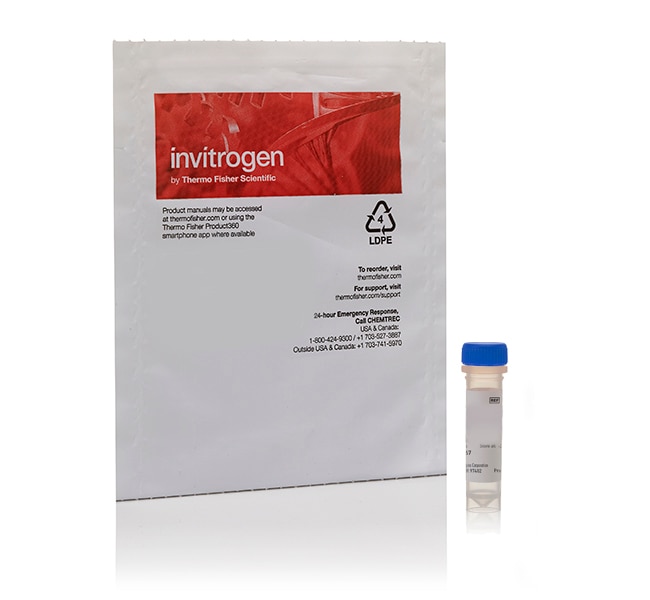
Streptavidine, conjugué Alexa Fluor™ 555
Le colorant de streptavidine Alexa Fluor™ 555 comprend une protéine de liaison à la biotine (la streptavidine) liée par covalenceAfficher plus
Have Questions?
Modifier l'affichage

| Référence | Quantité | Forme |
|---|---|---|
| S32355 | 0,5 mL | Liquide |
| S21381 | 1 mg | Pleine |
Référence S32355
Prix (EUR)
536,00
Each
Quantité:
0,5 mL
Forme:
Liquide
Prix (EUR)
536,00
Each
Le colorant de streptavidine Alexa Fluor™ 555 comprend une protéine de liaison à la biotine (la streptavidine) liée par covalence à un marqueur fluorescent (colorant Alexa Fluor™). La streptavidine a une affinité de liaison à la biotine très élevée, et un conjugué de streptavidine est couramment utilisé en même temps qu’un conjugué de biotine pour la détection spécifique d’une variété de protéines, de motifs de protéine, d’acides nucléiques, et autres molécules (par exemple, un anticorps primaire biotinylé lié à une protéine cible peut être détecté avec une streptavidine marquée par fluorescence). Des stratégies semblables à celle-ci sont mises en œuvre dans de nombreux protocoles de détection comme les transferts Western, la cytométrie de flux, l’imagerie et la microscopie, et les dosages sur microplaque. Les conjugués de streptavidine Alexa Fluor™ sont fournis sous forme de 1 mg de produit lyophilisé ou de 0,5 ml de solution de 2 mg/ml.
Caractéristiques importantes des conjugués de streptavidine Alexa Fluor™ 555 :
• Le conjugué de streptavidine Alexa Fluor™ 555 présente des maxima d’excitation / d’émission à ∼ 555 / 565
• Fluorescence brillante, photostable
• Haute solubilité dans les solutions aqueuses
• Disponible dans de nombreuses couleurs
• Idéal pour les transferts Western, la cytométrie en flux, l’imagerie et la microscopie, les dosages sur microplaques et autres
Propriétés des colorants Alexa Fluor™
Les colorants Alexa Fluor™ sont des colorants fluorescents organiques développés pour obtenir de meilleures performances dans les protocoles d’imagerie et autres protocoles de marquage et présentent une meilleure photostabilité et brillance et une meilleure solubilité dans les solutions aqueuses. Disponibles dans une large gamme de couleurs, ces colorants conviennent pour la plupart des applications d’imagerie.
Blocage de la biotine endogène
Les biotines naturellement présentes peuvent interférer avec les systèmes de détection de la biotine-streptavidine. Pour les expériences impliquant des cellules fixes et perméabilisées, essayez notre kit de blocage de la biotine endogène pour minimiser cette interférence.
Usage exclusivement réservé à la recherche. Non destiné à des fins thérapeutiques ou diagnostiques humaines ou animales.
Liens connexes :
En savoir plus sur la détection de l’avidine-biotine
En savoir plus sur les colorants Alexa Fluor™
Découvrez d’autres conjugués de streptavidine marqués
Lire la Section 7.6 Conjugés d’avidine et de streptavidine du Manuel des sondes moléculaires
Caractéristiques importantes des conjugués de streptavidine Alexa Fluor™ 555 :
• Le conjugué de streptavidine Alexa Fluor™ 555 présente des maxima d’excitation / d’émission à ∼ 555 / 565
• Fluorescence brillante, photostable
• Haute solubilité dans les solutions aqueuses
• Disponible dans de nombreuses couleurs
• Idéal pour les transferts Western, la cytométrie en flux, l’imagerie et la microscopie, les dosages sur microplaques et autres
Propriétés des colorants Alexa Fluor™
Les colorants Alexa Fluor™ sont des colorants fluorescents organiques développés pour obtenir de meilleures performances dans les protocoles d’imagerie et autres protocoles de marquage et présentent une meilleure photostabilité et brillance et une meilleure solubilité dans les solutions aqueuses. Disponibles dans une large gamme de couleurs, ces colorants conviennent pour la plupart des applications d’imagerie.
Blocage de la biotine endogène
Les biotines naturellement présentes peuvent interférer avec les systèmes de détection de la biotine-streptavidine. Pour les expériences impliquant des cellules fixes et perméabilisées, essayez notre kit de blocage de la biotine endogène pour minimiser cette interférence.
Usage exclusivement réservé à la recherche. Non destiné à des fins thérapeutiques ou diagnostiques humaines ou animales.
Liens connexes :
En savoir plus sur la détection de l’avidine-biotine
En savoir plus sur les colorants Alexa Fluor™
Découvrez d’autres conjugués de streptavidine marqués
Lire la Section 7.6 Conjugés d’avidine et de streptavidine du Manuel des sondes moléculaires
Usage exclusivement réservé à la recherche. Ne pas utiliser pour des procédures de diagnostic.
Spécifications
Concentration2 mg / ml
Marqueur ou colorantColorants Alexa Fluor
Type de produitConjugué de streptavidine (fluorescent)
Quantité0,5 mL
Conditions d’expéditionGlace humide
ConjuguéAlexa Fluor 555
FormeLiquide
Gamme de produitsAlexa Fluor
Unit SizeEach
Contenu et stockage
Stocker au réfrigérateur (2 – 8°C) à l’abri de la lumière.
Foire aux questions (FAQ)
I am planning to use a fluorescent streptavidin labeled conjugate. What are the storage conditions and shelf life for the lyophilized powder and reconstituted solution?
I am planning to use a fluorescent streptavidin labeled conjugate. How should I prepare the working solution of the conjugate?
Citations et références (9)
Citations et références
Abstract
Seeing the trees in the forest: selective electroporation of adipocytes within adipose tissue.
Journal:Am J Physiol Endocrinol Metab
PubMed ID:15126244
'Electroporation has been recently adapted for the transfer of macromolecules into cells of tissues in vivo. Although mature adipocytes constitute <20% of cells residing in adipose tissue, we hypothesized that fat cells might be susceptible to selective electrotransfer of plasmid DNA owing to their large size relative to other cells
PKC putative phosphorylation site Ser235 is required for MIP/AQP0 translocation to the plasma membrane.
Journal:Mol Vis
PubMed ID:18523655
'PURPOSE: To investigate the functional significance of MIP/AQP0 phosphorylation at serine(235). METHODS: MIP/AQP0 expression and cellular localization was studied in rat lens epithelia explants induced to differentiate by FGF-2. MIP wild type (WT) and MIP (S235A) mutant expression plasmids were constructed and transiently expressed in RK13 cells. Subcellular localization of
Collagen XVI harbors an integrin alpha1 beta1 recognition site in its C-terminal domains.
Journal:J Biol Chem
PubMed ID:16754661
'Collagen XVI is integrated tissue-dependently into distinct fibrillar aggregates, such as D-banded cartilage fibrils and fibrillin-1-containing microfibrils. In skin, the distribution of collagen XVI overlaps that of the collagen-binding integrins alpha1 beta1 and alpha2 beta1. Basal layer keratinocytes express integrin alpha2 beta1, whereas integrin alpha1 beta1 occurs in smooth muscle
Diabetes is predicted by the beta cell level of autoantigen.
Journal:J Immunol
PubMed ID:16177075
'Two novel transgenic (Tg) strains were created expressing hen egg-white lysozyme (HEL) in a pancreas-specific fashion. RmHP.111 mice had levels of HEL per cell similar to that of the established ILK-3 strain, while RmHP.117 mice had 10-fold lower levels (50,000 molecules per cell). When bred to 3A9 TCR Tg mice,
Metabolic and cellular plasticity in white adipose tissue II: role of peroxisome proliferator-activated receptor-alpha.
Journal:Am J Physiol Endocrinol Metab
PubMed ID:15941786
'Chronic activation of adipocyte beta-adrenergic receptors induces remodeling of white adipose tissue (WAT) that includes a transient inflammatory response followed by mitochondrial biogenesis, induction of fatty acid oxidation genes, and elevation of tissue oxidative metabolism. Gene profiling experiments of WAT during remodeling induced by the beta(3)-adrenergic receptor agonist CL-316,243 (CL)