Search


Citations et références (19)
Invitrogen™
Streptavidine, conjugué Alexa Fluor™ 647
Le colorant de streptavidine Alexa Fluor™ 647 comprend une protéine de liaison à la biotine (la streptavidine) liée par covalenceAfficher plus
Have Questions?
Modifier l'affichage

| Référence | Quantité | Forme |
|---|---|---|
| S32357 | 0,5 mL | Liquide |
| S21374 | 1 mg | Pleine |
Référence S32357
Prix (EUR)
536,00
Each
Quantité:
0,5 mL
Forme:
Liquide
Prix (EUR)
536,00
Each
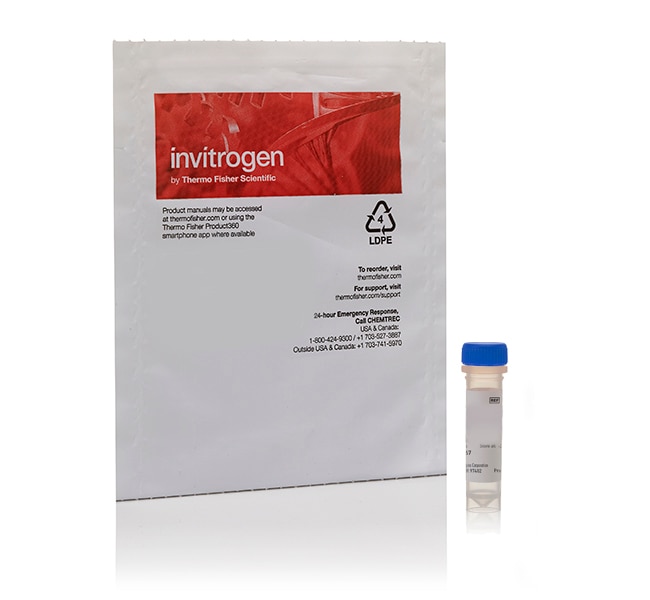
Le colorant de streptavidine Alexa Fluor™ 647 comprend une protéine de liaison à la biotine (la streptavidine) liée par covalence à un marqueur fluorescent (colorant Alexa Fluor™). La streptavidine a une affinité de liaison à la biotine très élevée, et un conjugué de streptavidine est couramment utilisé en même temps qu’un conjugué de biotine pour la détection spécifique d’une variété de protéines, de motifs de protéine, d’acides nucléiques, et autres molécules (par exemple, un anticorps primaire biotinylé lié à une protéine cible peut être détecté avec une streptavidine marquée par fluorescence). Des stratégies semblables à celle-ci sont mises en œuvre dans de nombreux protocoles de détection comme les transferts Western, la cytométrie de flux, l’imagerie et la microscopie, et les dosages sur microplaque. Les conjugués de streptavidine Alexa Fluor™ sont fournis sous forme de 1 mg de produit lyophilisé ou de 0,5 ml de solution de 2 mg/ml.
Caractéristiques importantes des conjugués de streptavidine Alexa Fluor™ 647 :
• Le conjugué de streptavidine Alexa Fluor™ 647 présente des maxima d’excitation / d’émission à ∼ 650 / 668
• Fluorescence brillante, photostable
• Haute solubilité dans les solutions aqueuses
• Disponible dans de nombreuses couleurs
• Idéal pour les transferts Western, la cytométrie en flux, l’imagerie et la microscopie, les dosages sur microplaques et autres
Propriétés des colorants Alexa Fluor™
Les colorants Alexa Fluor™ sont des colorants fluorescents organiques développés pour obtenir de meilleures performances dans les protocoles d’imagerie et autres protocoles de marquage et présentent une meilleure photostabilité et brillance et une meilleure solubilité dans les solutions aqueuses. Disponibles dans une large gamme de couleurs, ces colorants conviennent pour la plupart des applications d’imagerie.
Blocage de la biotine endogène
Les biotines naturellement présentes peuvent interférer avec les systèmes de détection de la biotine-streptavidine. Pour les expériences impliquant des cellules fixes et perméabilisées, essayez notre kit de blocage de la biotine endogène pour minimiser cette interférence.
Usage exclusivement réservé à la recherche. Non destiné à des fins thérapeutiques ou diagnostiques humaines ou animales.
Liens connexes :
En savoir plus sur la détection de l’avidine-biotine
En savoir plus sur les colorants Alexa Fluor™
Découvrez d’autres conjugués de streptavidine marqués
Lire la Section 7.6 Conjugés d’avidine et de streptavidine du Manuel des sondes moléculaires
Caractéristiques importantes des conjugués de streptavidine Alexa Fluor™ 647 :
• Le conjugué de streptavidine Alexa Fluor™ 647 présente des maxima d’excitation / d’émission à ∼ 650 / 668
• Fluorescence brillante, photostable
• Haute solubilité dans les solutions aqueuses
• Disponible dans de nombreuses couleurs
• Idéal pour les transferts Western, la cytométrie en flux, l’imagerie et la microscopie, les dosages sur microplaques et autres
Propriétés des colorants Alexa Fluor™
Les colorants Alexa Fluor™ sont des colorants fluorescents organiques développés pour obtenir de meilleures performances dans les protocoles d’imagerie et autres protocoles de marquage et présentent une meilleure photostabilité et brillance et une meilleure solubilité dans les solutions aqueuses. Disponibles dans une large gamme de couleurs, ces colorants conviennent pour la plupart des applications d’imagerie.
Blocage de la biotine endogène
Les biotines naturellement présentes peuvent interférer avec les systèmes de détection de la biotine-streptavidine. Pour les expériences impliquant des cellules fixes et perméabilisées, essayez notre kit de blocage de la biotine endogène pour minimiser cette interférence.
Usage exclusivement réservé à la recherche. Non destiné à des fins thérapeutiques ou diagnostiques humaines ou animales.
Liens connexes :
En savoir plus sur la détection de l’avidine-biotine
En savoir plus sur les colorants Alexa Fluor™
Découvrez d’autres conjugués de streptavidine marqués
Lire la Section 7.6 Conjugés d’avidine et de streptavidine du Manuel des sondes moléculaires
Usage exclusivement réservé à la recherche. Ne pas utiliser pour des procédures de diagnostic.
Spécifications
Concentration2 mg / ml
Marqueur ou colorantColorants Alexa Fluor
Type de produitConjugué de streptavidine (fluorescent)
Quantité0,5 mL
Conditions d’expéditionGlace humide
ConjuguéAlexa Fluor 647
FormeLiquide
Gamme de produitsAlexa Fluor
Unit SizeEach
Contenu et stockage
Stocker au réfrigérateur (2 – 8°C) à l’abri de la lumière.
Foire aux questions (FAQ)
I am planning to use a fluorescent streptavidin labeled conjugate. What are the storage conditions and shelf life for the lyophilized powder and reconstituted solution?
I am planning to use a fluorescent streptavidin labeled conjugate. How should I prepare the working solution of the conjugate?
Citations et références (19)
Citations et références
Abstract
Printing protein arrays from DNA arrays.
Journal:Nat Methods
PubMed ID:18204456
'We describe a method, DNA array to protein array (DAPA), which allows the ''printing'' of replicate protein arrays directly from a DNA array template using cell-free protein synthesis. At least 20 copies of a protein array can be obtained from a single DNA array. DAPA eliminates the need for separate
Comparison of hydroxylated print additives on antibody microarray performance.
Journal:J Proteome Res
PubMed ID:17081047
'Various hydroxylated additives were added to antibody print buffers at different concentrations to stabilize printed antibodies during normal array spot desiccation on commercial polymer-coated microarray slides. Polyvinyl alcohol addition to print buffers produced the most regular spot morphologies, homogeneous intra-spot antibody distribution, uniform fluorescence intensity, and improved analyte capture activity,
The tetraspanin CD9 mediates lateral association of MHC class II molecules on the dendritic cell surface.
Journal:Proc Natl Acad Sci U S A
PubMed ID:17190803
'We have found that MHC class II (MHC II) molecules exhibit a distinctive organization on the dendritic cell (DC) plasma membrane. Both in DC lysates and on the surface of living cells, I-A and I-E molecules engaged in lateral interactions not observed on other antigen-presenting cells such as B blasts.
Development of homogeneous binding assays based on fluorescence resonance energy transfer between quantum dots and Alexa Fluor fluorophores.
Journal:Anal Biochem
PubMed ID:16860286
'We studied the fluorescence resonance energy transfer (FRET) between quantum dots emitting at 565, 605, and 655 nm as energy donors and Alexa Fluor fluorophores with absorbance maxima at 594, 633, 647, and 680 nm as energy acceptors. As a first step, we prepared covalent conjugates between all three types
Restriction of receptor movement alters cellular response: physical force sensing by EphA2.
Journal:Science
PubMed ID:20223987
'Activation of the EphA2 receptor tyrosine kinase by ephrin-A1 ligands presented on apposed cell surfaces plays important roles in development and exhibits poorly understood functional alterations in cancer. We reconstituted this intermembrane signaling geometry between live EphA2-expressing human breast cancer cells and supported membranes displaying laterally mobile ephrin-A1. Receptor-ligand binding,