Search


Citations et références (2)
Invitrogen™
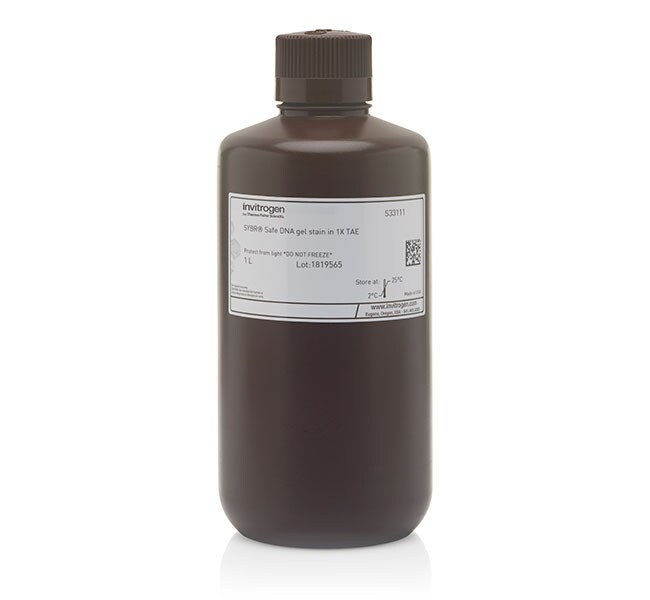
SYBR™ Safe DNA Gel Stain in 1X TAE
Le colorant de gel d’ADN SYBR Safe™ a été développé spécifiquement pour une mutagénicité réduite : plus sûre que leAfficher plus
Have Questions?
Modifier l'affichage

| Référence | Quantité |
|---|---|
| S33112 | 4 l |
| S33111 | 1 l |
Référence S33112
Prix (EUR)
722,00
Each
Quantité:
4 l
Prix (EUR)
722,00
Each
Le colorant de gel d’ADN SYBR Safe™ a été développé spécifiquement pour une mutagénicité réduite : plus sûre que le bromure d’éthidium pour la coloration de l’ADN dans les gels d’agarose ou d’acrylamide Le colorant SYBR Safe™ n’est pas seulement moins mutagène que le bromure d’éthidium, mais la sensibilité de détection du colorant SYBR Safe™ est meilleure que celle du bromure d’éthidium. La coloration SYBR Safe™ est une solution prémélangée qui peut être utilisée de la même manière qu’une solution de bromure d’éthidium, soit dans le gel pendant le cycle d’électrophorèse, soit comme coloration après le cycle. Lié aux acides nucléiques, le colorant vert fluorescent SYBR Safe™ affiche un maximum d’excitation de la fluorescence d’environ 280 et environ 502 nm, ainsi qu’un maximum d’émission de la fluorescence d’environ 530 nm.
Usage exclusivement réservé à la recherche. Ne pas utiliser pour des procédures de diagnostic.
Spécifications
Emplacement de détectionDétection sur gel
Méthode de détectionFluorescence
Quantité4 l
Durée de conservation6 mois
Conditions d’expéditionTempérature ambiante
Molécule cibleADN
Marqueur ou colorantSYBR Safe
Type de produitColoration sur gel d’ADN
Unit SizeEach
Contenu et stockage
• Fourni sous la forme d’une solution prête à l’emploi dans du TAE 1X
Conserver à température ambiante dans le récipient d’origine.
Conserver à température ambiante dans le récipient d’origine.
Foire aux questions (FAQ)
Why do I sometimes see speckles in my gel when using SYBR Safe DNA Gel Stain?
What is the pH range of SYBR dyes?
Which direction does the SYBR Safe dye run during electrophoresis?
Does ethanol precipitation remove the SYBR Safe dye?
Can I reuse SYBR Safe DNA Gel Stain for a second gel?
Citations et références (2)
Citations et références
Abstract
Development of a SYBR safe technique for the sensitive detection of DNA in cesium chloride density gradients for stable isotope probing assays.
Journal:J Microbiol Methods
PubMed ID:18329741
SYBR safe, a fluorescent nucleic acid stain, was evaluated as a replacement for ethidium bromide (EtBr) in cesium chloride (CsCl) density gradients for DNA stable isotope probing (DNA-SIP) assays. The separation of 12C- and 13C-labelled DNA using SYBR safe gave similar results to those obtained using EtBr with pure cultures
Mechanisms of palatal epithelial seam disintegration by transforming growth factor (TGF) beta3.
Journal:Dev Biol
PubMed ID:17698055
TGFbeta3 signaling initiates and completes sequential phases of cellular differentiation that is required for complete disintegration of the palatal medial edge seam, that progresses between 14 and 17 embryonic days in the murine system, which is necessary in establishing confluence of the palatal stroma. Understanding the cellular mechanism of palatal