Search


Citations et références (2)
Invitrogen™
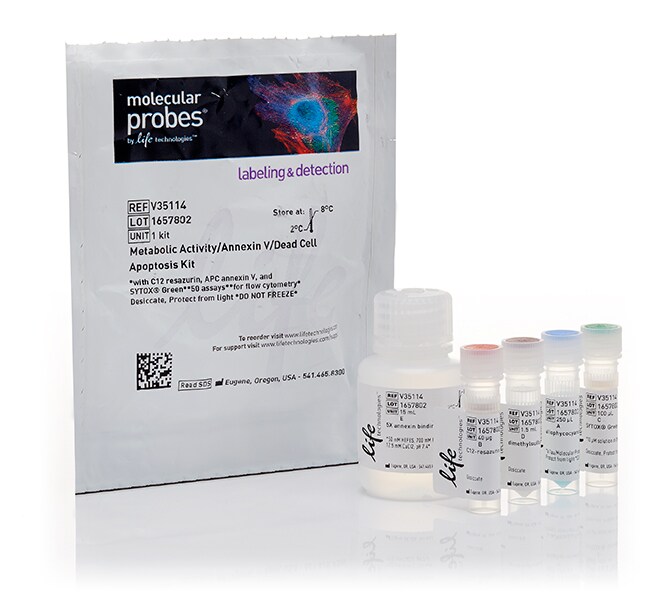
Metabolic Activity Dead Cell Apoptosis Kit with C12 Resazurin, Annexin V APC, and SYTOX™ Green, for flow cytometry
Ce produit de cytométrie en flux offre un dosage de fluorescence à trois couleurs qui distingue les cellules apoptotiques vivantesAfficher plus
| Référence | Quantité |
|---|---|
| V35114 | 1 kit |
Référence V35114
Prix (EUR)
943,92
Online exclusive
1 242,00Économisez 298,08 (24%)
1 kit
Quantité:
1 kit
Prix (EUR)
943,92
Online exclusive
1 242,00Économisez 298,08 (24%)
1 kit
Ce produit de cytométrie en flux offre un dosage de fluorescence à trois couleurs qui distingue les cellules apoptotiques vivantes et les cellules apoptotiques tardives les unes des autres. Ces populations peuvent être facilement distinguées à l’aide d’un cytomètre en flux qui possède des sources d’excitation de 488 nm et 633 nm (un laser à ions d’argon et un laser HeNe) et les réactifs suivants : annexine V pour détecter la phosphatidylsérine, résazurine C12 pour le métabolisme cellulaire, et colorant d’acide nucléique vert SYTOX™ pour les membranes compromises.
Consultez un guide de sélection pour tous les dosages d’apoptose pour la cytométrie en flux.
Consultez un guide de sélection pour tous les dosages d’apoptose pour la cytométrie en flux.
Usage exclusivement réservé à la recherche. Ne pas utiliser pour des procédures de diagnostic.
Spécifications
Excitation / émissionRésazurine C12 : 571⁄585, vert SYTOX™ : 503⁄524, APC : 650 / 660
Faisceaux laser du cytomètre en flux633/635, 488
À utiliser avec (application)Cytométrie en flux
À utiliser avec (équipement)Microscope à fluorescence, cytomètre en flux
Nbre de réactions50 reactions
Gamme de produitsSYTOX
Type de produitKit d’apoptose des cellules mortes
Quantité1 kit
Conditions d’expéditionGlace humide
ConjuguéAPC (Allophycocyanine), SYTOX™ Green résazurine C12
FormatTube, lame
Unit Size1 kit
Contenu et stockage
Contient 1 flacon d’annexine V, conjugué APC (250 µl), 1 flacon de coloration verte SYTOX™ (100 µl), 1 flacon de résazurine C12 (40 µg) et 1 flacon de DMSO (1,5 ml).
Conserver au réfrigérateur (2–8°C) et à l’abri de la lumière.
Conserver au réfrigérateur (2–8°C) et à l’abri de la lumière.
Foire aux questions (FAQ)
How do SYTO dyes bind to DNA?
I trypsinized my adherent cells and labeled with annexin V, and now my flow data is showing a high percentage of apoptotic cells even for control, untreated cells. What is the problem?
Can I detect annexin V staining in an imaging assay?
When should I stain adherent cells with annexin V for flow cytometric analysis? Before or after I trypsinize them?
Can I fix my cells after annexin V staining?
Citations et références (2)
Citations et références
Abstract
Bruton's tyrosine kinase is at the crossroads of metabolic adaptation in primary malignant human lymphocytes.
Journal:Sci Rep
PubMed ID:31363127
'In this work we explored metabolic aspects of human primary leukemic lymphocytes that hold a potential impact on the treatment of Bruton tyrosine kinase (BTK)-driven diseases. Our results suggest that there is crosstalk between Bruton tyrosine kinase (BTK) signaling and bioenergetic stress responses. In primary chronic lymphocytic leukemia (CLL) lymphocytes,
Ibrutinib Resistance Is Reduced by an Inhibitor of Fatty Acid Oxidation in Primary CLL Lymphocytes.
Journal:Front Oncol
PubMed ID:30319974
Chronic Lymphocytic Leukemia (CLL) is an incurable disease, characterized by the accumulation of malignant B-lymphocytes in the blood stream (quiescent state) and homing tissues (where they can proliferate). In CLL, the targeting of B-cell receptor signaling through a Burton's tyrosine kinase inhibitor (ibrutinib) has rendered outstanding clinical results. However, complete