Search


引用資料與參考文獻 (2)
Gibco™
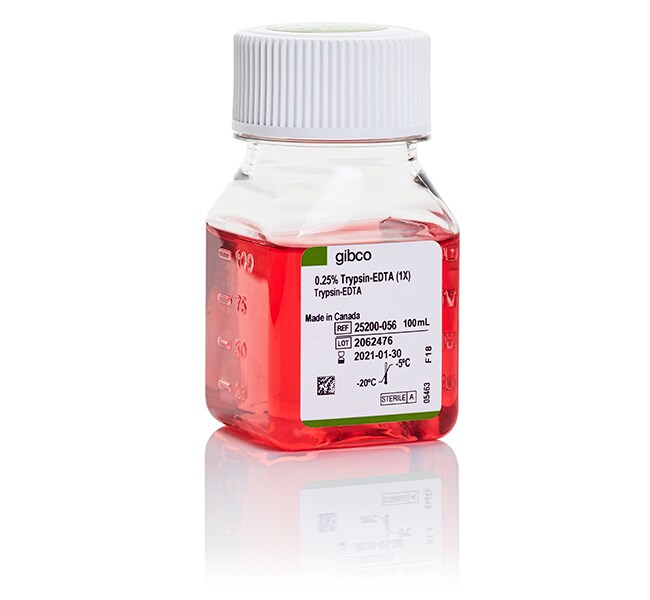
Trypsin-EDTA (0.25%), phenol red
This liquid formulation of trypsin contains EDTA and phenol red. Gibco Trypsin-EDTA is made from trypsin powder, an irradiated mixture深入閱讀
Have Questions?
變更視圖

| 產品號碼 | Quantity |
|---|---|
| 25200056 | 100 mL |
| 25200072 | 500 mL |
| 25200114 | 20 x 100 mL |
產品號碼 25200056
價格 (HKD)
168.00
Each
Quantity:
100 mL
價格 (HKD)
168.00
Each
This liquid formulation of trypsin contains EDTA and phenol red. Gibco Trypsin-EDTA is made from trypsin powder, an irradiated mixture of proteases derived from porcine pancreas. Due to its digestive strength, trypsin is widely used for cell dissociation, routine cell culture passaging, and primary tissue dissociation. The trypsin concentration required for dissociation varies with cell type and experimental requirements. See the complete range of Gibco trypsin solutions and recommended dissociation conditions.
This trypsin solution is modified as follows:
With
• EDTA
• Phenol Red
The complete formulation is available.
We offer a variety of trypsin formulations, including animal origin-free TrypLE reagents.
Quality testing
Gibco Trypsin solutions are tested for pH, osmolality, sterility, and performance. In addition, the raw materials are verified for e-beam irradiation and precursor lots are tested for endotoxin, PPV, PCV 1/2, mycoplasma, bacterial, fungal, and viral contamination, as well as multiple activity assays, ash analysis, and moisture analysis.
Documented traceability
We can provide detailed documentation to meet your regulatory needs. Gibco Trypsin information available includes lot traceability, animal origin certificates, lot analyses, irradiation certificates, a viral inactivation summary, and supply chain transparency.
cGMP manufacturing and quality system
For supply chain continuity, we manufacture Gibco Trypsin-EDTA (0.25%), phenol red at two separate facilities located in Grand Island, NY and Scotland, UK. Both sites are compliant with cGMP manufacturing requirements and are certified to the ISO 13485 standard.
This trypsin solution is modified as follows:
With
• EDTA
• Phenol Red
The complete formulation is available.
We offer a variety of trypsin formulations, including animal origin-free TrypLE reagents.
Quality testing
Gibco Trypsin solutions are tested for pH, osmolality, sterility, and performance. In addition, the raw materials are verified for e-beam irradiation and precursor lots are tested for endotoxin, PPV, PCV 1/2, mycoplasma, bacterial, fungal, and viral contamination, as well as multiple activity assays, ash analysis, and moisture analysis.
Documented traceability
We can provide detailed documentation to meet your regulatory needs. Gibco Trypsin information available includes lot traceability, animal origin certificates, lot analyses, irradiation certificates, a viral inactivation summary, and supply chain transparency.
cGMP manufacturing and quality system
For supply chain continuity, we manufacture Gibco Trypsin-EDTA (0.25%), phenol red at two separate facilities located in Grand Island, NY and Scotland, UK. Both sites are compliant with cGMP manufacturing requirements and are certified to the ISO 13485 standard.
For Research Use or Further Manufacturing. Not for use in diagnostic procedures.
規格
Cell TypeMammalian Cells
ChelatorsEDTA
Concentration1X
Osmolality270 - 320 mOsm/kg
Product LineGibco
Quantity100 mL
Shelf Life24 Months
Shipping ConditionWet Ice
SourceAnimal Origin
Tested ForIn vitro Bioassay
ClassificationAnimal Origin
FormLiquid
Product TypeCell Culture Dissociation Reagent
SterilitySterile-filtered
Sterilization MethodSterile-filtered
With AdditivesPhenol Red, EDTA
pH7.2 to 8
Unit SizeEach
內容物與存放
Storage conditions: -5°C to -20°C
Shipping conditions: Wet ice
Shelf life: 24 months from date of manufacture
Shipping conditions: Wet ice
Shelf life: 24 months from date of manufacture
常見問答集 (常見問題)
What are the storage conditions for the Trypsin-EDTA (0.25%), phenol red (Cat. No. 25200072)?
How long can I keep trypsin in the refrigerator after thawing?
What is the difference between TrypLE Express Enzyme, TrypLE Select Enzyme, and CTS TrypLE Select Enzyme?
What are the benefits of Gibco TrypLE reagent over trypsin?
What reagents do you offer for cell dissociation, and what are the main differences between them?
引用資料與參考文獻 (2)
引用資料與參考文獻
Abstract
Electrophoretic profiling of both RNA and protein from a single 250-pL sample.
Journal:Anal Chem
PubMed ID:11985318
'A novel approach is described that uses capillary electrophoresis (CE) to electrophoretically sample and separate both protein and RNA from a single injected plug of cell lysate. A 250-pL sample of lysate from Chinese hamster ovary cells (9.6 x 10(7) cells/mL) was hydrodynamically injected into a capillary containing a Tris-based
Characterization of the 46-kDa intermediates of matrix metalloproteinase 3 (stromelysin 1) obtained by site-directed mutation of phenylalanine 83.
Journal:J Biol Chem
PubMed ID:8631880
The precursor of matrix metalloproteinase 3 (MMP-3/ stromelysin 1) is activated in vitro by proteinases or mercurial compounds by stepwise processes which include the initial formation of short-lived intermediates and the subsequent intermolecular cleavage of the His82-Phe83 bond to generate the fully activated mature MMP-3 (Nagase, H., Enghild, J. J.,