Search


인용 및 참조 문헌 (171)
Invitrogen™
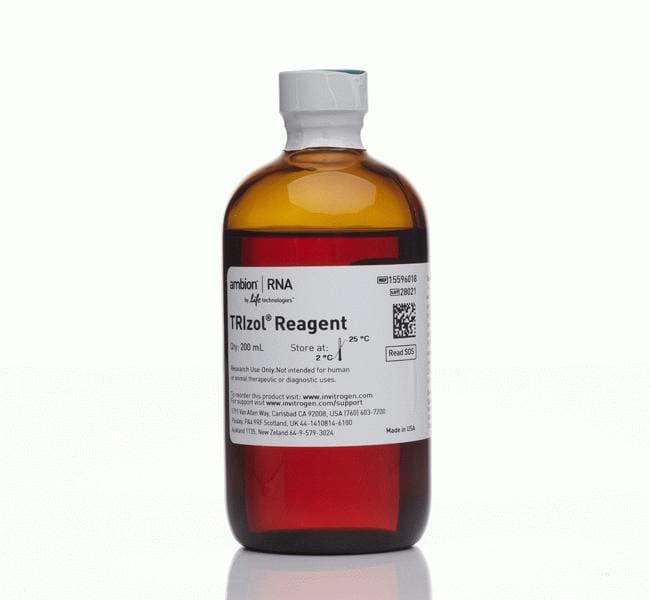
TRIzol™ Reagent
TRIzol™ Reagent is a complete, ready-to-use reagent for the isolation of high-quality total RNA or the simultaneous isolation of RNA, DNA, and protein from a variety of biological samples.
Have Questions?
보기 방식 변경

| 카탈로그 번호 | 수량 |
|---|---|
| 15596018 | 200 mL |
| 15596026 | 100 mL |
카탈로그 번호 15596018
제품 가격(KRW)
514,000
Online offer
Ends: 31-Dec-2026
604,000할인액 90,000
Each
수량:
200 mL
제품 가격(KRW)
514,000
Online offer
Ends: 31-Dec-2026
604,000할인액 90,000
Each
TRIzol™ Reagent is a complete, ready-to-use reagent for the isolation of high-quality total RNA or the simultaneous isolation of RNA, DNA, and protein from a variety of biological samples. This monophasic solution of phenol and guanidine isothiocyanate is designed to isolate separate fractions of RNA, DNA, and proteins from cell and tissue samples of human, animal, plant, yeast, or bacterial origin, within one hour.
TRIzol™ Reagent은 다양한 생물 표본에서 고품질 total RNA 분리 또는 RNA, DNA와 단백질 동시 분리에 사용하는 완전한 ready-to-use 시약입니다. 페놀과 guanidine isothiocyanate가 들어있는 본 단상(monophasic) 솔루션은 인간, 동물, 식물, 효모, 박테리아에서 RNA, DNA, 단백질 fragment 분리가 1시간 내에 이루어지도록 만들어져 있습니다.
• 동일 샘플에서 RNA, DNA, 단백질 분리
• 어려운 샘플 유형에서도 우수한 용해 성능
• 조직, 세포, 혈청, 바이러스, 박테리아에 최적화된 제형과 프로토콜
다양한 샘플 용량과 소스에서 RNA 정제
TRIzol™ Reagent은 소량의 조직(50-100 mg)과 세포 (5 × 10⁶), 대량 조직(≥1 g)과 세포(>107)에 모두 사용할 수 있으며 인간, 동물, 식물, 박테리아 기원 샘플의 정제 프로토콜이 사용됩니다. TRIzol™ Reagent는 샘플 homogenization 단계의 세포 교란 및 세포 성분 분해 중 RNase 활성을 효과적으로 억제하여 RNA 완전성을 유지시킵니다. TRIzol™ Reagent은 사용이 용이하여 여러 샘플을 동시에 처리할 수 있습니다. 전체 절차가 1시간 내에 완료됩니다. TRIzol™ Reagent로 분리한 total RNA은 단백질과 DNA 오염이 없습니다.
다 분자 표적의 분리된 제형
TRIzol™ Reagent는 샘플 하나에서 RNA, DNA, 단백질을 순차적으로 침전시킵니다. TRIzol™ Reagent로 샘플 homogenization을 실시한 후 chloroform을 추가하면 RNA가 함유된 맑은 상층액과 DNA 및 단백질이 들어있는 중간층, 아래 붉은색 유기층으로 분리됩니다. RNA은 상층액에 isopropanol을 넣어 침전시킬 수 있습니다. DNA는 중간층/유기층에 ethanol을 넣어 분리합니다. 단백질은 isopropanol 침전 후 phenol-ethanol 상층액에서 분리합니다. RNA, DNA, 단백질 침전물은 세척하여 불순물을 제거한 후 재현탁하여 그 다음 단계에 사용합니다.
이 제품은 연구용으로만 사용 가능합니다. 치료 또는 진단 목적으로 동물이나 인간에 사용할 수 없습니다.
• 동일 샘플에서 RNA, DNA, 단백질 분리
• 어려운 샘플 유형에서도 우수한 용해 성능
• 조직, 세포, 혈청, 바이러스, 박테리아에 최적화된 제형과 프로토콜
다양한 샘플 용량과 소스에서 RNA 정제
TRIzol™ Reagent은 소량의 조직(50-100 mg)과 세포 (5 × 10⁶), 대량 조직(≥1 g)과 세포(>107)에 모두 사용할 수 있으며 인간, 동물, 식물, 박테리아 기원 샘플의 정제 프로토콜이 사용됩니다. TRIzol™ Reagent는 샘플 homogenization 단계의 세포 교란 및 세포 성분 분해 중 RNase 활성을 효과적으로 억제하여 RNA 완전성을 유지시킵니다. TRIzol™ Reagent은 사용이 용이하여 여러 샘플을 동시에 처리할 수 있습니다. 전체 절차가 1시간 내에 완료됩니다. TRIzol™ Reagent로 분리한 total RNA은 단백질과 DNA 오염이 없습니다.
다 분자 표적의 분리된 제형
TRIzol™ Reagent는 샘플 하나에서 RNA, DNA, 단백질을 순차적으로 침전시킵니다. TRIzol™ Reagent로 샘플 homogenization을 실시한 후 chloroform을 추가하면 RNA가 함유된 맑은 상층액과 DNA 및 단백질이 들어있는 중간층, 아래 붉은색 유기층으로 분리됩니다. RNA은 상층액에 isopropanol을 넣어 침전시킬 수 있습니다. DNA는 중간층/유기층에 ethanol을 넣어 분리합니다. 단백질은 isopropanol 침전 후 phenol-ethanol 상층액에서 분리합니다. RNA, DNA, 단백질 침전물은 세척하여 불순물을 제거한 후 재현탁하여 그 다음 단계에 사용합니다.
이 제품은 연구용으로만 사용 가능합니다. 치료 또는 진단 목적으로 동물이나 인간에 사용할 수 없습니다.
For Research Use Only. Not for use in diagnostic procedures.
사양
용리량20 to 600 μL
최종 제품 유형Total RNA, DNA, Protein
용도(애플리케이션)RT-PCR, qPCR, cDNA library construction, NGS, microarray analysis, blot hybridization, Northern/Southern/Western blotting, in vitro translation, nuclease protection assays, nucleic acid labeling, hybridization, enzymatic assays, immunoprecipitation, gel shift assays, 2D gel electrophoresis
고처리량 호환성Not High-throughput Compatible (Manual)
정제 시간1 hr.
수량200 mL
배송 조건Room Temperature
시작 물질 양Bacteria: ≤107 cells
Cells: ≤107
Plant: ≤107 cells, 100 mg
Tissue: ≤100 mg
Yeast: ≤107 cells
Cells: ≤107
Plant: ≤107 cells, 100 mg
Tissue: ≤100 mg
Yeast: ≤107 cells
수율DNA: ≤7 μg
RNA: ≤73 μg
Protein: varies
RNA: ≤73 μg
Protein: varies
Isolation TechnologyOrganic Extraction
샘플 종류Bacteria, Cells, Plants, Tissue, Yeast
Unit SizeEach
구성 및 보관
200 mL TRIzol Reagent; room temperature
자주 묻는 질문(FAQ)
I'm getting a high A260/A280 ratio for RNA after extraction with TRIzol Reagent. What could be the cause of this?
I'm getting a precipitate at the bottom of the tube following centrifugation after adding chloroform (before isopropanol was added). What could be the cause of this?
During phase separation with TRIzol Reagent, I see a yellowish-brown or pinkish aqueous phase. What is causing this?
I isolated RNA from FFPE tissue and got very poor RNA quality and yield. How can I improve the overall RNA quality and yield?
My sample has a high content of proteoglycans and/or polysaccharides. Are there any modifications that I should make to the TRIzol protocol for RNA isolation?
인용 및 참조 문헌 (171)
인용 및 참조 문헌
Abstract
Recovery of an arenavirus entirely from RNA polymerase I/II-driven cDNA.
Journal:Proceedings of the National Academy of Sciences of the United States of America
PubMed ID:16537369
The prototypic arenavirus lymphocytic choriomeningitis virus has been a primary workhorse of viral immunologists for almost a century, and it has served as an important model for studying basic principles of arenavirus molecular biology. Its negative-stranded bisegmented RNA genome has, however, posed a major obstacle to attempts at manipulating the
Journal:
PubMed ID:16195417
Hyaluronan-CD44-ERK1/2 regulate human aortic smooth muscle cell motility during aging.
Journal:The Journal of biological chemistry
PubMed ID:18077444
ClC-3 is a fundamental molecular component of volume-sensitive outwardly rectifying Cl- channels and volume regulation in HeLa cells and Xenopus laevis oocytes.
Journal:J Biol Chem
PubMed ID:12183454
Volume-sensitive osmolyte and anion channels (VSOACs) are activated upon cell swelling in most vertebrate cells. Native VSOACs are believed to be a major pathway for regulatory volume decrease (RVD) through efflux of chloride and organic osmolytes. ClC-3 has been proposed to encode native VSOACs in Xenopus laevis oocytes and in
A novel single amino acid deletion caspase-8 mutant in cancer cells that lost proapoptotic activity.
Journal:J Biol Chem
PubMed ID:12055196
'Caspase-8 is an important initiation caspase that activates the caspase cascade during death receptor-mediated apoptosis. We here report a novel caspase-8 mutant with a naturally occurring deletion of leucine 62 (Delta Leu62casp-8). Delta Leu62casp-8 has a shorter half-life than its wild-type counterpart. Unlike wild-type caspase-8, Delta Leu62casp-8 failed to interact