Search


인용 및 참조 문헌 (6)
Invitrogen™
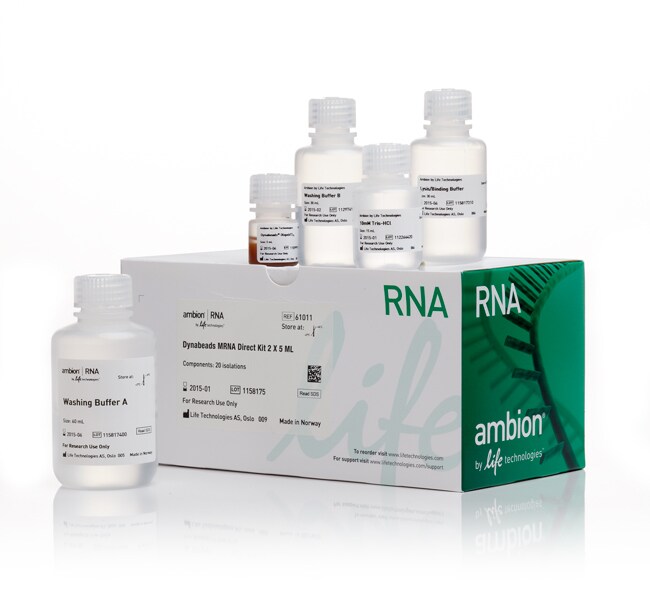
Dynabeads™ mRNA DIRECT™ Purification Kit
The Dynabeads™ mRNA DIRECT™ Kit is designed for simple and rapid isolation of pure, intact polyadenylated (polyA) mRNA directly from the crude lysate of animal and plant cells and tissues.
Have Questions?
보기 방식 변경

| 카탈로그 번호 | 수량 |
|---|---|
| 61012 | 10 mL |
| 61011 | 5 mL |
카탈로그 번호 61012
제품 가격(KRW)
1,942,000
Online offer
Ends: 30-Sep-2026
2,157,000할인액 215,000 (10%)
Each
수량:
10 mL
제품 가격(KRW)
1,942,000
Online offer
Ends: 30-Sep-2026
2,157,000할인액 215,000 (10%)
Each
15분 내에 완전한 mRNA Transcriptome 분리. 이 mRNA 분리 키트는 실제로 모든 미가공 샘플에서 mRNA 분자를 특정적으로 표적해 포획하고 핵산을 담은 원하는 정보가 mRNA인 경우 total RNA를 정제할 필요가 없습니다. 세포 total RNA의 mRNA 함량이 단 ∼1-5%인데, 왜 total RNA 성분의 일부인 mRNA에서 total RNA를 분리합니까? total RNA 정제에 대해 고안된 다른 기술은 최대 80%의 ribosomal RNA를 얻어내고 mRNA가 ribosomal RNA, transfer RNA, micro RNA, small nucleolar RNA, small cytoplasmic RNA와 경쟁하여 막 결합을 하게 합니다.
Dynabeads™ mRNA DIRECT™ Kit에서 mRNA 정제 비드는 다양한 미가공 시작 샘플에서 mRNA transcriptome를 특정적으로 표적해 포획합니다. Ribosomal RNA, DNA, 단백질, 작은 RNA 분자 (transfer RNA, micro RNA, small nucleolar RNA 등)은 비드에 결합하지 않고 폐기됩니다. polyadenylated RNA species (mRNA) 만 포획됩니다. 분리된 mRNA는 순수하여 ribosomal RNA 제거나 추출 후 DNase 처리가 필요하지 않습니다.
Lysis/Binding buffer에 있는 RNase 억제제와 엄격한 hybridization, 세척 단계로 이 mRNA 분리를 통해 RNA 분해 효소가 많은 샘플에서도 손상없는 mRNA를 얻을 수 있게 합니다. 신중한 버퍼 제형으로 강력한 chaotropic 제제를 사용하지 않아도 RNA 변성을 방지할 수 있습니다.
매우 다양한 샘플 유형에 사용 가능:
mRNA는 다음과 같은 모든 분자 어플리케이션에 이용하기 적합합니다.
cDNA 라이브러리 수립 전 이상적인 mRNA 정제법
다목적 elution 옵션:
- 15분 절차로 순수하고 완전한 mRNA 확보
- 매우 순수한 mRNA 분리, cDNA 합성을 진행하기 위한 최고의 선택
- 특별히 민감한 mRNA 분리로 매우 적은 양의 시작 샘플에서 cDNA 합성과 cDNA 라이브러리 수립이 가능합니다. (세포 하나로 cDNA 라이브러리 수립 가능.)
Dynabeads™ mRNA DIRECT™ Kit에서 mRNA 정제 비드는 다양한 미가공 시작 샘플에서 mRNA transcriptome를 특정적으로 표적해 포획합니다. Ribosomal RNA, DNA, 단백질, 작은 RNA 분자 (transfer RNA, micro RNA, small nucleolar RNA 등)은 비드에 결합하지 않고 폐기됩니다. polyadenylated RNA species (mRNA) 만 포획됩니다. 분리된 mRNA는 순수하여 ribosomal RNA 제거나 추출 후 DNase 처리가 필요하지 않습니다.
Lysis/Binding buffer에 있는 RNase 억제제와 엄격한 hybridization, 세척 단계로 이 mRNA 분리를 통해 RNA 분해 효소가 많은 샘플에서도 손상없는 mRNA를 얻을 수 있게 합니다. 신중한 버퍼 제형으로 강력한 chaotropic 제제를 사용하지 않아도 RNA 변성을 방지할 수 있습니다.
매우 다양한 샘플 유형에 사용 가능:
- 총 RNA 정제 준비
- 혈액, 혈청, 혈장, 객담
- 세포, 혈청, 혈장에서 살아있는 poly A+ RNA
- 포유류, 양서류, 어류, 곤충 조직: 뇌, 폐, 간, 소화관, 심장, 신장, 뇌하수체, 췌장, 난소, 근육, 시상하부, 난자, 전체 곤충 등...
- 식물 조직: 전체 식물, 싹, 공변세포(단일세포), 배, 꽃, 잎, 밑씨, 뿌리, 씨(aleurone, endosperm), 암술 등....
- 포르말린 고정 파라핀 포매 조직
- 효모(Sacchromyces cerevisiae)
- 미분화 핵산 샘플(DNA + 총 RNA)
mRNA는 다음과 같은 모든 분자 어플리케이션에 이용하기 적합합니다.
- 유전자 클로닝
- cDNA 합성, cDNA 라이브러리 수립
- RT-PCR, 정량 RT-PCR
- RPA - Ribonuclease Protection Assay
- Subtractive Hybridization
- Primer extension, SAGE, RACE, 등...
- 이동 자석 비드에서 물리적으로 mRNA 포획
- 신속하고 강하지 않은 자기 취급 절차
- 고 g-force spin에도 mRNA 손실 없음
- elution 중 컬럼 막에 포획되는 mRNA 없음
cDNA 라이브러리 수립 전 이상적인 mRNA 정제법
- transcriptome 최고의 수율과 함량 보장
- mRNA 분리 전 total RNA 분리 단계를 거치는 방법보다 많은 transcriptome 포획
다목적 elution 옵션:
- 5μl 이상의 모든 용량에서 elution
- mRNA elution은 선택적입니다.:
– Dynabeads
으로 다음 절차의 효소 반응이 억제되지 않습니다. – 비드에서 직접 cDNA 합성을 실시하여 재사용가능한 고형상 cDNA 라이브러리를 생성합니다.
For Research Use Only. Not for use in diagnostic procedures.
사양
용리량10 to 100 μL
최종 제품 유형mRNA
용도(애플리케이션)RT-PCR, qPCR, cDNA library construction, microarray analysis
용도(장비)Automated Liquid Handling Systems
고처리량 호환성High-throughput Compatible
수량10 mL
배송 조건Room Temperature
시작 물질 양Cells: ≤106
Plant: ≤400 mg
Tissue: ≤200 mg
Plant: ≤400 mg
Tissue: ≤200 mg
수율2 μg mRNA per 200 μL of beads (Binding capacity)
Isolation TechnologyMagnetic Bead
샘플 종류Cells, Plants, Plasma, Serum, Tissue, Total RNA, Blood
Unit SizeEach
구성 및 보관
• 10 mL Dynabeads Oligo (dt)25, 4°C
• 60 mL Lysis/Binding Buffer; 4°C
• 120 mL Washing Buffer A; 4°C
• 60 mL Washing Buffer B; 4°C
• 15 mL 10 mM Tris-HCl; 4°C
자주 묻는 질문(FAQ)
I am getting DNA contamination after mRNA isolation using Dynabeads magnetic beads. Why is this?
My Dynabeads magnetic beads are not pelleting well with the magnet. Do you have any suggestions for me?
I have a long double-stranded DNA fragment I would like to isolate. What product do you recommend?
Can I use Dynabeads magnetic beads to isolate single-stranded DNA templates?
What is the magnetic susceptibility for Dynabeads magnetic beads?
인용 및 참조 문헌 (6)
인용 및 참조 문헌
Abstract
Extracellular plasma RNA from colon cancer patients is confined in a vesicle-like structure and is mRNA-enriched.
Journal:RNA
PubMed ID:18456845
'Little is yet known about the origin and protective mechanism of free nucleic acids in plasma. We investigated the possibility of these free nucleic acids being particle associated. Plasma samples from colon cancer patients and cell culture media were subjected to various antibody incubations, ultracentrifugation, and RNA extraction protocols for
Relationships and differentially expressed genes among pancreatic cancers examined by large-scale serial analysis of gene expression.
Journal:Cancer Res
PubMed ID:11830538
'Pancreatic adenocarcinoma is among the most fatal of cancers, in part because of late diagnosis and a lack of effective therapies. Comprehensive studies are needed to better understand and address the cellular mechanisms and pathways of tumorigenesis. Serial analysis of gene expression was used to analyze gene expression profiles of
Stem cell and epithelial-mesenchymal transition markers are frequently overexpressed in circulating tumor cells of metastatic breast cancer patients.
Journal:Breast Cancer Res
PubMed ID:19589136
The persistence of circulating tumor cells (CTC) in breast cancer patients might be associated with stem cell like tumor cells which have been suggested to be the active source of metastatic spread in primary tumors. Furthermore, these cells also may undergo phenotypic changes, known as epithelial-mesenchymal transition (EMT), which allows
The transcription factors SOX9 and SOX10 are vitiligo autoantigens in autoimmune polyendocrine syndrome type I.
Journal:J Biol Chem
PubMed ID:11423552
Vitiligo is common in the hereditary disorder autoimmune polyendocrine syndrome type I (APS I). Patients with APS I are known to have high titer autoantibodies directed against various tissue-specific antigens. Using sera from APS I patients for immunoscreening of a cDNA library from human scalp, we identified the transcription factors
Disease-associated mutations in human mannose-binding lectin compromise oligomerization and activity of the final protein.
Journal:J Biol Chem
PubMed ID:14764589
Deficiency of human mannose-binding lectin (MBL) caused by mutations in the coding part of the MBL2 gene is associated with increased risk and severity of infections and autoimmunity. To study the biological consequences of MBL mutations, we expressed wild type MBL and mutated MBL in Chinese hamster ovary cells. The