Search

Gibco™
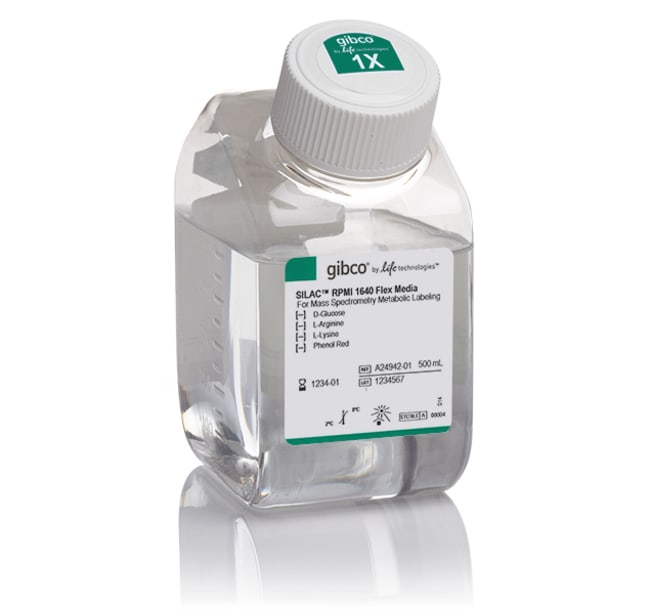
SILAC RPMI 1640 Flex Media, no glucose, no phenol red
SILAC RPMI 1640 Medium is RPMI 1640 basal cell culture medium without L-arginine, L-glutamine, and L-lysine for use during SILAC자세히 알아보기
| 카탈로그 번호 | 수량 |
|---|---|
| A2494201 | 500 mL |
카탈로그 번호 A2494201
제품 가격(KRW)
124,000
Online offer
Ends: 31-Dec-2026
141,000할인액 17,000 (12%)
Each
수량:
500 mL
제품 가격(KRW)
124,000
Online offer
Ends: 31-Dec-2026
141,000할인액 17,000 (12%)
Each
SILAC RPMI 1640 Medium is RPMI 1640 basal cell culture medium without L-arginine, L-glutamine, and L-lysine for use during SILAC protein labeling with stable isotope-labeled lysine and/or arginine. RPMI 1640 Medium is widely used for supporting the growth of many different mammalian cells. Cells successfully cultured in RPMI-1640 include HeLa, Jurkat, MCF-7, PC12, PBMC, astrocytes, and carcinomas. We offer a variety of Gibco™ RPMI 1640 modifications for a range of applications. Find the right modification using the media selector tool.
RPMI 1640 Medium is unique from other media because it contains the reducing agent glutathione and high concentrations of vitamins. RPMI 1640 Medium contains biotin, vitamin B12, and PABA, which are not found in Eagle's Minimal Essential Medium or Dulbecco's Modified Eagle Medium. In addition, the vitamins inositol and choline are present in very high concentrations. RPMI 1640 Medium contains no proteins, lipids, or growth factors. Therefore, RPMI 1640 Medium requires supplementation, commonly with 10% Fetal Bovine Serum (FBS). SILAC protein labeling experiments should be conducted using Gibco™ Dialyzed FBS. RPMI 1640 Medium uses a sodium bicarbonate buffer system (2.0 g/L), and therefore requires a 5-10% CO2 environment to maintain physiological pH.
cGMP Manufacturing and Quality System
SILAC RPMI 1640 Medium is manufactured at a cGMP-compliant facility located in Grand Island, New York. The facility is registered with the FDA as a medical device manufacturer and is certified to ISO 13485 standards.
This RPMI 1640 Medium is modified as follows:
| With | Without |
| • Glucose | |
| • Phenol red | |
| • HEPES | |
| • L-arginine | |
| • L-glutamine | |
| • L-lysine |
RPMI 1640 Medium is unique from other media because it contains the reducing agent glutathione and high concentrations of vitamins. RPMI 1640 Medium contains biotin, vitamin B12, and PABA, which are not found in Eagle's Minimal Essential Medium or Dulbecco's Modified Eagle Medium. In addition, the vitamins inositol and choline are present in very high concentrations. RPMI 1640 Medium contains no proteins, lipids, or growth factors. Therefore, RPMI 1640 Medium requires supplementation, commonly with 10% Fetal Bovine Serum (FBS). SILAC protein labeling experiments should be conducted using Gibco™ Dialyzed FBS. RPMI 1640 Medium uses a sodium bicarbonate buffer system (2.0 g/L), and therefore requires a 5-10% CO2 environment to maintain physiological pH.
cGMP Manufacturing and Quality System
SILAC RPMI 1640 Medium is manufactured at a cGMP-compliant facility located in Grand Island, New York. The facility is registered with the FDA as a medical device manufacturer and is certified to ISO 13485 standards.
For Research Use or Further Manufacturing. Not for use in diagnostic procedures.
사양
세포 유형Mammalian Cells
제품라인Gibco
제품 유형RPMI 1640
수량500 mL
유통 기한12 Months
Culture TypeMammalian Cell Culture
형태Liquid
Serum LevelStandard Serum Supplementation
첨가제 없음No Glucose, No Glutamine, No HEPES, No Phenol Red, No Sodium Pyruvate, No Arginine, No Lysine
Unit SizeEach
구성 및 보관
Store in refrigerator (2–8°C) and protect from light.
Shelf life: 12 months from date of manufacture.
Shelf life: 12 months from date of manufacture.