Search


인용 및 참조 문헌 (18)
Invitrogen™
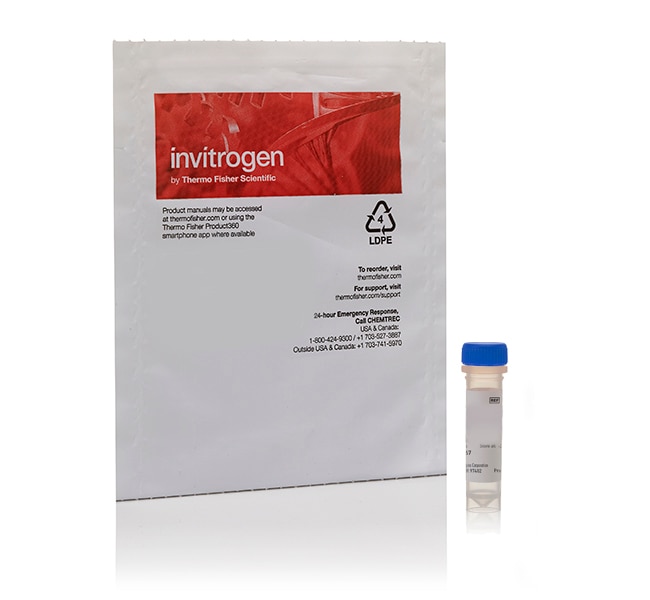
Isolectin GS-IB4 From Griffonia simplicifolia, Alexa Fluor™ 594 Conjugate
Isolectin GS-IB4 is a 114,000-dalton glycoprotein that is part of a family of five tetrameric type I isolectins (IA4, IA3B,자세히 알아보기
| 카탈로그 번호 | 수량 |
|---|---|
| I21413 | 500 μg |
카탈로그 번호 I21413
제품 가격(KRW)
735,000
Online offer
Ends: 31-Dec-2026
816,000할인액 81,000 (10%)
Each
수량:
500 μg
제품 가격(KRW)
735,000
Online offer
Ends: 31-Dec-2026
816,000할인액 81,000 (10%)
Each
Isolectin GS-IB4 is a 114,000-dalton glycoprotein that is part of a family of five tetrameric type I isolectins (IA4, IA3B, IA2B2, IAB3, and IB4) isolated from the seeds of the tropical African legume Griffonia simplicifolia. The A subunit prefers N-acetyl-D-galactosamine end groups while the B subunit is selective for terminal a-D-galactosyl residues. The red fluorescent Alexa Fluor™ 594 isolectin GS-IB4 conjugate can be used in fluorescence microscopy.
View complete list of fluorescent dye-conjugated lectins ›
View complete list of fluorescent dye-conjugated lectins ›
For Research Use Only. Not for use in diagnostic procedures.
사양
라벨 유형Alexa Fluor Dyes
제품라인Alexa Fluor
단백질 아형Lectins
수량500 μg
배송 조건Room Temperature
소스Africa Shrub legume
콘주게이트Alexa Fluor 594
형태Lyophilized
Unit SizeEach
구성 및 보관
Store in freezer (-5 to -30°C) and protect from light.
자주 묻는 질문(FAQ)
How do I know which tracer to choose for my experiment?
인용 및 참조 문헌 (18)
인용 및 참조 문헌
Abstract
Insulin-like growth factor 2 and potential regulators of hemangioma growth and involution identified by large-scale expression analysis.
Journal:Proc Natl Acad Sci U S A
PubMed ID:12032304
'Hemangiomas are benign tumors of the vascular endothelium and are the most common tumors of infancy. These tumors are characterized by an initial phase of rapid proliferation, which is followed, in most cases, by spontaneous involution. Although most lesions resolve without complication, there are some cases in which hemangiomas can
Cell fusion-independent differentiation of neural stem cells to the endothelial lineage.
Journal:Nature
PubMed ID:15254537
'Somatic stem cells have been claimed to possess an unexpectedly broad differentiation potential (referred to here as plasticity) that could be induced by exposing stem cells to the extracellular developmental signals of other lineages in mixed-cell cultures. Recently, this and other experimental evidence supporting the existence of stem-cell plasticity have
Effects of familial hemiplegic migraine type 1 mutation T666M on voltage-gated calcium channel activities in trigeminal ganglion neurons.
Journal:J Neurophysiol
PubMed ID:22190617
'Familial hemiplegic migraine type 1 (FHM-1), a rare hereditary form of migraine with aura and hemiparesis, serves as a good model for exploring migraine pathophysiology. The FHM-1 gene encodes the pore-forming Ca(V)2.1 subunit of human P/Q-type voltage-gated Ca(2+) channels (VGCCs). Some FHM-1 mutations result in a decrease of whole cell
CXCL16 orchestrates adenosine A3 receptor and MCP-1/CCL2 activity to protect neurons from excitotoxic cell death in the CNS.
Journal:J Neurosci
PubMed ID:22378888
A role for chemokines as molecules mediating neuron-glia cross talk has emerged in recent years, both in physiological and pathological conditions. We demonstrate here for the first time that the chemokine CXCL16 and its unique receptor CXCR6 are functionally expressed in the CNS, and induce neuroprotection against excitotoxic damage due
Microglial cells in astroglial cultures: a cautionary note.
Journal:J Neuroinflammation
PubMed ID:17937799
Primary rodent astroglial-enriched cultures are the most popular model to study astroglial biology in vitro. From the original methods described in the 1970's a great number of minor modifications have been incorporated into these protocols by different laboratories. These protocols result in cultures in which the astrocyte is the predominant