Search



Citations & References (2)
Invitrogen™
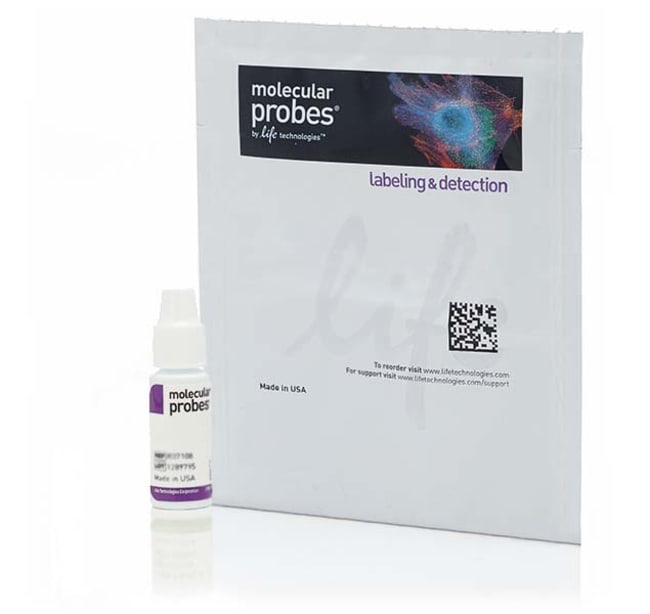
ProLong™ Gold Antifade Mountant with DNA Stain DAPI
ProLong Gold Antifade Mountant with DNA Stain DAPI come mixed and ready-to-use to make counterstaining more convenient and consistent while protecting fluorescently stained samples.
Have Questions?
Change view

| Catalog Number | Quantity |
|---|---|
| P36941 | 1 x 2 mL |
| P36935 | 5 x 2 mL |
| P36931 | 1 x 10 mL |
Catalog number P36941
Price (MXN)
2,331.64
Each
Quantity:
1 x 2 mL
Price (MXN)
2,331.64
Each
ProLong Gold Antifade Mountant with DNA Stain DAPI is a mounting media that can be directly applied to fluorescently labeled cell or tissue samples on microscope slides. It comes ready-to-use and stored at room temperature—just apply a drop, add a coverslip, cure, and image. ProLong Gold Antifade Mountants come in a 2-mL dropper bottle or 10-mL bottle. It is formulated with the blue DNA stain DAPI to make your nuclear counterstaining more convenient and consistent when preparing your samples for imaging.
ProLong Gold Antifade Mountant with DNA Stain DAPI contains chemical components designed to protect fluorescent dyes from fading (photobleaching) during fluorescence microscopy experiments. It is a curing mounting media that forms an optical path of 1.47 RI and allows longer-term storage of the sample.
Many mountants can quench initial fluorescence signal strength by up to 80%. ProLong Gold Antifade Mountant was developed to minimize this initial signal quenching for the broadest range of colors and dyes and is formulated with the DAPI DNA nuclear stain to simplify your experiments. DAPI stain is excited by UV light at 360 nm when bound to DNA, with an emission maximum at 460 nm, and is detected using a DAPI traditional filter.
ProLong Gold Antifade Mountant is not recommended for mounting samples containing fluorescent proteins such as GFP or TagRFP but can be used with Alexa Fluor dyes of your choice. For superior antifade protection of fluorescent proteins and fluorescent dyes, ProLong Diamond or ProLong Glass Antifade Mountants are recommended. ProLong Glass mountants are recommended for all immersion oil imaging applications. For immediate viewing of a sample, choose our non-curing mountant, SlowFade Gold Antifade Mountant with DAPI.
For Research Use Only. Not for use in diagnostic procedures.
Specifications
Quantity1 x 2 mL
Product LineProLong
Product TypeAntifade Mountant
Reagent TypeMounting Solution, Antifade Solution
Volume (Metric)2 mL
Unit SizeEach
Contents & Storage
Store at room temperature.
Frequently asked questions (FAQs)
What do ProLong Gold, ProLong Diamond and ProLong Glass antifade mountant reagents contain?
Can I use ProLong Gold, ProLong Diamond, or ProLong Glass mounting medium in a multi-well plate?
What can affect sample curing of ProLong Gold-, ProLong Diamond-, and ProLong Glass-mounted samples?
Are ProLong, ProLong Gold, ProLong Diamond, and ProLong Glass reagents compatible with DyLight dye-conjugated antibodies and streptavidin and with other organic dyes?
Can I use any of the ProLong, ProLong Gold, ProLong Diamond, or ProLong Glass reagents on live samples?
Citations & References (2)
Citations & References
Abstract
Inhibitors of intravesicular acidification protect against Shiga toxin in a pH-independent manner.
Journal:Traffic
PubMed ID:22132807
Shiga toxin inhibits protein synthesis after being transported from the cell surface to endosomes and retrogradely through the Golgi apparatus to the endoplasmic reticulum (ER) and into the cytosol. In this study, we have abolished proton gradients across internal membranes in different ways and investigated the effect on the various
Dynamin-related protein 1 (Drp1)-mediated diastolic dysfunction in myocardial ischemia-reperfusion injury: therapeutic benefits of Drp1 inhibition to reduce mitochondrial fission.
Journal:
PubMed ID:24076965
Mitochondrial fission, regulated by dynamin-related protein-1 (Drp1), is a newly recognized determinant of mitochondrial function, but its contribution to left ventricular (LV) impairment following ischemia-reperfusion (IR) injury is unknown. We report that Drp1 activation during IR results in LV dysfunction and that Drp1 inhibition is beneficial. In both isolated neonatal