Search


Citas y referencias (10)
Invitrogen™
Estándar de ADN de 50 bp
La escalera de ADN de 50 bp Invitrogen está diseñada para la medición y cuantificación aproximada de ADN bicatenario enMás información
| Número de catálogo | Cantidad |
|---|---|
| 10416014 | 50 μg |
Número de catálogo 10416014
Precio (MXN)
-
Cantidad:
50 μg
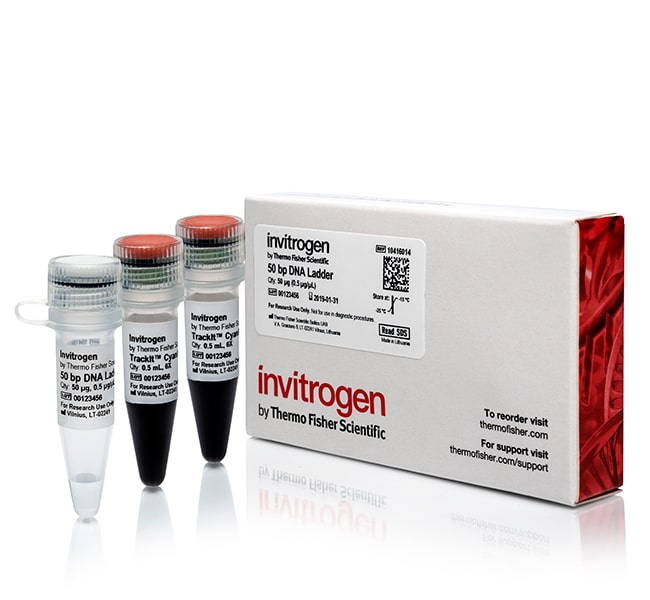
La escalera de ADN de 50 bp Invitrogen está diseñada para la medición y cuantificación aproximada de ADN bicatenario en un intervalo de 50 bp a 2500 bp. La escalera de ADN de 50 bp consta de 17 fragmentos de ADN individuales purificados mediante cromatografía con bandas de referencia en 2500, 800 y 350 bp para una orientación cómoda.
La escalera de ADN de 50 bp es ideal para la separación en geles de agarosa al 2 %.
Características destacadas de la escalera de ADN de 50 bp:
• Bandas nítidas y claras: fragmentos purificados mediante cromatografía para ofrecer resultados uniformes y fiables
• Cómoda: se suministra con tampón de carga de gel 6X Tracklt Cyan/Orange para el seguimiento de la migración del ADN
• Precisa: una cantidad exacta de ADN en cada banda
Uso del producto
La escalera de ADN bicatenario se puede visualizar en geles de agarosa al 2 % tras la tinción con bromuro de etidio o SYBR Safe. La escalera está diseñada con una intensidad uniforme de bandas de ADN para una visión clara de cada banda. Una cantidad exacta de ADN en cada banda permite la cuantificación aproximada de las muestras de ADN.
Esta escalera puede marcarse radiactivamente con polinucleótido quinasa T4 o ADN polimerasa T4.
La escalera de ADN de 50 bp es ideal para la separación en geles de agarosa al 2 %.
Características destacadas de la escalera de ADN de 50 bp:
• Bandas nítidas y claras: fragmentos purificados mediante cromatografía para ofrecer resultados uniformes y fiables
• Cómoda: se suministra con tampón de carga de gel 6X Tracklt Cyan/Orange para el seguimiento de la migración del ADN
• Precisa: una cantidad exacta de ADN en cada banda
Uso del producto
La escalera de ADN bicatenario se puede visualizar en geles de agarosa al 2 % tras la tinción con bromuro de etidio o SYBR Safe. La escalera está diseñada con una intensidad uniforme de bandas de ADN para una visión clara de cada banda. Una cantidad exacta de ADN en cada banda permite la cuantificación aproximada de las muestras de ADN.
Esta escalera puede marcarse radiactivamente con polinucleótido quinasa T4 o ADN polimerasa T4.
Para uso exclusivo en investigación. No apto para uso en procedimientos diagnósticos.
Especificaciones
Concentración0,5 μg/μL
Compatibilidad del gelGel de agarosa
N.º de reacciones100 aplicaciones
Cantidad50 μg
Listo para cargarNo
Volumen de carga de muestras1 ml
Condiciones de envíoAprobado para su envío a temperatura ambiente o en hielo seco
TecnologíaFragmentos de ADN purificados por cromatografía individual
Volumen (métrico)100 µl
Tipo de gelAgarosa
Tipo de productoMarcador de peso molecular
Intervalo de tamaños50 bp - 2500 bp
Unit SizeEach
Contenido y almacenamiento
• 100 µl 50 pb DNA Ladder
• 1 ml 6X trackIT Cian/Orange Loading Buffer
almacenar en -20° C.
• 1 ml 6X trackIT Cian/Orange Loading Buffer
almacenar en -20° C.
Preguntas frecuentes
Can I know the sequences of Invitrogen DNA ladders?
Are Invitrogen DNA ladders composed of linear or circular/supercoiled DNA?
Are Invitrogen DNA ladders composed of single-stranded or double-stranded DNA fragments?
I'm seeing anomalous migration of my DNA ladder. What happened?
What is the difference between the TrackIt DNA Ladders and other DNA ladders?
Citations & References (10)
Citations & References
Abstract
ChIP-Seq using high-throughput DNA sequencing for genome-wide identification of transcription factor binding sites.
Journal:Methods Enzymol
PubMed ID:20946807
'Much of eukaryotic gene regulation is mediated by binding of transcription factors near or within their target genes. Transcription factor binding sites (TFBS) are often identified globally using chromatin immunoprecipitation (ChIP) in which specific protein-DNA interactions are isolated using an antibody against the factor of interest. Coupling ChIP with high-throughput
Post intrastromal corneal ring segments insertion complicated by Candida parapsilosis keratitis.
Journal:Clin Ophthalmol
PubMed ID:23467516
'This case report describes the clinical and histopathologic features, including molecular confirmation, of fungal keratitis after intrastromal corneal ring segments placement for keratoconus. A 52-year-old woman underwent insertion of Intacs(®) corneal implants for treatment of keratoconus. Extrusion of the implants was noted 5 months post insertion and replaced. Three months
Development of PCR-RFLP assay for the discrimination of Plasmodium species and variants of P. vivax (VK210, VK247 and P. vivax-like) in Anopheles mosquitoes.
Journal:Acta Trop
PubMed ID:21420375
'The identification of Plasmodium species in Anopheles mosquitoes is an integral component of malaria control programs. We developed a new assay to identify Plasmodium falciparum, Plasmodium malariae, and Plasmodium vivax variants. Specific primers were designed to hybridize to CS gene-specific regions. Polymerase chain reaction (PCR) and restriction fragment length polymorphism
Report of an international collaborative study to evaluate the suitability of multiplex PCR as an identity assay for different sub-strains of BCG vaccine.
Journal:Vaccine
PubMed ID:20732463
'Current methods for the identification of BCG vaccine in quality control settings involve acid-fast staining with microscopic examination. However, this method is unable to distinguish the many different sub-strains of BCG, or to differentiate BCG strains from virulent members of the Mycobacterium tuberculosis complex. A multiplex PCR (mPCR) which uses
Identification of novel mutation in cathepsin C gene causing Papillon-Lefèvre Syndrome in Mexican patients.
Journal:BMC Med Genet
PubMed ID:23311634
Papillon-Lefèvre Syndrome (PLS) is a type IV genodermatosis caused by mutations in cathepsin C (CTSC), with a worldwide prevalence of 1-4 cases per million in the general population. In México, the prevalence of this syndrome is unknown, and there are few case reports. The diagnosis of twenty patients in the