Search


Citas y referencias (75)
Invitrogen™
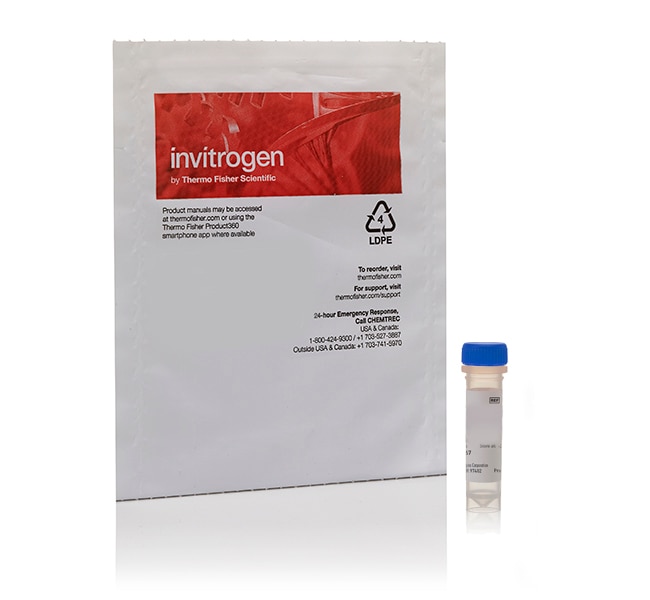
Ionomicina, sal de calcio
La ionomicina es un ionóforo efectivo de Ca2+ que se utiliza comunmente para modificar las concentraciones intracelulares de Ca2+ yMás información
| Número de catálogo | Cantidad |
|---|---|
| I24222 | 1 mg |
Número de catálogo I24222
Precio (MXN)
-
Cantidad:
1 mg
La ionomicina es un ionóforo efectivo de Ca2+ que se utiliza comunmente para modificar las concentraciones intracelulares de Ca2+ y para calibrar indicadores fluorescentes de Ca2+ cuando se estudian las propiedades reguladoras de Ca2+ en procesos celulares. La ionomicina también transporta Pb2+ y algunos otros cationes divalentes, así como varios cationes trivalentes de la serie de lantanida, con eficiencias mayores o iguales a las de Ca2+.
Obtenga más información sobre los indicadores de iones, incluidos el calcio, el potasio, el pH y los indicadores de potencial de membrana ›
Obtenga más información sobre los indicadores de iones, incluidos el calcio, el potasio, el pH y los indicadores de potencial de membrana ›
Para uso exclusivo en investigación. No apto para uso en procedimientos diagnósticos.
Especificaciones
IndicadorIonóforo
Fórmula molecularC41H70CaO9
Peso molecular747.08
Cantidad1 mg
Almacenamiento recomendadoAlmacenar en congelador (de -5 °C a -30 °C)
Condiciones de envíoTemperatura ambiente
Forma físicaSólido
Tipo de productoSal de calcio
Unit SizeEach
Citations & References (75)
Citations & References
Abstract
Histamine regulates cytokine production in maturing dendritic cells, resulting in altered T cell polarization.
Journal:J Clin Invest
PubMed ID:11748270
'Atopic diseases such as allergy and asthma are characterized by increases in Th2 cells and serum IgE antibodies. The binding of allergens to IgE on mast cells triggers the release of several mediators, of which histamine is the most prevalent. Here we show that histamine, together with a maturation signal,
Recombinant expression of the plasma membrane Na(+)/Ca(2+) exchanger affects local and global Ca(2+) homeostasis in Chinese hamster ovary cells.
Journal:J Biol Chem
PubMed ID:12145298
'The cardiac type Na(+)/Ca(2+) exchanger (NCX1) has been transiently expressed in Chinese hamster ovary cells, which do not contain an endogenous exchanger, together with aequorin chimeras that are targeted to different intracellular compartments to investigate intracellular Ca(2+) homeostasis. The expression of NCX decreased the endoplasmic reticulum Ca(2+) concentration, [Ca(2+)](er), in
Signaling alterations in activation-induced nonresponsive CD8 T cells.
Journal:J Immunol
PubMed ID:11489986
'Costimulation-dependent production and autocrine use of IL-2 by activated CD8 T cells results in initial clonal expansion, but this is transient. The cells quickly become anergic, unable to produce IL-2 in response to Ag and costimulation, irrespective of the form of costimulation. This activation-induced non-responsiveness (AINR) differs from "classical" anergy
Phosphatidylinositol 3-kinase-dependent extracellular calcium influx is essential for CX(3)CR1-mediated activation of the mitogen-activated protein kinase cascade.
Journal:J Biol Chem
PubMed ID:11432847
'Fractalkine, the first member of the CX(3)C chemokine family, induces leukocyte chemotaxis through activation of its high affinity receptor, CX(3)CR1. Like other chemokine receptors, CX(3)CR1 is coupled to a pertussis toxin-sensitive heterotrimeric G(i) protein, which is necessary for rapid rise in the concentration of intracellular calcium. Using a Chinese hamster
Differences in regulation between nuclear and cytoplasmic Ca2+ in cultured smooth muscle cells.
Journal:Am J Physiol
PubMed ID:1386189
'The free Ca2+ concentrations in the nucleus ([Ca2+]n) and cytoplasm ([Ca2+]c) of cultured smooth muscle cells were estimated using the fluorescent dye indo-1 and the ACAS 570 confocal laser microscope. In resting DDT1MF2 smooth muscle cells [Ca2+]n was found to be lower than [Ca2+]c. Both values increased transiently in response