Search


Citas y referencias (7)
Invitrogen™
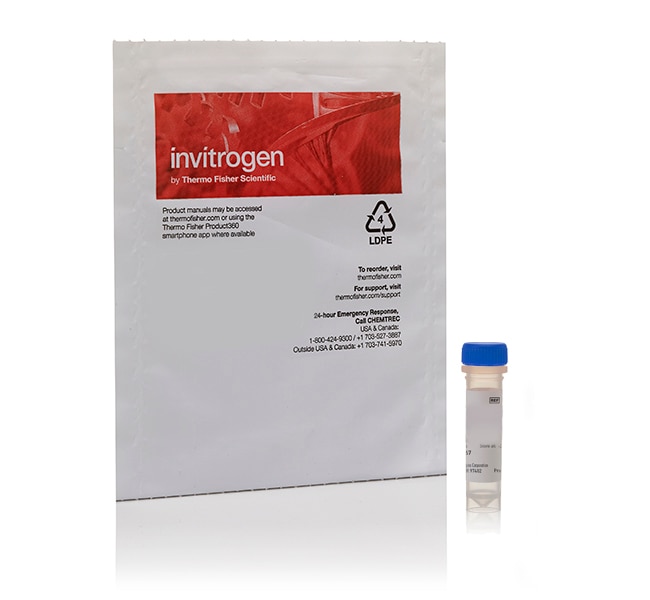
SNARF™-4F 5-(and-6)-Carboxylic Acid
El indicador de pH radiométrico impenetrable en las células SNARF™-4F 5-(y-6)-ácido carboxílico (pKa de ∼6,4) muestra un cambio significativo deMás información
| Número de catálogo | Cantidad |
|---|---|
| S23920 | 1 mg |
Número de catálogo S23920
Precio (MXN)
-
Cantidad:
1 mg
El indicador de pH radiométrico impenetrable en las células SNARF™-4F 5-(y-6)-ácido carboxílico (pKa de ∼6,4) muestra un cambio significativo de emisión dependiente del pH de la fluorescencia amarillo-naranja a la fluorescencia roja profunda en condiciones ácidas y básicas, respectivamente. Esta dependencia del pH permite utilizar la relación de las intensidades de fluorescencia del colorante en dos longitudes de onda de emisión, normalmente 580 nm y 640 nm, para las determinaciones cuantitativas del pH
Obtenga más información sobre los indicadores de iones, incluidos los indicadores de calcio, potasio, pH y potencial de la membrana ›
Obtenga más información sobre los indicadores de iones, incluidos los indicadores de calcio, potasio, pH y potencial de la membrana ›
Para uso exclusivo en investigación. No apto para uso en procedimientos diagnósticos.
Especificaciones
Método de detecciónFluorescente
Tipo de coloranteA base de colorantes fluorescentes
IndicadorIndicador de pH
Cantidad1 mg
Condiciones de envíoTemperatura ambiente
Para utilizar con (equipo)Microscopio de fluorescencia, Citómetro de flujo, Lector de microplacas
Línea de productosSNARF
Tipo de productoIndicador de pH
Unit SizeEach
Contenido y almacenamiento
Almacenar a temperatura ambiente y proteger de la luz.
Citations & References (7)
Citations & References
Abstract
Application of a pH-sensitive fluoroprobe (C-SNARF-4) for pH microenvironment analysis in Pseudomonas aeruginosa biofilms.
Journal:Appl Environ Microbiol
PubMed ID:15870340
'An important feature of microbial biofilms is the development of four-dimensional physical and chemical gradients in space and time. There is need for novel approaches to probe these so-called microenvironments to determine their effect on biofilm-specific processes. In this study, we describe the use of seminaphthorhodafluor-4F 5-(and-6) carboxylic acid (C-SNARF-4)
Characterization of dual-wavelength seminaphthofluorescein and seminapthorhodafluor dyes for pH sensing under high hydrostatic pressures.
Journal:Anal Biochem
PubMed ID:17274941
'Hydrostatic pressure is an important physical parameter in biology, with pressures in the few-hundred-atm range having significant effects on cellular morphology, metabolism, and viability. To ensure valid results when studying pressure effects using fluorescence spectroscopy and imaging methods, metabolic probes need to be characterized for high-pressure use. Of interest is
Fluorescent indicators for intracellular pH.
Journal:Chem Rev
PubMed ID:19831417
This review is about intracellular pH sensors, includingsmall fluorescent organic molecules, nanoparticles, andfluorescent proteins, e.g., GFP. It focuses on their preparations, photophysical properties, and advantages/disadvantagesfor intracellular pH measurements. The discussion is limitedto fluorescent indicators that have been applied to measureintracellular pH values since 1980.
Synthesis and photophysical properties of new fluorinated benzo[c]xanthene dyes as intracellular pH indicators.
Journal:Bioorg Med Chem Lett
PubMed ID:11677123
Two new fluorinated benzo[c]xanthene dyes were synthesized by reaction of fluorinated 1,6-dihydroxynaphthalenes with 2,4- (and 2,5)-dicarboxy-3'-dimethylamino-2'-hydroxybenzophenone. The two critical fluorinated 1,6-dihydroxynaphthalene intermediates were prepared via a regioselective route. The fluorinated benzo[c]xanthene dyes exhibit desired lower pK(a) values (6.4 and 7.2, respectively) than their parent compound (pK(a)=7.5) while the pH-dependent dual-emission
Single cell kinetics of intracellular, nonviral, nucleic acid delivery vehicle acidification and trafficking.
Journal:Bioconjug Chem
PubMed ID:16029041
Mechanistic understanding of the intracellular trafficking of nonviral nucleic acid delivery vehicles remains elusive. A live, single cell-based assay is described here that is used to investigate and quantitate the spatiotemporal, intracellular pH microenvironment of polymeric-based nucleic acid delivery vehicles. Polycations such as polyethylenimine (PEI), poly-l-lysine (PLL), beta-cyclodextrin-containing polymers lacking