Search


引用資料與參考文獻 (3)
Thermo Scientific™
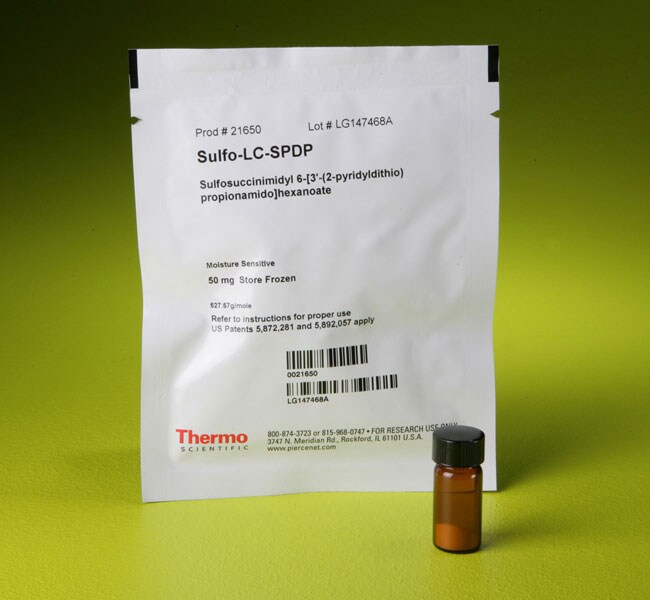
Sulfo-LC-SPDP (sulfosuccinimidyl 6-(3'-(2-pyridyldithio)propionamido)hexanoate)
Thermo Scientific Pierce Sulfo-LC-SPDP is a water-soluble, long-chain crosslinker for amine-to-sulfhydryl conjugation via NHS-ester and pyridyldithiol reactive groups that form深入閱讀
| 產品號碼 | Quantity |
|---|---|
| 21650 | 50 mg |
產品號碼 21650
價格 (TWD)
***
Quantity:
50 mg
價格 (TWD)
***
Thermo Scientific Pierce Sulfo-LC-SPDP is a water-soluble, long-chain crosslinker for amine-to-sulfhydryl conjugation via NHS-ester and pyridyldithiol reactive groups that form cleavable (reducible) disulfide bonds with cysteines.
Features of Sulfo-LC-SPDP:
• Reactive groups: NHS ester and pyridyldithiol
• Reactive towards: amino and sulfhydryl groups
• Releases a detectable by-product when reacted with a free sulfhydryl group; by measuring the release of pyridine-2-thione at 343 nm, the reaction can be easily followed
• Water soluble, sulfo-NHS ester reacts rapidly with any primary amine-containing molecule
• Disulfide bond in the spacer arm is readily cleaved by 10-50 mM DTT or TCEP at pH 8.5
• Spacer arm is also easily cleaved using reducing SDS-PAGE sample loading buffer
• Cleavable crosslinker allows separation of crosslinked products
• Sulfo-LC-SPDP crosslinker is not membrane permeable, allowing cell surface labeling
• Compare to other varieties of SPDP-type reagents, including pegylated forms
Sulfo-LC-SPDP is Sulfosuccinimidyl 6-(3'-[2-pyridyldithio]-propionamido)hexanoate, a heterobifunctional, thiol-cleavable and membrane impermeable crosslinker. It contains an amine-reactive N-hydroxysuccinimide (NHS) ester that will react with lysine residues to form a stable amide bond. The other end of the spacer arm is terminated in the pyridyl disulfide group that will react with sulfhydryls to form a reversible disulfide bond.
Applications:
• Reversible crosslinking of proteins
• Adding sulfhydryl groups to proteins by attachment to lysine residues
• Protein crosslinking to create antibody-enzyme and other bioconjugates via a two-step reaction
• Attaching haptens to carrier proteins for antibody production
• Preparing immunotoxin conjugates
Specifications:
We manufacture Sulfo-LC-SPDP to the highest specifications to produce the most specific bioconjugates, ensure the integrity of your data and to provide you with the highest degree of consistency. Each lot of Sulfo-LC-SPDP is tested to meet the following minimum specifications.
• Identity: IR scan shows only peaks characteristic of the structure and functional groups of Sulfo-LC-SPDP crosslinker
• Solubility: ≥ 95 mg/mL in DI water
• Purity: ≥ 90% by quantitative NMR (the highest standard for crosslinker purity)
Product References:
Crosslinker Application Guide -- search for recent literature references for this product
Related Products
Sulfo-LC-SPDP (sulfosuccinimidyl 6-(3'-(2-pyridyldithio)propionamido)hexanoate)
SPDP (succinimidyl 3-(2-pyridyldithio)propionate)
Features of Sulfo-LC-SPDP:
• Reactive groups: NHS ester and pyridyldithiol
• Reactive towards: amino and sulfhydryl groups
• Releases a detectable by-product when reacted with a free sulfhydryl group; by measuring the release of pyridine-2-thione at 343 nm, the reaction can be easily followed
• Water soluble, sulfo-NHS ester reacts rapidly with any primary amine-containing molecule
• Disulfide bond in the spacer arm is readily cleaved by 10-50 mM DTT or TCEP at pH 8.5
• Spacer arm is also easily cleaved using reducing SDS-PAGE sample loading buffer
• Cleavable crosslinker allows separation of crosslinked products
• Sulfo-LC-SPDP crosslinker is not membrane permeable, allowing cell surface labeling
• Compare to other varieties of SPDP-type reagents, including pegylated forms
Sulfo-LC-SPDP is Sulfosuccinimidyl 6-(3'-[2-pyridyldithio]-propionamido)hexanoate, a heterobifunctional, thiol-cleavable and membrane impermeable crosslinker. It contains an amine-reactive N-hydroxysuccinimide (NHS) ester that will react with lysine residues to form a stable amide bond. The other end of the spacer arm is terminated in the pyridyl disulfide group that will react with sulfhydryls to form a reversible disulfide bond.
Applications:
• Reversible crosslinking of proteins
• Adding sulfhydryl groups to proteins by attachment to lysine residues
• Protein crosslinking to create antibody-enzyme and other bioconjugates via a two-step reaction
• Attaching haptens to carrier proteins for antibody production
• Preparing immunotoxin conjugates
Specifications:
We manufacture Sulfo-LC-SPDP to the highest specifications to produce the most specific bioconjugates, ensure the integrity of your data and to provide you with the highest degree of consistency. Each lot of Sulfo-LC-SPDP is tested to meet the following minimum specifications.
• Identity: IR scan shows only peaks characteristic of the structure and functional groups of Sulfo-LC-SPDP crosslinker
• Solubility: ≥ 95 mg/mL in DI water
• Purity: ≥ 90% by quantitative NMR (the highest standard for crosslinker purity)
Product References:
Crosslinker Application Guide -- search for recent literature references for this product
Related Products
Sulfo-LC-SPDP (sulfosuccinimidyl 6-(3'-(2-pyridyldithio)propionamido)hexanoate)
SPDP (succinimidyl 3-(2-pyridyldithio)propionate)
For Research Use Only. Not for use in diagnostic procedures.
規格
Cell PermeabilityNo
DescriptionSulfo-LC-SPDP
FormPowder
Labeling MethodChemical Labeling
Molecular Weight (g/mol)527.57
PEGylatedNo
Product LinePierce
Quantity50 mg
Reactive MoietyPyridyldisulfide, Sulfo-NHS Ester
Shipping ConditionAmbient
SolubilityWater
Spacer Arm Length15.7 Å
Water SolubleYes
Chemical ReactivityAmine-Sulfhydryl
CleavableBy Thiols
Crosslinker TypeHeterobifunctional
FormatStandard
Product TypeCrosslinker
SpacerMedium (10 to 30 Å)
Unit SizeEach
內容物與存放
Upon receipt store at -20°C protected from moisture.
常見問答集 (常見問題)
Can you provide the shelf-life for Sulfo-LC-SPDP (sulfosuccinimidyl 6-(3'-(2-pyridyldithio)propionamido)hexanoate)?
引用資料與參考文獻 (3)
引用資料與參考文獻
Abstract
Vascular endothelial growth factor selectively targets boronated dendrimers to tumor vasculature.
Journal:Mol Cancer Ther
PubMed ID:16170035
'Tumor neovasculature is a potential but, until very recently, unexplored target for boron neutron capture therapy (BNCT) of cancer. In the present report, we describe the construction of a vascular endothelial growth factor (VEGF)-containing bioconjugate that potentially could be used to target up-regulated VEGF receptors (VEGFR), which are overexpressed on
Identification of CKAP4/p63 as a major substrate of the palmitoyl acyltransferase DHHC2, a putative tumor suppressor, using a novel proteomics method.
Journal:Mol Cell Proteomics
PubMed ID:18296695
'Protein palmitoylation is the post-translational addition of the 16-carbon fatty acid palmitate to specific cysteine residues by a labile thioester linkage. Palmitoylation is mediated by a family of at least 23 palmitoyl acyltransferases (PATs) characterized by an Asp-His-His-Cys (DHHC) motif. Many palmitoylated proteins have been identified, but PAT-substrate relationships are
Carbon nanotubes enhance CpG uptake and potentiate antiglioma immunity.
Journal:Clin Cancer Res
PubMed ID:21088258
Stimulation of toll-like receptor-9 (TLR9) by CpG oligodeoxynucleotides (CpG) has been shown to counteract the immunosuppressive microenvironment and to inhibit tumor growth in glioma models. Because TLR9 is located intracellularly, we hypothesized that methods that enhance its internalization may also potentiate its immunostimulatory response. The goal of this study was