Search



Thermo Scientific™
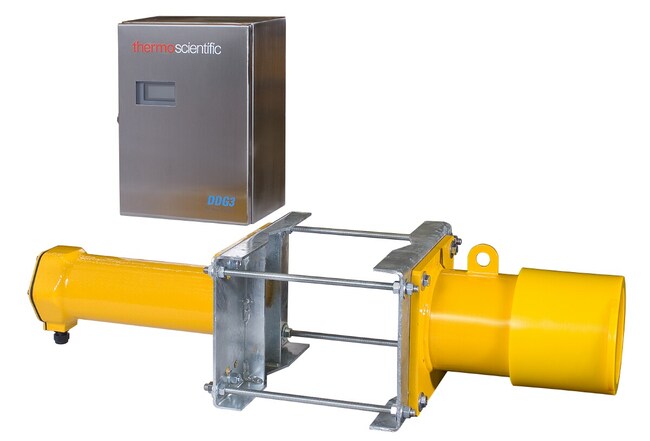
DDG3 Digital Density Gauge
Ensure accurate process control and optimize productivity in the processing of industrial liquids and slurries with the DDG3 Digital Density Gauge, with the new DDG3 controller.
| 產品號碼 | Circuitry |
|---|---|
| AM870 | 16 bit microprocessor, 32K memory, Analogue I/O 12 bit resolution, 4 line transflective backlit LCD, LED indicators on all I/O, 16 key Tactile membrane |
產品號碼 AM870
價格 (TWD)
-
Circuitry:
16 bit microprocessor, 32K memory, Analogue I/O 12 bit resolution, 4 line transflective backlit LCD, LED indicators on all I/O, 16 key Tactile membrane
The Thermo Scientific™ DDG3 Digital Density Gauge is a non-intrusive, non-contact device for accurate density or percent solids measurement for liquids and slurries flowing in a pipe. Equipped with a range of communication protocols, it is especially suitable for applications involving highly toxic, highly corrosive materials or processes operating at elevated temperature. The DDG3 is easy to install and used across the mineral processing, petrochemical, coal, food, water treatment, and pulp/paper industries to support efficient process control and optimize productivity.
Transform your skills with the DDG3 training course for end-users. Unlock the full potential of your equipment with our comprehensive eLearning course. To learn more and register, contact us at training.ppa@thermofisher.com
The DDG3 is a nucleonic density gauge that is installed on the outside of a pipe - no shutdown required - to provide reliable data for robust process control: Key features include:
- Non-intrusive measurement, for applications involving high temperature and/or highly toxic or highly corrosive materials
- High performance microprocessor electronics, for reliable operation over the long-term
- Sensitive scintillation detectors, for accurate measurement with lower strength isotopes
- Rugged construction, for use in harsh environments
- User friendly menu driven display, for easy set-up and calibration
- Suitable for pipes up to 1000 mm in diameter
- Auto source decay compensation, for enhanced long-term performance.
規格
Certifications/ComplianceIP66, CE
Circuitry16 bit microprocessor, 32K memory, Analogue I/O 12 bit resolution, 4 line transflective backlit LCD, LED indicators on all I/O, 16 key Tactile membrane
Housing MaterialController Assembly: Stainless Steel (316) IP66
Detector Assembly: Epoxy-coated Mild Steel or optional Stainless Steel
Source Housing: Epoxy-coated Mild Steel over Lead or optional Stainless Steel
Detector Assembly: Epoxy-coated Mild Steel or optional Stainless Steel
Source Housing: Epoxy-coated Mild Steel over Lead or optional Stainless Steel
InputsOne 4 to 20 mA current loop input for flow meter
One 4 to 20 mA current loop input for temperature
One 4 to 20 mA current loop input for temperature
Interface Cable2 pair, overall shielded, 10 m standard, up to 1000 m maximum
Mounting HardwareController: Wall mount
Operating Temperature RangeDetector Assembly: 0°C to +60°C (+32°F to +140°F)
Controller Assembly: 0°C to +55°C (+32°F to +131°F)
Controller Assembly: 0°C to +55°C (+32°F to +131°F)
OutputsTwo 4-20 mA programmable current loop outputs
Voltage free contact for remote alarm rated 220 VDC, 250 VAC, 2 A max
Voltage free contact for remote totaliser rated 220 VDC, 250 VAC, 2 A max
Voltage free contact for remote alarm rated 220 VDC, 250 VAC, 2 A max
Voltage free contact for remote totaliser rated 220 VDC, 250 VAC, 2 A max
Power Supply24 VDC, 110/230 V, 50/60 Hz, 10 W
Product LineAM870
ProtocolsModBus RTU, ModBus TCP (standard)
HART, Profinet, Ethernet I/P (optional)
HART, Profinet, Ethernet I/P (optional)
Weight (English)Detector Assembly: 55 lb.
Controller Assembly: 11 lb.
Source Housing: 95 lb.
Controller Assembly: 11 lb.
Source Housing: 95 lb.
Weight (Metric)Detector Assembly: 25 kg
Controller Assembly: 5 kg
Source Housing: 42 kg
Controller Assembly: 5 kg
Source Housing: 42 kg
Detector TypeNAI scintillation detector
Gamma Ray Source TypeCs-137 or Co-60
Product TypeHigh Performance Density Gauge
Unit SizeEach