Search
Invitrogen
MDM2 Recombinant Rabbit Monoclonal Antibody (4H26L4)
{{$productOrderCtrl.translations['antibody.pdp.commerceCard.promotion.promotions']}}
{{$productOrderCtrl.translations['antibody.pdp.commerceCard.promotion.viewpromo']}}
{{$productOrderCtrl.translations['antibody.pdp.commerceCard.promotion.promocode']}}: {{promo.promoCode}} {{promo.promoTitle}} {{promo.promoDescription}}. {{$productOrderCtrl.translations['antibody.pdp.commerceCard.promotion.learnmore']}}
Additional Information:
{{banner.description}}

FIGURE: 1 / 19
MDM2 Antibody (700555) in ICC/IF
Immunofluorescent analysis of MDM2 was done on 70% confluent log phase U2OS cells. The cells were fixed with 4% paraformaldehyde for 15 minutes, permeabilized with 0.25% Triton X-100 for 10 minutes, and blocked with 5% BSA for 1 hour at room temperature. The cells were labeled with MDM2 Recombinant Rabbit Monoclonal Antibody (Product # 700555) at 2 µg/mL and incubated for 3 hours at room temperature and then labeled with Alexa Fluor 488 Goat anti-Rabbit IgG Secondary Antibody (Product # A-11008) at a dilution of 1:400 for 30 minutes at roo... View More


Product Details
700555
Applications
Tested Dilution
Publications
Product Specifications
Species Reactivity
Human,
Mouse
Published species
Human
Host/Isotype
Rabbit
/ IgG
Expression System
Expi293
Class
Recombinant Monoclonal
Type
Antibody
Clone
4H26L4
Immunogen
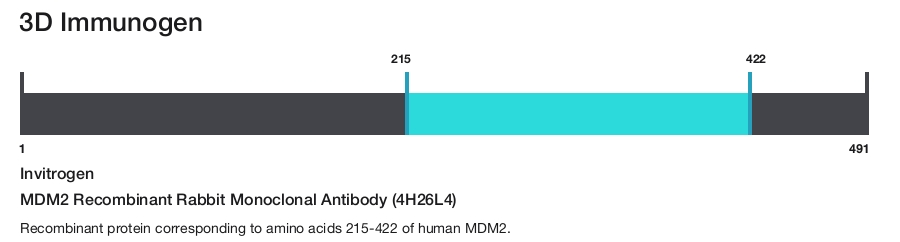
Recombinant protein corresponding to amino acids 215-422 of human MDM2.
Conjugate
Form
Liquid
Concentration
0.5 mg/mL
Amount
100 µg
Purification
Protein A
Storage buffer
PBS
Contains
0.09% sodium azide
Storage conditions
Store at 4°C short term. For long term storage, store at -20°C, avoiding freeze/thaw cycles.
Shipping conditions
Wet ice
RRID
Product Specific Information
70-0555 has been successfully used in immunofluorescence and western blot. In western blot applications, 70-0555 recognizes the ~55kD and ~75kD isoforms of MDM2.
Recombinant rabbit monoclonal antibodies are produced using in vitro expression systems. The expression systems are developed by cloning in the specific antibody DNA sequences from immunoreactive rabbits. Then, individual clones are screened to select the best candidates for production. The advantages of using recombinant rabbit monoclonal antibodies include: better specificity and sensitivity, lot-to-lot consistency, animal origin-free formulations, and broader immunoreactivity to diverse targets due to larger rabbit immune repertoire.
Target Information
MDM2 is a ubiquitin ligase for p53 and plays a central role in regulation of the stability of p53. MDM2 is located on chromosome 12 on the q arm. Akt-mediated phosphorylation of MDM2 at Ser166 and Ser186 increases its interaction with p300, allowing MDM2-mediated ubiquitination and degradation of p53. Phosphorylation of MDM2 also blocks its binding to p19ARF, increasing the degradation of p53. MDM2 has also been shown to negatively regulate p53 function. MDM2 binds and inhibits transactivation role played by p53 and overexpression of MDM2 can result in the inactivation of p53 and decrease its tumor suppressor function. Another process by which MDM2 can inactivate p53 is by degrading p53 as the protein also possesses E3 ubiquitin ligase activity. Further, MDM2 plays important roles in apoptosis and cell cycle. MDM2 is over expressed in a wide range of human malignancies including soft tissue carcinomas and breast cancer. In addition to p53, MDM2 is involved in processes of cell cycle, apoptosis, and tumorigenesis through interactions with proteins that include retinoblastoma 1 and ribosomal protein L5. More than 40 different alternatively spliced transcript variants of MDM2 have been isolated from both tumor and normal tissues.
For Research Use Only. Not for use in diagnostic procedures. Not for resale without express authorization.
Bioinformatics
Protein Aliases: alternatively spliced isoform; Double minute 2 protein; double minute 2, human homolog of; p53-binding protein; E3 ubiquitin-protein ligase Mdm2; Hdm2; HGNC:6973; human homolog of; MDM2 isoform KB9; MDM2 isoform N1_40; MDM2 oncogene, E3 ubiquitin protein ligase; MDM2 proto-oncogene, E3 ubiquitin protein ligase; MDM2 variant FB28; Mdm2, p53 E3 ubiquitin protein ligase homolog; Mdm2, transformed 3T3 cell double minute 2, p53 binding protein; MGC5370; MGC71221; Oncoprotein Mdm2; OTTHUMP00000183490; OTTHUMP00000183492; OTTHUMP00000183494; OTTHUMP00000183495; OTTHUMP00000183496; OTTHUMP00000183497; p53 associated; p53-binding protein Mdm2; RING-type E3 ubiquitin transferase Mdm2; unnamed protein product
Gene Aliases: 1700007J15Rik; AA415488; ACTFS; hdm2; HDMX; LSKB; Mdm-2; MDM2
UniProt ID: (Human) Q00987, (Mouse) P23804
Entrez Gene ID: (Human) 4193, (Mouse) 17246
p53 binding
ubiquitin-protein transferase activity
protein binding
5S rRNA binding
zinc ion binding
transferase activity
ligase activity
SUMO transferase activity
enzyme binding
protein domain specific binding
ubiquitin protein ligase binding
receptor serine/threonine kinase binding
identical protein binding
peroxisome proliferator activated receptor binding
ribonucleoprotein complex binding
ubiquitin binding
metal ion binding
ubiquitin protein ligase activity
NEDD8 ligase activity
disordered domain specific binding
UDP-N-acetylmuramoylalanyl-D-glutamyl-2,6-diaminopimelate-D-alanyl-D-alanine ligase activity
ribosomal S6-glutamic acid ligase activity
coenzyme F420-0 gamma-glutamyl ligase activity
coenzyme F420-2 alpha-glutamyl ligase activity
protein-glycine ligase activity
protein-glycine ligase activity, initiating
protein-glycine ligase activity, elongating
tubulin-glycine ligase activity
protein-glutamic acid ligase activity
tubulin-glutamic acid ligase activity
scaffold protein binding
chromatin/chromatin-binding, or -regulatory protein
negative regulation of transcription from RNA polymerase II promoter
protein polyubiquitination
blood vessel development
blood vessel remodeling
regulation of heart rate
heart valve development
atrioventricular valve morphogenesis
endocardial cushion morphogenesis
ventricular septum development
atrial septum development
ubiquitin-dependent protein catabolic process
apoptotic process
traversing start control point of mitotic cell cycle
heart development
positive regulation of cell proliferation
response to xenobiotic stimulus
response to toxic substance
response to iron ion
regulation of gene expression
positive regulation of gene expression
negative regulation of gene expression
negative regulation of protein processing
negative regulation of neuron projection development
protein ubiquitination
protein sumoylation
DNA damage response, signal transduction by p53 class mediator
protein destabilization
response to magnesium ion
positive regulation of proteasomal ubiquitin-dependent protein catabolic process
protein localization to nucleus
regulation of protein catabolic process
response to cocaine
negative regulation of apoptotic process
proteasome-mediated ubiquitin-dependent protein catabolic process
negative regulation of DNA damage response, signal transduction by p53 class mediator
protein-containing complex subunit organization
establishment of protein localization
response to ether
positive regulation of cell cycle
negative regulation of transcription, DNA-templated
positive regulation of mitotic cell cycle
response to antibiotic
positive regulation of protein export from nucleus
response to steroid hormone
positive regulation of muscle cell differentiation
proteolysis involved in cellular protein catabolic process
regulation of cell cycle
protein autoubiquitination
cardiac septum morphogenesis
protein-containing complex assembly
regulation of biological quality
cellular response to hydrogen peroxide
cellular response to antibiotic
cellular response to vitamin B1
cellular response to alkaloid
cellular response to growth factor stimulus
cellular response to peptide hormone stimulus
cellular response to estrogen stimulus
cellular response to hypoxia
cellular response to gamma radiation
cellular response to UV-C
signal transduction by p53 class mediator
fibroblast activation
cellular response to actinomycin D
regulation of postsynaptic neurotransmitter receptor internalization
regulation of protein catabolic process at postsynapse, modulating synaptic transmission
negative regulation of signal transduction by p53 class mediator
negative regulation of intrinsic apoptotic signaling pathway by p53 class mediator
response to formaldehyde
positive regulation of vascular smooth muscle cell proliferation
positive regulation of vascular associated smooth muscle cell migration
amyloid fibril formation
response to water-immersion restraint stress
negative regulation of apoptotic signaling pathway
protein complex assembly
DNA damage response, signal transduction by p53 class mediator resulting in cell cycle arrest
peptidyl-lysine modification
protein catabolic process
protein ubiquitination involved in ubiquitin-dependent protein catabolic process
negative regulation of cysteine-type endopeptidase activity involved in apoptotic process
negative regulation of cell cycle arrest
Disclaimer

Clicking the images or links will redirect you to a website hosted by BenchSci that provides third-party scientific content. Neither the content nor the BenchSci technology and processes for selection have been evaluated by us; we are providing them as-is and without warranty of any kind, including for use or application of the Thermo Fisher Scientific products presented.

Performance Guarantee
If an Invitrogen™ antibody doesn't perform as described on our website or datasheet,we'll replace the product at no cost to you, or provide you with a credit for a future purchase.*
Learn more
We're here to help
Get expert recommendations for common problems or connect directly with an on staff expert for technical assistance related to applications, equipment and general product use.
Contact tech support