Search
Invitrogen
CCR7 Recombinant Rabbit Monoclonal Antibody (SR36-04)
{{$productOrderCtrl.translations['antibody.pdp.commerceCard.promotion.promotions']}}
{{$productOrderCtrl.translations['antibody.pdp.commerceCard.promotion.viewpromo']}}
{{$productOrderCtrl.translations['antibody.pdp.commerceCard.promotion.promocode']}}: {{promo.promoCode}} {{promo.promoTitle}} {{promo.promoDescription}}. {{$productOrderCtrl.translations['antibody.pdp.commerceCard.promotion.learnmore']}}
Additional Information:
{{banner.description}}

FIGURE: 1 / 5
CCR7 Antibody (MA5-31992) in ICC/IF
Immunofluorescence analysis of C-C chemokine receptor type 7 was performed using 70% confluent log phase MCF7 cells. The cells were fixed with 4% paraformaldehyde for 10 minutes, permeabilized with 0.1% Triton™ X-100 for 15 minutes, and blocked with 2% BSA for 45 minutes at room temperature. The cells were labeled with CCR7 Recombinant Rabbit Monoclonal Antibody (SR36-04) (Product # MA5-31992) at 1:100 dilution in 0.1% BSA, incubated at 4 degree celsius overnight and then labeled with Donkey anti-Rabbit IgG (H+L) Highly Cross-Adsorbed Seco... View More


Product Details
MA5-31992
Applications
Tested Dilution
Publications
Product Specifications
Species Reactivity
Human,
Mouse,
Rat
Published species
Human,
Mouse
Host/Isotype
Rabbit
/ IgG
Expression System
HEK293 cells
Class
Recombinant Monoclonal
Type
Antibody
Clone
SR36-04
Immunogen
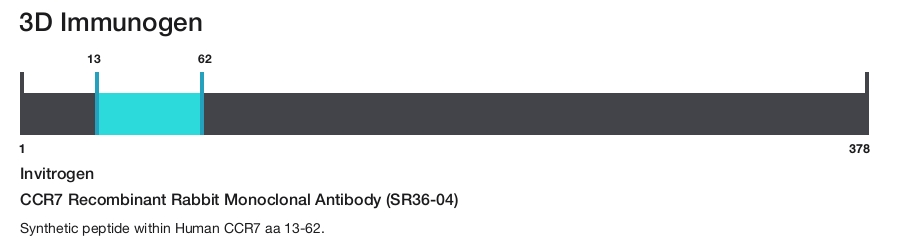
Synthetic peptide within Human CCR7 aa 13-62.
Conjugate
Form
Liquid
Concentration
2.021 mg/mL
Amount
202.1 µg
Purification
Protein A
Storage buffer
TBS, pH 7.4, with 40% Glycerol, 0.05% BSA
Contains
0.05% sodium azide
Storage conditions
Store at 4°C short term. For long term storage, store at -20°C, avoiding freeze/thaw cycles.
Shipping conditions
Ambient (domestic); Wet ice (international)
RRID
Product Specific Information
Recombinant rabbit monoclonal antibodies are produced using in vitro expression systems. The expression systems are developed by cloning in the specific antibody DNA sequences from immunoreactive rabbits. Then, individual clones are screened to select the best candidates for production. The advantages of using recombinant rabbit monoclonal antibodies include: better specificity and sensitivity, lot-to-lot consistency, animal origin-free formulations, and broader immunoreactivity to diverse targets due to larger rabbit immune repertoire.
Target Information
CCR7 is a member of the G-protein-coupled chemokine receptor family with seven membrane-spanning domains and functions as a receptor for 6Ckine/SLC (secondary lymphoid-tissue chemokine), CCL19 and CCL21. CCR7 has been shown to be internalized via clathrin-coated pits and the majority recycled back to the plasma membrane. CCR7 is expressed on T cells and can be used to distinguish populations of naive from central and effector memory T cells. CCR7 has been shown to play a role in migration of memory T cells to inflamed tissue. Expression of CCR7 is also found on DC's. During DC maturation CCR7 expression increases and is thought to be involved in a variety of functions: chemotaxis to the lymph node, cellular architecture, rate of endocytosis, survival and maturation.
For Research Use Only. Not for use in diagnostic procedures. Not for resale without express authorization.
Bioinformatics
Protein Aliases: BLR2; Bukitt's lymphoma receptor 2; C-C chemokine receptor type 7; C-C CKR-7; CC chemokine receptor 7; CD197; CDw197; chemokine (C-C motif) receptor 7; chemokine (C-C) receptor 7; EBI1; EBV-induced G protein-coupled receptor 1; EBV-induced G-protein coupled receptor 1; Epstein-Barr virus induced gene 1; Epstein-Barr virus-induced G-protein coupled receptor 1; G-protein coupled receptor; CCR7; lymphocyte-specific G protein-coupled peptide receptor; MIP-3 beta receptor; unnamed protein product
Gene Aliases: BLR2; CC-CKR-7; CCR-7; CCR7; CD197; CDw197; CMKBR7; EBI1; Ebi1h; EVI1
UniProt ID: (Human) P32248, (Mouse) P47774
Entrez Gene ID: (Human) 1236, (Rat) 287673, (Mouse) 12775
G-protein coupled receptor activity
chemokine receptor activity
C-C chemokine receptor activity
chemokine (C-C motif) ligand 19 binding
chemokine (C-C motif) ligand 21 binding
C-C motif chemokine 19 receptor activity
C-C motif chemokine 21 receptor activity
signal transducer activity
protein binding
myeloid dendritic cell chemotaxis
positive regulation of dendritic cell antigen processing and presentation
positive regulation of hypersensitivity
positive regulation of humoral immune response
chemotaxis
inflammatory response
immune response
G-protein coupled receptor signaling pathway
response to lipopolysaccharide
regulation of interferon-gamma production
positive regulation of interleukin-12 production
chemokine (C-C motif) ligand 19 signaling pathway
chemokine (C-C motif) ligand 21 signaling pathway
negative thymic T cell selection
regulation of interleukin-1 beta secretion
positive regulation of T cell receptor signaling pathway
chemokine-mediated signaling pathway
cellular response to cytokine stimulus
interleukin-12 secretion
positive regulation of neutrophil chemotaxis
mature conventional dendritic cell differentiation
positive regulation of dendritic cell chemotaxis
positive regulation of immunological synapse formation
positive regulation of T cell costimulation
positive regulation of glycoprotein biosynthetic process involved in immunological synapse formation
establishment of T cell polarity
lymphocyte chemotaxis across high endothelial venule
regulation of tolerance induction to self antigen
signal transduction
activation of JUN kinase activity
positive regulation of macrophage chemotaxis
positive regulation of T cell chemotaxis
actin cytoskeleton organization
positive regulation of tumor necrosis factor production
response to prostaglandin E
positive regulation of T cell proliferation
positive regulation of GTPase activity
positive regulation of T-helper 1 cell differentiation
positive regulation of receptor-mediated endocytosis
lymph node development
positive regulation of interleukin-1 beta secretion
positive regulation of phagocytosis
positive regulation of filopodium assembly
response to nitric oxide
lymphocyte migration into lymph node
negative regulation of leukocyte apoptotic process
positive regulation of cell motility
positive regulation of thymocyte migration
regulation of dendritic cell dendrite assembly
positive regulation of cell-matrix adhesion
dendritic cell chemotaxis
positive regulation of cytosolic calcium ion concentration
calcium-mediated signaling
positive regulation of actin filament polymerization
positive regulation of pseudopodium assembly
ruffle organization
regulation of Cdc42 protein signal transduction
regulation of interleukin-1 beta production
negative regulation of interleukin-12 production
positive regulation of Rac protein signal transduction
CCL19-activated CCR7 signaling pathway
CCL21-activated CCR7 signaling pathway
positive regulation of I-kappaB kinase/NF-kappaB signaling
positive regulation of cell adhesion
positive regulation of JNK cascade
homeostasis of number of cells
release of sequestered calcium ion into cytosol
positive regulation of protein kinase B signaling
cell chemotaxis
positive regulation of ERK1 and ERK2 cascade
cellular response to prostaglandin E stimulus
positive regulation of phospholipase C/protein kinase C signal transduction
negative regulation of dendritic cell apoptotic process
Disclaimer

Clicking the images or links will redirect you to a website hosted by BenchSci that provides third-party scientific content. Neither the content nor the BenchSci technology and processes for selection have been evaluated by us; we are providing them as-is and without warranty of any kind, including for use or application of the Thermo Fisher Scientific products presented.

Performance Guarantee
If an Invitrogen™ antibody doesn't perform as described on our website or datasheet,we'll replace the product at no cost to you, or provide you with a credit for a future purchase.*
Learn more
We're here to help
Get expert recommendations for common problems or connect directly with an on staff expert for technical assistance related to applications, equipment and general product use.
Contact tech support