Search
Invitrogen
Phospho-ABL1/ABL2 (Tyr393, Tyr439) Polyclonal Antibody
{{$productOrderCtrl.translations['antibody.pdp.commerceCard.promotion.promotions']}}
{{$productOrderCtrl.translations['antibody.pdp.commerceCard.promotion.viewpromo']}}
{{$productOrderCtrl.translations['antibody.pdp.commerceCard.promotion.promocode']}}: {{promo.promoCode}} {{promo.promoTitle}} {{promo.promoDescription}}. {{$productOrderCtrl.translations['antibody.pdp.commerceCard.promotion.learnmore']}}
Additional Information:
{{banner.description}}

FIGURE: 1 / 2
Phospho-ABL1/ABL2 (Tyr393, Tyr439) Antibody (PA5-114547) in IHC (P)
Immunohistochemistry analysis of Phospho-ABL1/ABL2 (Tyr412, Tyr393) in human brain tissue sections. Samples were treated with formaldehyde and treated with citrate buffer for antigen retrieval, blocked, and incubated (1.5 hours at 22°C) with polyclonal antibody (Product # PA5-114547) at a dilution of 1:200. Secondary staining was applied with HRP conjugated goat anti-rabbit.


Product Details
PA5-114547
Applications
Tested Dilution
Publications
Product Specifications
Species Reactivity
Human,
Mouse,
Non-human primate,
Rat
Host/Isotype
Rabbit
/ IgG
Class
Polyclonal
Type
Antibody
Immunogen
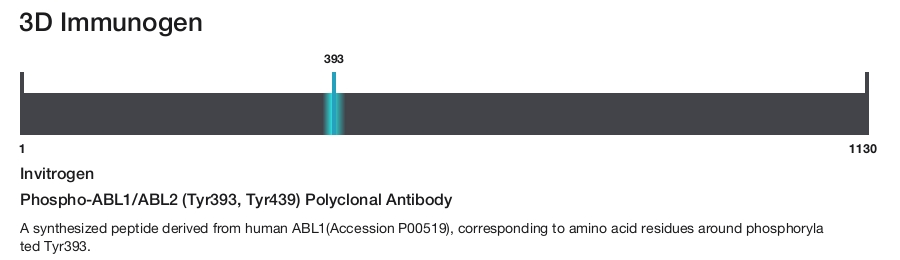
A synthesized peptide derived from human ABL1(Accession P00519), corresponding to amino acid residues around phosphorylated Tyr393.
Conjugate
Form
Liquid
Concentration
1 mg/mL
Amount
100 µg
Purification
sequential chromatography
Storage buffer
PBS with 50% glycerol
Contains
0.02% sodium azide
Storage conditions
-20°C
Shipping conditions
Ambient (domestic); Wet ice (international)
RRID
Product Specific Information
Antibody detects endogenous levels of ABL1/2 only when phosphorylated at Tyr393, which site historically referenced asTyr412.
Target Information
The Abl oncogene was initially identified as the viral transforming gene of Abelson murine leukemia virus (A-MuLV). The major translational product of c-Abl has been identified as a protein with tyrosine kinase activity and an SH2 domain. The Abl oncogene is implicated in several human leukemias including 90-95% of chronic myelocytic leukemia (CML), 20-25% of adult acute lymphoblastic leukemia (ALL) and 2-5% of pediatric ALL. In these leukemias the c-Abl proto-oncogene undergoes a (9;22) chromosomal translocation producing the Philadelphia (Ph1) chromosome. The molecular consequence of this translocation is the generation of a chimeric Bcr/c-Abl mRNA encoding activated Abl protein-tyrosine kinase.
For Research Use Only. Not for use in diagnostic procedures. Not for resale without express authorization.
References (0)
Have you cited this product in a publication?
Let us know so we can reference it here.
Bioinformatics
Protein Aliases: Abelson murine leukemia oncogene; Abelson murine leukemia viral (v-abl) oncogene homolog 1; Abelson murine leukemia viral (v-abl) oncogene homolog 2; Abelson murine leukemia viral oncogene homolog 1; Abelson murine leukemia viral oncogene homolog 2; Abelson tyrosine-protein kinase 1; Abelson tyrosine-protein kinase 2; Abelson-related gene protein; ABL kinase domain; abl protein; ABL protooncogene 1 nonreceptor tyrosine kinase; ABL1; Abl1-related gene product; abl2; arg tyrosine kinase; BCR-ABL1 p190; BCR/ABL e8a2 fusion; BCR/ABL1 e1a2 fusion protein; BCR/ABL1 fusion; bcr/c-abl oncogene protein; c-abl oncogene 1, non-receptor tyrosine kinase; c-abl oncogene 1, receptor tyrosine kinase; c-abl oncogene 2, non-receptor tyrosine kinase; chimeric BCR::ABL1 protein; non-receptor tyrosine kinase; p150; p190; Proto-oncogene c-Abl; proto-oncogene tyrosine-protein kinase ABL1; tyrosine kinase ARG; tyrosine kinase protein; Tyrosine-protein kinase ABL1; Tyrosine-protein kinase ABL2; Tyrosine-protein kinase ARG; unnamed protein product; v-abl Abelson murine leukemia oncogene 1; v-abl Abelson murine leukemia viral oncogene 1; v-abl Abelson murine leukemia viral oncogene 2; v-abl Abelson murine leukemia viral oncogene homolog 1; v-abl Abelson murine leukemia viral oncogene homolog 2; v-abl Abelson murine leukemia viral oncogene homolog 2 (arg, Abelson-related gene)
Gene Aliases: AA536808; ABL; ABL1; ABL2; ABLL; AI325092; ARG; BCR-ABL; bcr/abl; c-ABL; c-ABL1; CHDSKM; E430008G22Rik; JTK7; p150; v-abl
UniProt ID: (Human) P00519, (Human) P42684, (Mouse) P00520
Entrez Gene ID: (Human) 25, (Human) 27, (Rat) 311860, (Mouse) 11350, (Mouse) 11352, (Rat) 304883
nucleotide binding
magnesium ion binding
four-way junction DNA binding
bubble DNA binding
phosphotyrosine binding
DNA binding
transcription coactivator activity
actin monomer binding
nicotinate-nucleotide adenylyltransferase activity
protein kinase activity
protein serine/threonine kinase activity
protein tyrosine kinase activity
non-membrane spanning protein tyrosine kinase activity
protein kinase C binding
protein binding
ATP binding
enzyme activator activity
kinase activity
transferase activity
enzyme binding
protein kinase binding
protein domain specific binding
syntaxin binding
manganese ion binding
neuropilin binding
SH2 domain binding
protein serine/threonine kinase activator activity
metal ion binding
ephrin receptor binding
actin filament binding
mitogen-activated protein kinase binding
proline-rich region binding
delta-catenin binding
supercoiled DNA binding
sequence-specific double-stranded DNA binding
receptor binding
protein C-terminus binding
SH3 domain binding
transferase activity, transferring phosphorus-containing groups
molecular_function
B-1 B cell homeostasis
B cell proliferation involved in immune response
transitional one stage B cell differentiation
phagocytosis
cellular response to DNA damage stimulus
DNA damage induced protein phosphorylation
response to oxidative stress
epidermal growth factor receptor signaling pathway
positive regulation of cytosolic calcium ion concentration
learning or memory
associative learning
cell migration
peptidyl-tyrosine phosphorylation
cerebellum morphogenesis
negative regulation of cell-cell adhesion
microspike assembly
actin cytoskeleton organization
actin filament polymerization
negative regulation of BMP signaling pathway
regulation of actin cytoskeleton organization
positive regulation of osteoblast proliferation
substrate adhesion-dependent cell spreading
cellular response to oxidative stress
response to endoplasmic reticulum stress
peptidyl-tyrosine autophosphorylation
B cell proliferation
response to drug
signal transduction in response to DNA damage
positive regulation of apoptotic process
positive regulation of I-kappaB kinase/NF-kappaB signaling
negative regulation of I-kappaB kinase/NF-kappaB signaling
positive regulation of neuron apoptotic process
innate immune response
positive regulation of vasoconstriction
negative regulation of mitotic cell cycle
positive regulation of mitotic cell cycle
alpha-beta T cell differentiation
protein autophosphorylation
platelet-derived growth factor receptor signaling pathway
positive regulation of fibroblast proliferation
spleen development
thymus development
collateral sprouting
positive regulation of peptidyl-tyrosine phosphorylation
activated T cell proliferation
B cell receptor signaling pathway
neuromuscular process controlling balance
positive regulation of release of sequestered calcium ion into cytosol
positive regulation of oxidoreductase activity
negative regulation of ubiquitin-protein transferase activity
regulation of cell cycle
Bergmann glial cell differentiation
negative regulation of ERK1 and ERK2 cascade
positive regulation of ERK1 and ERK2 cascade
cellular response to lipopolysaccharide
cellular response to transforming growth factor beta stimulus
response to epinephrine
negative regulation of protein serine/threonine kinase activity
actin filament branching
positive regulation of dendrite development
positive regulation of interleukin-2 secretion
negative regulation of phospholipase C activity
positive regulation of neuron death
positive regulation of hydrogen peroxide-mediated programmed cell death
positive regulation of interferon-gamma secretion
regulation of extracellular matrix organization
positive regulation of extracellular matrix organization
glomerular visceral epithelial cell apoptotic process
positive regulation of Wnt signaling pathway, planar cell polarity pathway
negative regulation of endothelial cell apoptotic process
regulation of cellular senescence
negative regulation of cellular senescence
regulation of response to DNA damage stimulus
cell adhesion
signal transduction
phospholipase C-activating G-protein coupled receptor signaling pathway
regulation of autophagy
positive regulation of neuron projection development
regulation of endocytosis
regulation of cell adhesion
negative regulation of Rho protein signal transduction
exploration behavior
protein modification process
cellular response to retinoic acid
positive regulation of establishment of T cell polarity
regulation of cell motility
positive regulation of T cell migration
mitotic cell cycle
neural tube closure
immune effector process
immune response-activating cell surface receptor signaling pathway
DNA repair
mismatch repair
regulation of transcription, DNA-templated
endocytosis
autophagy
apoptotic process
integrin-mediated signaling pathway
I-kappaB kinase/NF-kappaB signaling
intrinsic apoptotic signaling pathway in response to DNA damage
response to xenobiotic stimulus
post-embryonic development
regulation of gene expression
positive regulation of macromolecule biosynthetic process
positive regulation of endothelial cell migration
neuron differentiation
BMP signaling pathway
regulation of axon extension
phospholipase C-inhibiting G-protein coupled receptor signaling pathway
regulation of microtubule polymerization
regulation of Cdc42 protein signal transduction
positive regulation of interferon-gamma production
positive regulation of interleukin-2 production
cellular response to stress
intracellular signal transduction
platelet-derived growth factor receptor-beta signaling pathway
Fc-gamma receptor signaling pathway involved in phagocytosis
neuropilin signaling pathway
regulation of cell proliferation
endothelial cell migration
regulation of T cell differentiation
regulation of cell differentiation
positive regulation of cell adhesion
positive regulation of transcription from RNA polymerase II promoter
ephrin receptor signaling pathway
T cell receptor signaling pathway
neuron apoptotic process
myoblast proliferation
positive regulation of stress fiber assembly
establishment of localization in cell
mitochondrial depolarization
positive regulation of focal adhesion assembly
cardiac muscle cell proliferation
neuroepithelial cell differentiation
cellular response to hydrogen peroxide
ERK1 and ERK2 cascade
DNA conformation change
circulatory system development
positive regulation of cell migration involved in sprouting angiogenesis
cellular senescence
vascular endothelial cell response to oscillatory fluid shear stress
cell-cell adhesion
regulation of postsynaptic specialization assembly
positive regulation of phospholipase C/protein kinase C signal transduction
positive regulation of substrate adhesion-dependent cell spreading
negative regulation of long-term synaptic potentiation
cellular response to oxygen-containing compound
regulation of hematopoietic stem cell differentiation
regulation of intracellular signal transduction
cellular response to dopamine
DN4 thymocyte differentiation
protein localization to cytoplasmic microtubule plus-end
regulation of modification of synaptic structure
positive regulation of blood vessel branching
negative regulation of double-strand break repair via homologous recombination
positive regulation of protein phosphorylation
protein phosphorylation
phosphorylation
substrate-dependent cell migration, cell extension
actin filament organization
learning
visual learning
positive regulation of phospholipase C activity
neuron remodeling
positive regulation of protein binding
cellular protein localization
dendrite morphogenesis
actin filament bundle assembly
dendritic spine maintenance
biological_process
cell differentiation
regulation of apoptotic process
Disclaimer

Clicking the images or links will redirect you to a website hosted by BenchSci that provides third-party scientific content. Neither the content nor the BenchSci technology and processes for selection have been evaluated by us; we are providing them as-is and without warranty of any kind, including for use or application of the Thermo Fisher Scientific products presented.

Performance Guarantee
If an Invitrogen™ antibody doesn't perform as described on our website or datasheet,we'll replace the product at no cost to you, or provide you with a credit for a future purchase.*
Learn more
We're here to help
Get expert recommendations for common problems or connect directly with an on staff expert for technical assistance related to applications, equipment and general product use.
Contact tech support