Thermo Fisher Scientific

Your educational resource for biopharma, pharma, environmental, food and agriculture, industrial, and clinical labs

  • Categories
    • Advancing Materials
    • Advancing Mining
    • AnalyteGuru
    • Analyzing Metals
    • Ask a Scientist
    • Behind the Bench
    • Biotech at Scale
    • Clinical Conversations
    • Examining Food
    • Identifying Threats
    • Illuminating Semiconductors
    • Life in Atomic Resolution
    • Life in the Lab
    • OEMpowered
    • The Connected Lab
  • About Us
  • Contact
Accelerating ScienceAnalyteGuru / Gas Chromatography / Helping Laboratories Work Toward Sustainability

Helping Laboratories Work Toward Sustainability

By Dr. Daniela Cavagnino, Product Marketing Manager, GC/Autosampler, Thermo Fisher Scientific 11.30.2022

There is an ever-increasing awareness of the environmental impact of our everyday activities, motivating many industries to assess the environmental impact of their current practices and build strategies to make their operations more sustainable.

Our Mission is to enable our customers to make the world healthier, cleaner and safer. While scientific analytical laboratories are providing insights to some of the world’s most pressing issues, many activities in the laboratory carry an environmental cost, as they often involve heavy use of chemicals and high power consumption.
Thermo Fisher Scientific began a collaboration in 2017 with My Green Lab®, a nonprofit organization with several programs aimed at promoting a culture of sustainability in scientific communities and helping scientists improve environmental health and resource utilization without compromising the integrity of the scientific research and analytical results. Learn more about this collaboration in the video Thermo Fisher and My Green Lab: Making Science Sustainable.

Together with My Green Lab, Thermo Fisher Scientific is facilitating greener product choice through the ACT Label program.

Similar to labels found on food that detail nutritional information, the ACT (Accountability, Consistency, and Transparency) Environmental Impact Factor Label shows how products rate in sustainability-related categories, helping scientists and procurement specialists make a more sustainable choice with clear, third-party verified information about the environmental impact of laboratory products.
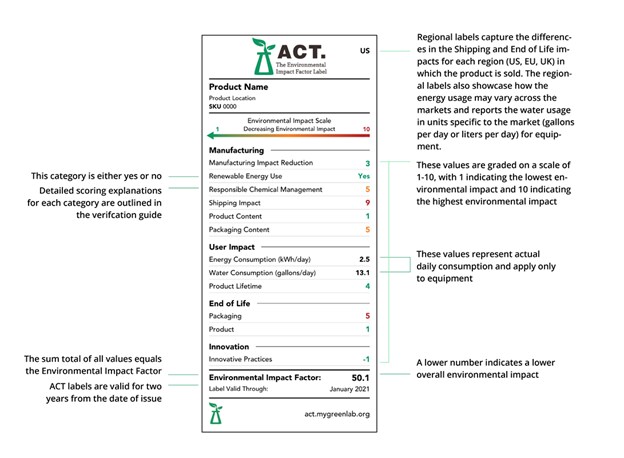
This program is designed to evaluate and score laboratory products on a number of sustainability criteria, including energy consumption, end-of-life product cycle and disposal, as well as sustainable product manufacturing and packaging material.

Thermo Fisher Scientific is utilizing ACT labeling for a variety of laboratory products and analytical instruments, and is committed to invest in further product developments that allow our users to increase sustainability within their laboratories. The ACT labels for the labeled products can be found on the My Green Lab ACT database.

More recently, some notable products in the Thermo Fisher Scientific portfolio of analytical solutions received ACT Labels — the Thermo Scientific™ TRACE™ 1600 Series Gas Chromatograph systems and the Thermo Scientific™ iCAP™ PRO Series ICP-OES.

The TRACE 1600 Series GC and related products are designed to help increase sustainability through some important design principals:

  1. Maintaining low energy consumption: The compact design of the TRACE 1600 Series GC ensures rapid stabilization of the heated zones and faster heating of the oven, limiting power consumption to 7.3 KWh/day for 230V operation, assuming a continuous run during a typical eight-hour workday.
  2. Reducing helium carrier gas consumption: If using an alternative carrier gas is not possible without compromising analytical performance, the Thermo ScientificTM HeSaver-H2SaferTM technology makes it possible to replace most of the non-renewable helium gas with nitrogen during GC operation, maintaining helium only to feed the column for the separation process and dramatically extending the helium cylinder lifetime. To learn more about how it works, view this video: HeSaver-H2Safer SSL Injector for the TRACE 1600 Series GC.
  3. Reducing solvent consumption and waste through automated sample preparation. Read this case study to see how Veritas SpA, a public water service provider, saved costs and reduced environmental impact through automation. Additionally, if you are dealing with solid or semi-solid samples, discover the sample prep automation and savings capability of the new Thermo Scientific™ Extreva™ASE™ Accelerated Solvent Extractor.

The iCAP PRO Series ICP-OES is also designed to allow your laboratory to maintain sustainable operations:

  1. Reducing argon gas consumption: Using iFR (intelligent Full Range) analysis mode (which measures the entire wavelength range in one measurement) allows analysis time to be shortened and — as a result — the time the instrument spends consuming argon to maintain the plasma.
  2. Reducing overall power consumption: Using the high-efficiency RF generator, low RF powers can be set for even the most challenging samples.

Thermo Fisher Scientific is proud to support analytical laboratories in their green choices and guide them on the journey to sustainable operations.

1975 text image

Innovations of 1975 and the Birth of the First Commercialized Suppressed Ion Chromatograph

The year 1975 was a remarkable period in the history of tech...

Read More
Mushroom image

Deciphering Selenium Nutrition Using Speciation Analysis with ICP-MS

Many elements, such as chromium, zinc or selenium are consid...

Read More
Food packaging

Enhancing PFAS Analysis in Food Contact Materials Using Combustion Ion Chromatography

Per- and polyfluoroalkyl substances (PFAS) have been used in...

Read More
Robust Analysis of Halogens and Sulfur in Industrial and Environmental Samples

Robust Analysis of Halogens and Sulfur in Industrial and Environmental Samples

In industrial processes, accurately determining halogens and...

Read More

Dr. Daniela Cavagnino

Dr. Daniela Cavagnino is Product Marketing Manager for GC and Sampling Solutions. She started her career in gas chromatography at Thermo Fisher Scientific spending several years in the R&D laboratories working on GC technology innovation. Then, she conveyed her technical background into product management and marketing management roles with more than 20 years’ experience in promoting GC/GCMS technology and applications in several different market segments.
Simple, Accurate and Robust Determination of Tromethamine in Pharmaceutical Formulations
A Powerful Method to Assay Anions in Simulated Lithium-ion Battery Electrolyte Samples Using RFIC

Privacy StatementTerms & ConditionsLocationsSitemap

© 2025 Thermo Fisher Scientific. All Rights Reserved.

Talk to us