Thermo Fisher Scientific

Your educational resource for biopharma, pharma, environmental, food and agriculture, industrial, and clinical labs

  • Categories
    • Advancing Materials
    • Advancing Mining
    • AnalyteGuru
    • Analyzing Metals
    • Ask a Scientist
    • Behind the Bench
    • Biotech at Scale
    • Clinical Conversations
    • Examining Food
    • Identifying Threats
    • Illuminating Semiconductors
    • Life in Atomic Resolution
    • Life in the Lab
    • OEMpowered
    • The Connected Lab
  • About Us
  • Contact
Accelerating ScienceAnalyteGuru / Isotope Ratio MS / How Do Scientists Determine the Age of a Rock?

How Do Scientists Determine the Age of a Rock?

By Dr. Claudia Bouman, Product Manager, Multicollector ICP-MS and Noble Gas MS, Thermo Fisher Scientific, Bremen, Germany, 06.29.2018

A person’s age can be risky to determine without asking directly. But what about rocks and other materials on Earth? Geochronologists are real detectives able to unravel the age of minerals and rocks on Earth. One of the widespread methods within geochronology the radiometric dating technique based on the radioactive decay of Uranium (U) into Lead (Pb). With this technique, geochronologists can date rocks of 100 million to billions of years old.

uranium-2

How does it work?

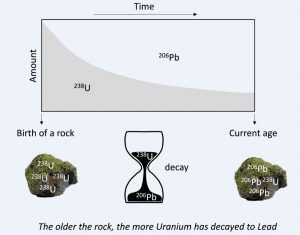
It works like a clock that starts ticking as soon as the rock is formed. Rocks often contain traces of the element uranium and some of the uranium (238U) decays to lead (206Pb). The rate at which this happens is constant and reported as “half-life” (i.e., the time required for half of the uranium to decay to lead). During the life of a rock, the amount of uranium decreases and the amount of lead increases. Young rocks have very high amounts of uranium and low amounts of lead content, whereas very old rocks have very little uranium and high lead amounts. Since the half-life is known and one can measure the uranium and lead contents in the rock, one can calculate the age of a rock.

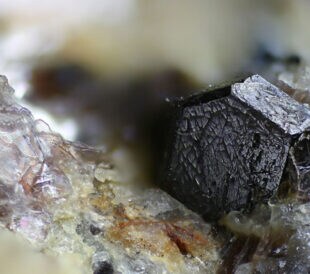
As rocks contain various minerals, geochronologists need to select the minerals that contain the most uranium. One of the most dated minerals is zircon (ZrSiO4). In order to get the age of the rock with precisions better than 0.1%, one would need to measure the uranium and lead isotopes of the zircon crystals very precisely. It’s not an easy task, but with magnetic sector mass spectrometry this can be done.

Before being able to get analyzed on their isotope composition (238U/206Pb), uranium and lead must be separated from the zircon crystals. This is done by crushing the rock and separating the zircon crystals. Those get dissolved by chemical dissolution, followed by chemical separation procedure to separate the uranium from the lead. The final product is a solution containing the uranium and lead from the initial zircon crystals. This solution gets loaded onto a metal filament, heated and ionized in the mass spectrometer and separated on mass.

uranium

The Thermo Scientific™ Triton Plus™ TIMS is specially designed for these high precision isotope ratio analyses of zircons.

Features and Benefits for zircon analysis include:

    • State-of-the-art ion detection system for the highest stability and precision
    • New amplifier technology enabling high precision analysis for small samples
    • Highly efficient and stable ion source optics for highest ion transmission
    • Robust magnet for highest mass stability / high speed peak jumping
    • Low abundance sensitivity for minimized tailing

Read more

    • High-precision U–Pb dating of complex zircon from the Lewisian Gneiss Complex of Scotland using an i…
    • High-precision zircon U/Pb geochronology by ID-TIMS using new 1013 ohm resistors by Von Quadt et al …
    • ID-TIMS U–Pb geochronology at the 0.1‰ level using 1013 Ω resistors and simultaneous U and 18O/16O i…

For in-situ work, a laser ablation system coupled to an ICP-MS is ideal. With this, one can determine age variations within the zircon crystal. The Thermo Scientific™ Element XR™ is routinely coupled with laser ablation systems to provide U-Pb isotope data of zircons.

Read more

    • Application Note on Laser Ablation Split Stream (LASS) Between Three Inductively Coupled Plasma Mass…
    • Application Note on Simultaneous in situ Analysis of U-Pb Age and Hf Isotopes of Zircon by Laser Abl…

Next to the uranium-lead technique, geochronologists also use Ar-Ar radiometric dating to get age information, for example, sanidine crystals from volcanic tuff. This technique is based on the K-Ar dating technique, where the ratio 40K/39K is constant and 40K is decaying to 40Ca and 40Ar. If 40Ar is trapped in a crystal and one can measure the ratio 40K/40Ar, then the time evolved since the crystal was formed can be calculated. For such analysis, geoscientists use static vacuum mass spectrometers. Especially for high precise Ar-Ar dating, Thermo Fisher Scientific has developed the Thermo Scientific™ Argus VI™ Noble Gas Mass Spectrometer. This instrument enables simultaneous analysis of all five Ar isotopes on a mixed Faraday-Ion Counting detection system.

Read more

    • Application Note on Argon Isotope Ratio Measurements using Different Detector Strategies
Thermo Fisher Scientific's Edward Goucher and Alexandra Graham pictured beside KCL's Stefania Boccuzzi and Vincenzo Abbate

Advancing Drug Analysis with VeriSpray PaperSpray Mass Spectrometry

At the January 2025 CFSRE Seized Drugs Symposium, a Thermo F...

Read More
Mushroom image

Deciphering Selenium Nutrition Using Speciation Analysis with ICP-MS

Many elements, such as chromium, zinc or selenium are consid...

Read More

Advancements in Thorium Isotope Analysis: The Role of Neoma MS/MS MC-ICP-MS

Thorium (Th) isotope analysis is important across various sc...

Read More

Why You Need a Verification-Class Mass Spectrometer: Solving the Top 5 Pain Points of Translational Metabolomics Researchers

Why You Need a Verification-Class Mass Spectrometer: Solving the Top 5 Pain Points of Translational Metabolomics Researchers

Part 3: Solving the top 5 pain points of translational metab...

Read More

Dr. Claudia Bouman

Claudia Bouman is Product Manager at Thermo Fisher Scientific in Bremen, Germany, responsible for the Multicollector ICP-MS and Noble Gas MS product line. Claudia graduated from the University of Utrecht and completed her Ph.D. in Isotope Geochemistry at the VU in Amsterdam, Netherlands. In 2002, Claudia joined the Bremen factory to work as an Application Specialist. Since then, she had various roles in Product Management, Sales Support and Marketing.
5 Reasons to Use Charged Aerosol Detection (CAD)
Is Lab Data Valuable Without the Right Analysis Tools?

Privacy StatementTerms & ConditionsLocationsSitemap

© 2025 Thermo Fisher Scientific. All Rights Reserved.

Talk to us