Thermo Fisher Scientific

Your educational resource for biopharma, pharma, environmental, food and agriculture, industrial, and clinical labs

  • Categories
    • Advancing Materials
    • Advancing Mining
    • AnalyteGuru
    • Analyzing Metals
    • Ask a Scientist
    • Behind the Bench
    • Biotech at Scale
    • Clinical Conversations
    • Examining Food
    • Identifying Threats
    • Illuminating Semiconductors
    • Life in Atomic Resolution
    • Life in the Lab
    • OEMpowered
    • The Connected Lab
  • About Us
  • Contact
Accelerating ScienceAnalyteGuru / Ion Chromatography / Turning up the Heat on PFAS with Combustion Ion Chromatography

Turning up the Heat on PFAS with Combustion Ion Chromatography

By Dr. Carl Fisher, Product Marketing Manager, Ion Chromatography/Sample Preparation, Thermo Fisher Scientific 10.05.2022

One of my favorite lunches is a grilled cheese sandwich. In preparing this meal I pull out the butter from the fridge (where I keep it for freshness), but it is usually rock solid and I end up chipping away chunks that I then try to spread, ending up with patchy globs on torn bread. When I then put it in the frying pan, the results are spotty, to say the least. What I have discovered is, if I first put the butter in the heated pan, a pool of liquid is created that can then evenly coat the bread placed there, with the result being a uniform, golden hue indicative of pleasantly crunchy lunchtime goodness.

Applying heat is also transformative when you need to determine the ionic content of solids, which would otherwise be inaccessible to analysis. Ion chromatography (IC) is the gold standard for the determination of ions and polar molecules, such as chloride and bromide, but for analysis, samples need to be in a liquid form that can be injected into an IC system. This would typically exclude solid, semi-solid, or gaseous samples.
The solution for this is combustion ion chromatography (CIC). CIC combusts samples by heating them to ~1000 ℃ in the presence of humidified O2 (pyrohydrolytic oxidization) and then captures the gasses liberated into an absorption solution that can then be injected into an IC system. A recent workshop on CIC (view it on-demand here) outlines the principles of this technique, describing how you can overcome challenging matrices to determine the presence of potentially corrosive compounds, and presents a new integrated CIC workflow. This technique has been applied to a wide range of samples, including printed circuit boards, liquid petroleum gas (LPG), carbonated beverages, iron ore, and even green tea.

A great place to find details about these applications is AppsLab, a vast repository of analytical methods containing detailed method information, chromatograms and application notes. There are even eWorkflows that can be imported directly into Thermo Scientific™ Chromeleon™ Chromatography Data System (CDS) software to give you a jump-start on your sample run setup.

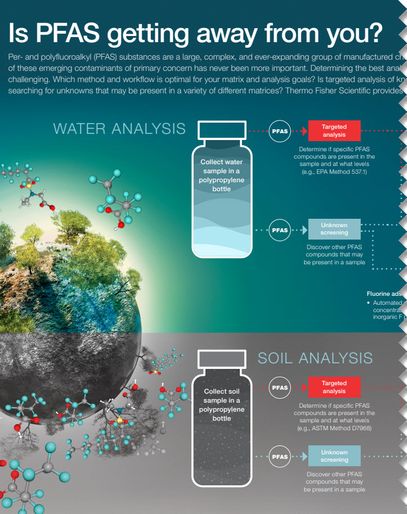
One of the most exciting applications of CIC has been in the analysis of a family of chemicals that has made headlines due to their toxicity and ubiquity: PFAS (per- and polyfluoroalkyl substances). In the U.S., both the ASTM and the Environmental Protection Agency (EPA) are working on standard methods that use CIC to determine total adsorbable organofluorine (AOF) as a complement to more targeted analyses (see infographic). To get a taste for some of the work that has gone into developing a method, you can read the paper titled “Development of a standardized adsorbable organofluorine screening method for wastewaters with detection by combustion ion chromatography,” published in the September 2022 issue of the journal Analytical Methods. In it, researchers from the U.S. EPA describe a CIC method that combusts PFAS from surface and wastewaters following their adsorption onto activated carbon. While more than just PFAS can account for elevated levels of fluorine in environmental waters, AOF concentrations can provide an indication that more detailed analyses using targeted or even untargeted methods with high-resolution accurate mass (HRAM) spectrometry are justified.

By applying heat, CIC can transform your samples, unlocking their contents so that you can deliver the results you’ve been craving.

Here are a few CIC application notes to whet your appetite:

  • Fast determinations of brominated compounds in carbonated beverages using oxidative pyrolytic combus…
  • AOF by combustion IC – non-targeted complemental determination of PFAS in aqueous samples
  • Determination of Fluoride in Tea Using a Combustion Ion Chromatography System
Food packaging

Enhancing PFAS Analysis in Food Contact Materials Using Combustion Ion Chromatography

Per- and polyfluoroalkyl substances (PFAS) have been used in...

Read More
US EPA Method 1621_1200x600

Understanding PFAS and Combustion-Ion Chromatography

Per- and polyfluoroalkyl substances (PFAS) comprise more tha...

Read More
Robust Analysis of Halogens and Sulfur in Industrial and Environmental Samples

Robust Analysis of Halogens and Sulfur in Industrial and Environmental Samples

In industrial processes, accurately determining halogens and...

Read More

IC Golden Jubilee blog header image

What is the Ion Chromatography Golden Jubilee? Celebrating 50 Years of IC Innovation

The year 2025 marks the golden jubilee of ion chromatography...

Read More

Dr. Carl Fisher

Dr. Carl Fisher is a Product Marketing Manager in the Ion Chromatography/Sample Preparation (IC/SP) business unit of Thermo Fisher Scientific, focusing on delivering intuitive, reliable IC and sample preparation solutions for routine analyses.
HPAE-PAD for Quick, Sensitive Determination of Carbohydrates in Pharmaceutical Formulations
Helping Develop World-Class HPLC Instruments: An Interview with Dr. Susanne Fabel

Privacy StatementTerms & ConditionsLocationsSitemap

© 2025 Thermo Fisher Scientific. All Rights Reserved.

Talk to us