AGBT has been an amazing conference so far, with the plenary sessions of the day covering novel genomics applications and technology. As the sun set on the horizon, the focus shifted to workshops, in-suite presentations, and demos.
Adam Ameur of the National Genomics Infrastructure (NGI) from Uppsala, Sweden, and Lucy DesJardin of the University of Iowa gave talks in the Ion Suite (Amarante 1).
A core lab’s perspective: experiences of human and microbial sequencing on the Ion S5 XL System
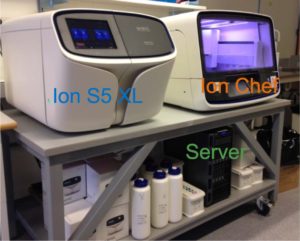
Adam discussed various applications that have been run successfully on the Ion S5™XL platform. In his talk, he shared his experience with the Ion systems, emphasizing the ease of installation, set-up, and how the instruments didn’t take up too much room. His talk covered the simplicity of the Ion systems in every aspect, from installation, set up, to running experiments. Adam further explores all the projects his lab currently works on and the varied range of applications that are run on the Ion systems.
- Copy Number Variation in Cancer Cell Lines
- CNV analysis are mostly done using microarrays and the team is exploring how the Ion S5 systems can help provide more.
- They tested a Leukemia cell line for which microarray data was available. The tested Ion S5 systems were successfully able to detect previously observed CNV gains and deletions on chromosomes 12 and 17
- 16S Metagenomics Studies.
- Prior analysis of the bacterial composition of colon samples was performed on the Ion PGM™ using the Ion 16S™ Metagenomics kit. The goal was to increase multiplexing with the Ion S5 XL and Ion 530™ chip
- They were able to run 32 samples on a single 530 chip with an average of ~525K reads per sample. With the Ion S5, they can do sequencing more efficiently.
- Human Exome Sequencing
- The core facility runs a lot of exomes on the Ion Proton™ and has generated a local database system that can perform rapid analysis.
- In a research test, using exome sequencing they were able to detect rare recessive diseases in two retrospective samples. With exome-seq producing over 17 Gbp of data.
- Ion AmpliSeq Whole Transcriptome
- AmpliSeq whole transcriptome is one of the core facilities’ main applications. This time, the goal was to evaluate the Ion 540™ chip for AmpliSeq whole transcriptome samples and compare with previous results.
- They tested 24 tumor research samples and were able to reproduce the results observing high concordance with previous data.
- Virus Integration Detection
- HPV is a causative agent for cervical cancer and is a double-stranded DNA virus that integrates into the host genome. This integration of the HPV virus can lead to invasive cervical cancer.
- They tested the ability to multiplex on the Ion S5 system. They were able to detect the virus integration site and were able to multiplex >10 samples on the 530 chip.
- Ion AmpliSeq™ Panel for Circular RNA Research
- Circular RNA (circRNA) is a new class of noncoding RNA found in plants, archea, and animals. These are very stable molecules and is this is a growing field of research. The team wanted to develop an Ion AmpliSeq panel for circRNAs
- Since identification of circRNAs from RNA-seq is challenging, an AmpliSeq panel may potentially allow for increased specificity and sensitivity, precise RNA expression levels, and cost efficient, multiplexing, and high throughput capabilities.
- The team successfully developed the AmpliSeq research panel based on human brain RNA data. Their preliminary data shows high correlation in circRNA expression for replicate samples, they were able to cluster according to relative circRNA expression and could multiplex 11 human RNA samples – all in all, the Panel WORKED! (>5million reads)
Adam’s talk highlighted how the Ion S5 systems can be used for several applications with ease and simplicity. He mentioned, “Just using S5 is smooth and easy to operate.”
Time Matters: The role of whole genome sequencing in high-resolution bacterial strain typing for foodborne disease analysis
 Lucy E DesJardin of the University of Iowa discussed the role of whole genome sequencing in high-resolution bacterial strain typing for foodborne disease research. Foodborne outbreak investigation takes time, and rapid responses and detection may allow for faster investigation and tracking.
Salmonella is the most common foodborne disease in the United States accounting for 1 million illnesses, 19,000 hospitalizations, and 380 deaths annually. The bacteria can be transmitted via contact with animals, person-to-person, or by foods contaminated with small amounts of animal feces. There are over 40-50 cases per week reported to the CDC. Salmonella is genetically homogenous, and there is need for a more discriminatory method to strain-type so that cases in the cluster can be more accurately matched and investigated.
The team studied Salmonella by performing whole genome analysis on the Ion S5XL system combined with the Ion Chef. The Ion Chef allowed for fast, easy, automated template preparation and the Ion S5 for sequencing. They also used web-based analysis using the AssemblerSPAdes Ion Torrent™ server plugin for de novo assembly and phylogenetic analysis of the bacteria, allowing them to receive enhanced cluster resolution.
In conclusion, the Ion S5 along with the Ion Chef can provide a fast rapid analysis of microbial DNA that may be helpful in future epidemics or outbreaks.
Missed AGBT 2016? We have you covered for everything – Check out our AGBT Recap
*For Research Use Only. Not for use in diagnostic procedures

Paving the Way for Clinical Transformation with Genetic Research
Looking Ahead to the 2022 American Society of Human Genetics...
Read More
SeqStudio Flex Genetic Analyzer Launch Event
Cirque du CE – Flexibility Meets Performance Step into the...
Read More
High-Content Screening Platform Innovations: Enabling thick tissue and 3D model imaging
Cameron Smurthwaite MSc, MBA, explores new innovations in hi...
Read More
Fostering the Adoption of Liquid Biopsy in Routine Clinical Practice – A Discussion with Leaders on the Forefront
The research benefits of liquid biopsy are well known and ha...
Read More
Leave a Reply