Real-time PCR (qPCR) has transformed how scientists detect and quantify nucleic acid targets, offering analytical sensitivity, speed, and scalability. Many real-time PCR reactions measure a single target per well — a setup called singleplex qPCR.
However, the effectiveness of real-time PCR can be increased by an approach called multiplex qPCR. By amplifying and detecting multiple independent targets within the same well, multiplex qPCR allows you to obtain more data from fewer reactions, efficiently use reagents, and improve reproducibility.
Whether you’re analyzing gene expression or detecting pathogens, multiplexing helps streamline your workflow.
From singleplex to multiplex: How it works
A typical real-time PCR assay includes two primers and, when using Applied Biosystems™ TaqMan™ chemistry, a fluorescently labeled probe. In singleplex experiments, one assay is amplified per well. In multiplex qPCR, two or more targets are amplified simultaneously, each identified by a probe labeled with its own dye.
Among available chemistries, Applied Biosystems™ TaqMan™ probe–based assays are among the best suited for multiplexing because each probe provides both specificity and independent fluorescence detection. This dual capability allows researchers to amplify multiple assays in one reaction and detect each target independently.
Why choose multiplex qPCR?
Multiplex qPCR can offer important advantages over singleplex workflows:
• Higher throughput – Detect more targets per well, increasing the number of samples that can be amplified in a plate.
• Lower reagent and sample use – Efficiently use reagents and limited biological samples.
• Improved precision and reliability – Internal controls within the same well normalize variability.
• Enhanced data confidence – Unlike singleplex experiments, all targets and the control are tied to each other in each well.
While duplexing (two targets per well) is often a practical first step, the power of multiplex qPCR can be further increased by combining three or more assays in a single reaction. Thermo Fisher Scientific’s advanced tools, services and products make high-order multiplexing (up to six targets) not only achievable but increasingly accessible.
When multiplexing makes the most sense
Multiplexing helps deliver the most significant benefit when you are:
• Amplifying large sample cohorts using a consistent set of assays.
• Needing more quality assurance in the data.
• Working with limited or precious sample material.
If your project requires a large number of assays (for example, more than 12), a real-time PCR array may be more efficient.
As the number of targets in the multiplex increases (3–6), careful planning becomes even more important. Thermo Fisher Technical Applications Scientists and Field Applications Scientists can provide guidance.
How to design a successful multiplex qPCR assay
The recipe for developing an effective multiplex qPCR workflow includes assay considerations and testing.
1. Identify compatible assays
Start by selecting the assays you wish to combine. The number of assays you can multiplex depends on your instrument’s optical filters. For instance, if your real-time PCR instrument has six detection channels, you can theoretically multiplex up to six targets.
Use the Multiplexing Support Request Tool on the qPCR Assay Design Hub to check assay compatibility. Thermo Fisher’s Multiplexing Support Team offers free in silico analysis to identify potential unwanted primer or probe interactions.
2. Choose the right reporter dyes
Proper dye selection helps ensure clear spectral discrimination. Recommended dyes include: Applied Biosystems™ FAM™, VIC™, ABY™/NED™, JUN™, Cy5™, and Cy5.5™. Most Applied Biosystems™ reagents include the passive reference dye ROX™, which provides many benefits — especially for multiplex reactions. Consider avoiding red reporter dyes, such as JUN, to allow the use of ROX.
ABY, NED, and TAMRA are all orange-emitting dyes. Avoid having multiple dyes of similar emissions in a multiplex. Using dyes, the instrument is already calibrated for, simplifies multiplexing. When using non-standard dyes, called custom dyes, custom dye calibrations will be needed.
3. Primer concentrations
For singleplex TaqMan probe-based assays, universal primer concentration (900 nM) is recommended. However, in a multiplex, universal primer concentration could allow a more abundant target’s amplicon to reach a concentration that saturates Taq DNA polymerase, which could suppress amplification of lesser abundant targets. To prevent polymerase saturation in a multiplex, an assay can be formulated with a reduced primer concentration, called primer-limited. The researcher should choose which assays need to be primer-limited based on anticipated target abundances.
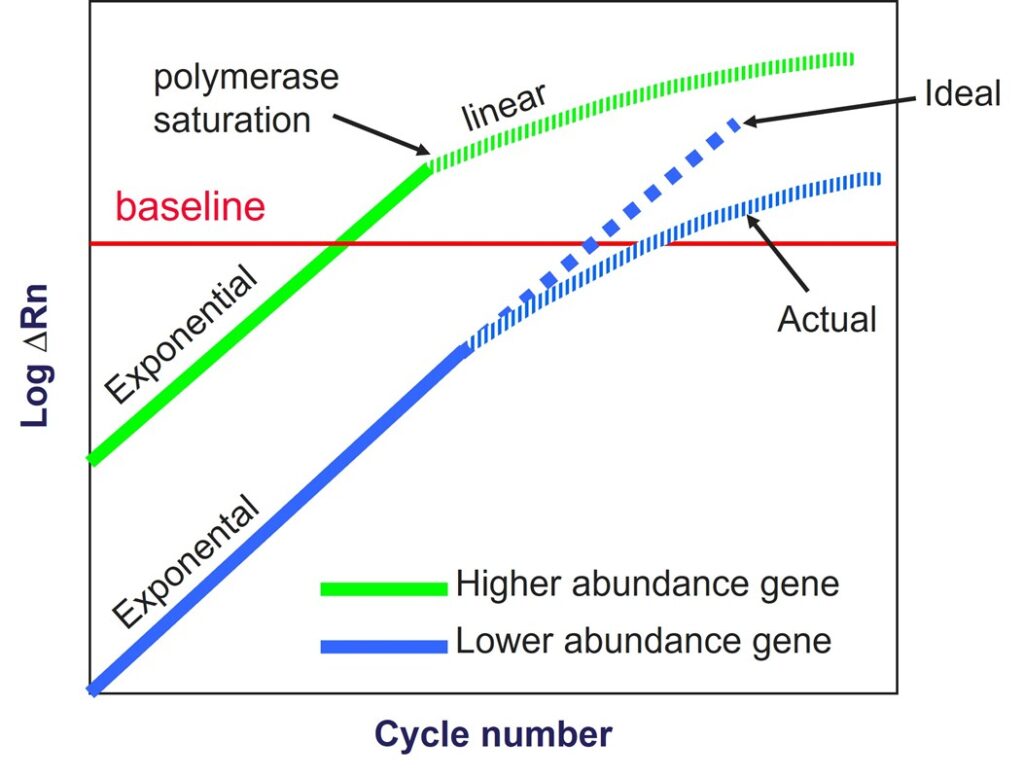
If universal singleplex primer concentration (900nM) is used, the higher abundance gene continues to amplify until the polymerase is saturated, causing amplification to transition to linear phase. Amplification of the lower abundance gene must also transition to linear phase when Taq DNA polymerase is saturated. In this saturation scenario, the Ct value of the lesser abundant gene is inaccurate or even absent; the multiplex failed.

Polymerase saturation is prevented by a reduction in primer concentration, called “primer limitation.” A primer limited assay transitions from exponential to linear phase due to primer exhaustion rather than saturation of the polymerase, allowing exponential amplification to be detected for the lower abundance gene.
VIC-labeled, primer-limited (PL) formats can be selected online for Applied Biosystems™ TaqMan™ Gene Expression Assays or Applied Biosystems™ Custom TaqMan™ Gene Expression Assays. Specialty oligos can also synthesize assays with different reporter dyes and primer-limited format.
4. Performance testing before scale-up
Before using a multiplex for its intended application, its performance should be tested. The more rigorous method of performance testing is by mixed standard curves. One target is serially diluted across a range likely to be encountered in samples. To these serial dilutions are added a consistent amount of a second target. The mixed standard curve is amplified in real-time PCR. Ideally, both targets will maintain linearity in the standard curve plot across the entire range tested. If the multiplex will be triplex or higher, multiple pairs of targets will need to be tested in this way. Note that Invitrogen™ GeneArt™, a part of Thermo Fisher, can synthesize DNA controls needed to create mixed standard curves.
A less rigorous way to test the performance of a multiplex is to amplify a representative collection of samples in singleplex and multiplex, and compare the results.
5. Synthesize multiplex assay into one tube (optional)
If the performance of the multiplex has been verified as being acceptable, specialty oligos can help deliver the assays in a single tube format, which simplifies preparing the reactions and helps ensure consistent ratios among all the primers and probes.
For Research Use Only. Not for use in diagnostic procedures
Need expert help? Contact us
Ready to streamline your workflow with multiplex qPCR?
📞 Call 800-955-6288, option 2. When prompted, say “technical support,” then specify “real-time PCR.”
Thermo Fisher’s Technical Applications Scientists and Field Applications Scientists are ready to help you design, test, and optimize your multiplex qPCR assays. Summary Multiplex qPCR helps you get more results from every reaction by enabling simultaneous detection of multiple targets within a single well. With smart dye and primer concentration selections, you can achieve multiplexing success: efficiently using reagents, time, and sample material. Leverage Thermo Fisher Scientific’s tools, resources, and experienced professional guidance to bring your multiplex qPCR experiments to life.
Explore: Multiplexing resources | Multiplexing Support Request Tool | Predesigned TaqMan™ Assays
© 2025 Thermo Fisher Scientific Inc. All rights reserved. All trademarks are the property of Thermo Fisher Scientific and its subsidiaries unless otherwise specified. TaqMan is a registered trademark of Roche Molecular Systems, Inc., used under permission and license.

When PCR Gets Dirty – Tackling PCR Inhibitors
In this first Absolute Gene-ius: Science Snapshot episode, h...
Read More
qPCR-based fragmentomics for monitoring cancer disease progression
As fragmentomics gains momentum in cancer liquid biopsy rese...
Read More
Scaling Human-Relevant Oncology Testing: OncoPro Tumoroids on ScreenIn3D’s UpScale Platform
The United States National Institutes of Health has prioriti...
Read More
Why Most Modern Drug Candidates Fail at Solubility
Drug discovery capabilities continue to advance rapidly. Med... Dirk Leister
Read More
Leave a Reply