Setting the stage
In the heart of Amsterdam, the Beurs van Berlage Conference Centre is a perfect stage for an event focused on how work, in this case, in the laboratory, is changing. Once a commodity exchange, its red-brick exterior and soaring steel-framed halls create an environment that really fosters interaction and exchange—perfect for the ambitions of Lab of the Future 2025.
The Lab of the Future Congress takes place twice a year—once in the U.S. and once in Europe—bringing together scientists, technologists, and industry leaders to explore how automation, AI, and digitalization are reshaping the modern research environment. The focus is on the changing nature of the lab environment, the role of emerging technologies, such as FAIR data, robotics, and automation, and advances in fields like AI, as well as the imperative for collaboration across the scientific community.
Our presence
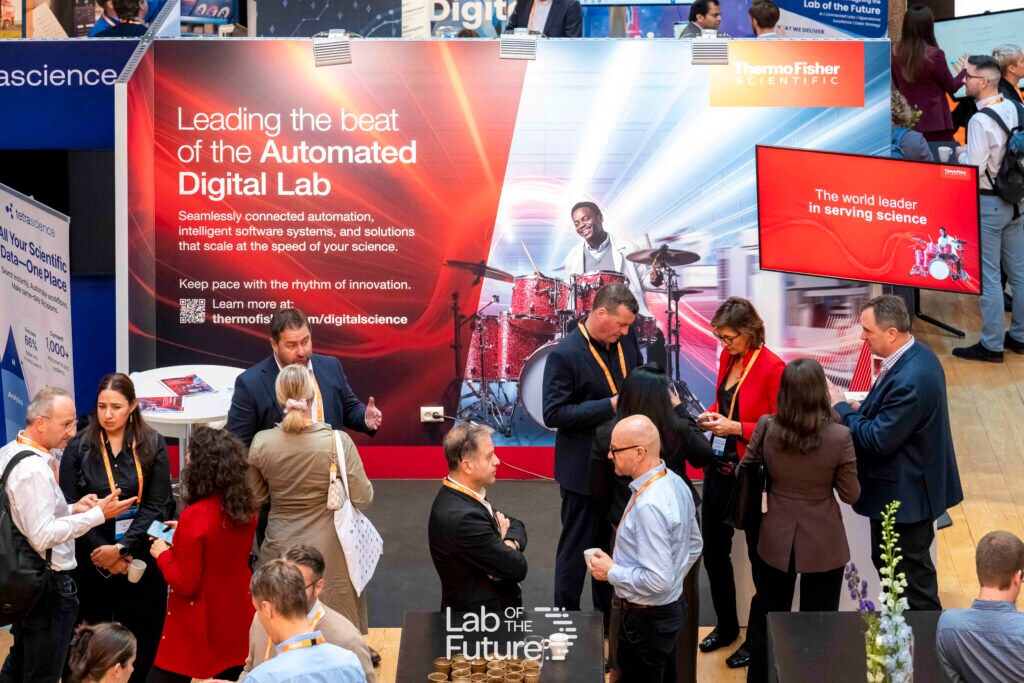
Our Thermo Fisher Scientific team truly set the tone for the event from the outset. Our marketing team knocked it out of the park, with refreshed booth graphics and Rhythm of Innovation magazine—fronted by a scientist on drums—it was more than visuals; it became a metaphor for the team. For me, it represents a signal that we’re not just participating in the future of science but driving the beat of change. That rhythm echoed through every detail—from our curated playlist (which is well worth a listen!) to branded drumsticks and Bluetooth speakers—creating a vibe that was energising, grounded, and unmistakably ours.

A call to accelerate science
I was privileged to have one of the opening keynote presentations at the event, along with three other great presenters from J&J, Servier, and Accenture. My objective was to channel some of this energy and make the point that the lab is the true accelerator of science. Automation, digital foundations, robotic automation, and AI are no longer peripheral—they are the forces capable of cutting years from drug development and unlocking step-changes in scientific productivity.
I shared our vision of an AI-native, Automated Digital Lab, enabled by a laboratory operating system —that most importantly, is open by design and collaborative by nature. Thermo Fisher is incredibly well-positioned to define and shape what a laboratory operating system can be, grounded in open standards and partnership across the scientific community, and most importantly, focused on solving real-world customer problems by accelerating their science and unlocking scientist productivity.
We also spotlighted our new strategic partnership with BenchSci, recently announced in a joint press release. By integrating their ASCEND GenAI R&D platform with Thermo Fisher™ Connect Discover, we’re enabling scientists to uncover novel disease biology through AI-driven insights, unify fragmented data sources, and design experiments that are smarter, faster, and more efficient. Think of this as building an AI-enabled assistant, embedded in our Thermo Fisher™ Connect Platform, Enterprise Edition, that helps scientists explore ideas, leveraging a conversation interface on richly curated research datasets that can include internal information, and ultimately accelerate the design of their wet lab experiments.
This unlocks huge synergy and opportunity with our current Connect Enterprise focus on lab orchestration. Connect Discover is not just another solution—it represents an ability to accelerate the very start of the journey for the Lab Operating System, ensuring that reagents, resources, instruments, workflows, and data are clearly linked to the science and experimental objectives. Thermo Fisher is uniquely positioned to orchestrate the entire lab ecosystem—uniting customers, technologies, and partners into a connected, intelligent environment where innovation can truly scale.
As I reminded the audience, “it takes a village”—and our role is to be the trusted partner, working side by side with customers and the wider industry to lead the beat of innovation and help science move faster, smarter, and further.

Industry conversations
Throughout the two days, that message was echoed: progress will only come through openness and partnership. Speakers agreed that science is accelerating under immense pressure, demanding both precision and responsibility. Some declared the “era of LIMS and ELN is dead,” while others pointed to evidence of rising adoption—reminding us that while tools evolve, the real challenge is transformation.
As one panelist noted, too many scientists are still working with “paper on glass.” The task is not just digitization but reimagining workflows, and as Paul Denny-Gouldson of Zifo put it: “If we’re asking scientists to change, we need to show them the art of the possible.”
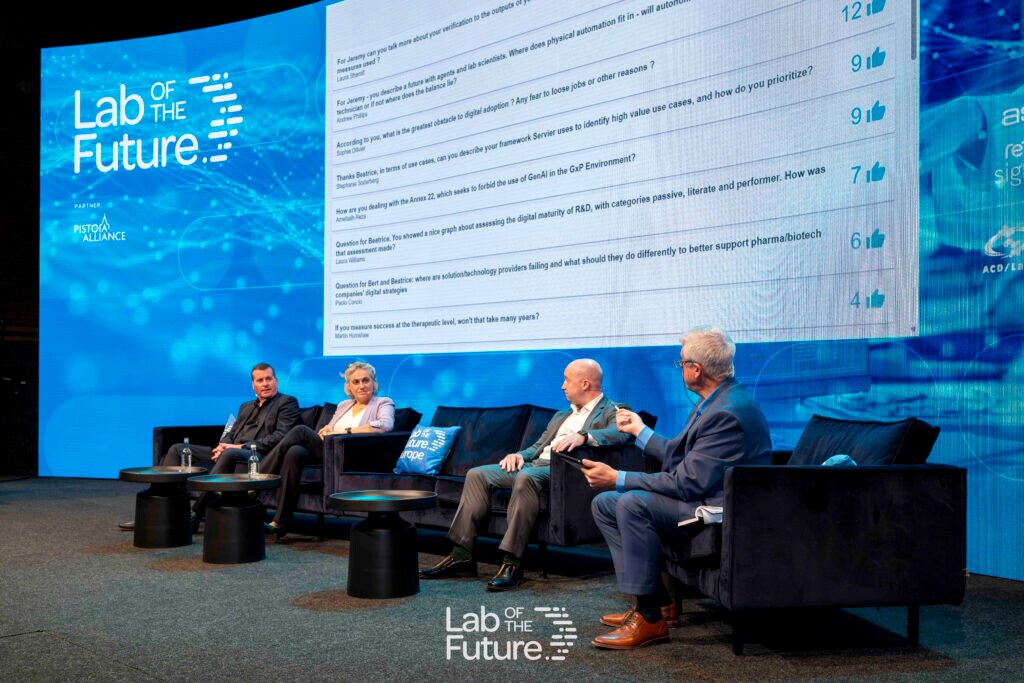
One of the most electric sessions was a panel featuring Teodor Leahu (L7 Informatics), Jason Hirshman (Uncountable), Aisyah Sjöholm (Insilico Medicine), and Andreas Steinle (Roche). The debate—AI’s role in drug discovery—was sharp, even philosophical. Can we trust AI to innovate in discovery? Yes, said some—if the data is right and the prompts are precise. But therein lay the tension. Jason Hirshman argued that creativity is essential—the framing of the question itself is an act of human ingenuity. Teodor Leahu countered that creativity introduces risk, insisting there should be no room for it in processes that demand precision and reproducibility.
Debates like these underscored a bigger truth: trust is central. It surfaced again and again, not only as a technical requirement but as a cultural anchor. As Novo Nordisk’s Adama Ibrahim reminded the audience, in a world of accelerating science, trust is the anchor.
Looking ahead
Day two brought a standout session from Martin Hornshaw, grounding the ambition in customer case studies that showed how innovation at scale can deliver tangible business outcomes today.
By the close, one truth was clear: the lab of the future is not a fixed destination, but a direction. It will be shaped not just by technology, but by the choices we make about trust, design, and what it means to do science. And while the pace of change is quickening, the opportunity lies in coming together—across disciplines, organisations, and perspectives—to enable it with purpose and clarity.
In the end, perhaps the most powerful insight was also the simplest: the lab is not just where we discover the future, it is where we decide it. Let’s make it so.
Thermo Fisher Scientific Recognized as a Star Player in Lab Informatics by MarketsandMarkets’ 360Quadrants
Laboratory informatics solutions are essential for lab users...
Read More
Benefits of Implementing a Laboratory Information Management System
Evaluating laboratory operations with advanced LIMS software...
Read More
Unlocking the Potential: The Power of Platform-Based Orchestration in the Life Sciences Industry
Across the evolving life sciences sector, organizations face...
Read More
Why Every Emerging CRO Should Consider Implementing a LIMS
Within the fast-paced and highly competitive field of contra...
Read More
Leave a Reply