Antioxidants Polyphenolic Content of Mulberries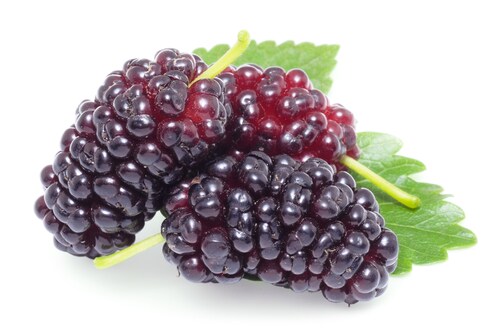
Recently, Natić et al. set out to analyze the polyphenolic content of 11 mulberry (Morus alba) genotypes, including five black, four white, and two pink varieties.1 The team prepped the samples then fractionated them to separate the anthocyanins from the non-anthocyanins using solid phase extraction C18 Sep-Pak cartridges (Thermo Scientific). They subjected both portions to ultra high performance liquid chromatography tandem mass spectrometry (UHPLC-MS/MS) for identification using an Accela 600 pump, autosampler, and LTQ Orbitrap platform controlled with Xcalibur software (all Thermo Scientific). For quantification, they also employed UHPLC-MS/MS with diode array detection (DAD) using Dionex Ultimate 3000 coupled with a TSQ Quantum Access Max triple-quadrupole platform (Thermo Scientific).
Using UHPLC-MS/MS without standards, the team identified 14 hydroxycinnamic acid esters, 13 flavonol glycosides, and 14 anthocyanins. Turning to UHPLC-DAD-MS/MS, they quantified 16 phenolic compounds in the samples. The highest total phenolic content values occurred in black-colored mulberry samples (326.29 mg GAE/100 g FW) and the lowest registered in pink-colored samples (43.89 mg GAE/100 g FW). Rutin was the most abundant phenolic compound, making up 44.66% of the total quantified phenolics in all the samples combined. For black varieties, the rutin content was significantly higher (30.43 mg/kg FW to 77.28 mg/kg FW) than the white or pink varieties (0.65 to 13.46 mg/kg FW). Other phenolic acids with higher concentrations in black-colored samples included protocatechuic acid, chlorogenic acid, and ferulic acid.
The team also detected these notable phenolic acids: gallic acid, p-hydroxybenzoic acid, gentisic acid, caffeic acid, p-coumaric acid, and ellagic acid. Of the flavonoids, four flavan-3-ols appeared and made up approximately 10% of the total quantified phenolics: gallocatechin, epigallocatechin, gallocatechin gallate, and epigallocatechin gallate.
Natić et al. relied upon four assays to establish the antioxidant capacity of the samples: DPPH scavenging activity (DPPH-SA), superoxide anion radical scavenging activity (SAS), reducing power (RP), and metal chelating activity (MCA). This study is the first application of RP and MCA to mulberry extracts. The team reported that all extracts exhibited anti-DPPH activity (50.18-86.79%), which was significantly higher than previously reported values. They found all extracts active in a variety-specific way on the SAS assay, with higher activity reported for black samples (16.53–62.83%). Similarly, RP assay revealed that all black-colored extracts exhibited some reducing capacity (0.03–38.45 uM ascorbic acid) while other samples were inactive. They report lower values (0.21–8.15%) on the MCA assay.
Overall, the team reports the mulberry–particularly the black-colored varieties–to be a rich source of antioxidants. They highlighted two genotypes in particular, referenced as MA 0601P and MA 0505P, as likely candidates for clonal propagation and commercial applications.
Reference
1 Natić, M. M. et al. (2015) ‘Analysis and characterisation of phytochemicals in mulberry (Morus alba L.) fruits grown in Vojvodina, North Serbia.’ Food Chemistry 171:128–136.

Natural Colorants: Unlocking the Future Through Fungal Innovation and Mass Spectrometry
As consumer demand continues to shift toward clean-label, pl... Daniel Merriman
Read More
What to Keep in Mind When Analyzing Chlorophyll Samples using UV-Vis Spectrometry
In some food industries, it can be important to determine th...
Read More
Can UV-Vis Spectrometry Be Used to Analyze Chlorophyll in Canola Oil?
Canola oil is a type of vegetable oil derived from the seeds...
Read More
Changing Texture and Taste of Plant-Based Meats with Added Oils
Consumers are increasingly choosing plant-based foods becaus...
Read More

Leave a Reply