Selecting the right centrifuge represents a critical decision for any laboratory. This equipment serves as a cornerstone for numerous scientific procedures, from basic sample preparation to advanced research applications. To help ensure optimal performance, safety, and compatibility with your laboratory’s specific needs, multiple factors must be carefully evaluated.
Match the centrifuge to your application
Evaluate your laboratory’s specific protocols and requirements. Different scientific disciplines demand distinct centrifugation capabilities. Clinical laboratories typically require instruments certified for diagnostic testing, while research facilities might prioritize versatility across multiple applications. Whether you’ll be processing blood samples, performing cell culture work, or conducting molecular biology procedures, this will narrow down the centrifuge models matching your needs.
Choose centrifuge and rotor to fit your sample volume and format
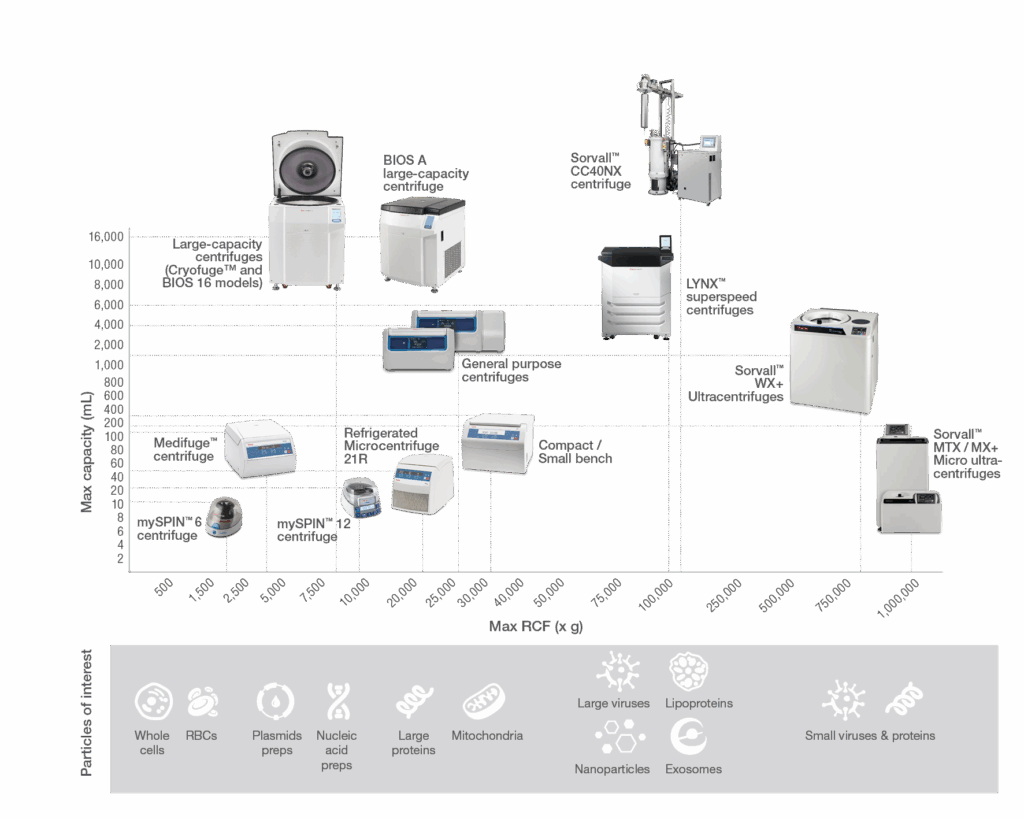
The volume and container formats of your typical samples directly influence the appropriate centrifuge and rotor category. Microcentrifuges excel at processing small volumes in PCR tubes or microtubes, and compact centrifuges can spin microplates, making them excellent for molecular biology applications. Medium-capacity benchtop models accommodate standard conical tubes (15-50 mL), commonly used in cell culture and general laboratory procedures. Large-capacity floor-standing models can spin large collection tubes, bottles, blood bags, or BioProcess Containers (BPC).
Of course, choosing the right centrifuge isn’t just about application and volume. To see how speed, temperature control, sustainability, and other factors impact your decision, download the complete Centrifuge Buying Guide.
Balance speed with separation needs
Different centrifugation protocols require specific speed and force parameters to achieve proper separation. Low-speed centrifuges operating up to approximately 7,500 rpm are suitable for whole cell separation, basic pelleting, and many clinical applications. High-speed models reaching 20,000+ rpm become necessary for subcellular fractionation, protein purification, and advanced molecular applications.
Further considerations
Additional factors to consider include temperature control, laboratory space constraints, rotor versatility, and safety features.
Why sustainability matters more than ever
Environmental considerations have become increasingly important in laboratory equipment selection. Recent regulatory changes, including the EU F-Gas Regulation (EU) 2024/573 and similar US EPA initiatives, are driving manufacturers toward more environmentally responsible refrigeration systems. Advanced centrifuges now incorporate natural refrigerant cooling systems using either CO₂ (with a Global Warming Potential of 1) or R290 (with a GWP of 3) instead of traditional hydrofluorocarbons with much higher environmental impact. The energy efficiency of lab equipment also helps reduce the total cost of ownership. This includes not only the annual energy costs but also quality considerations, service offerings, rotor inspection programs, and more.
In our buying guide, you will also find further trending topics such as connectivity, user experience, and ergonomics.
Ready to explore in detail?
Our Centrifuge Buying Guide covers trending topics like connectivity, user experience, ergonomics, and long-term ownership costs, giving you a complete framework for confident decision-making.
Not ready to download? Learn more about our Lab Centrifuges with GreenCool Technology.

Why is it Important to Think About Sustainability for Lab Centrifuges?
Centrifuges are essential laboratory instruments used to sep...
Read More
Is Your Centrifuge Ready for Retirement?
10 Signs That Show You Should Replace Your Centrifuge In lab...
Read More
The Essential Process of Platelet-Poor Plasma (PPP) Preparation in Clinical Laboratories
In the clinical laboratory setting, the preparation of Plate...
Read More
Unveiling Exosome Isolation and Purification Protocols: A Deep Dive into Ultracentrifugation Techniques
Exosomes, a subtype of extracellular vesicles (EVs), have be...
Read More
Leave a Reply