 Is it possible to characterize the production behavior of masterbatches supplied by different manufacturers in a short time by using a laboratory mixer? When a manufacturer had an interruption in production time due to a problem with its drive motor, we did some analysis and determined that pigment differentiation was a factor.
Pigments are mainly used in the plastics and rubber industry in order to color the end product according to the customer’s wishes. As pigments in powder form often generate processing difficulties in feeding and handling, masterbatches are used to overcome this problem. A masterbatch is a concentrate of pigments or additives dispersed into a polymer matrix.
In this case, titanium dioxide supplied by two different manufacturers was compounded to a proportion of 60% with polyethylene to form a masterbatch. During production it was noticed that for one of the titanium dioxide masterbatches, the power consumption of the drive motor rose steadily until the unit was switched off by its overload protection. This resulted in interruptions in production due to the necessity of emptying out and cleaning the machine.
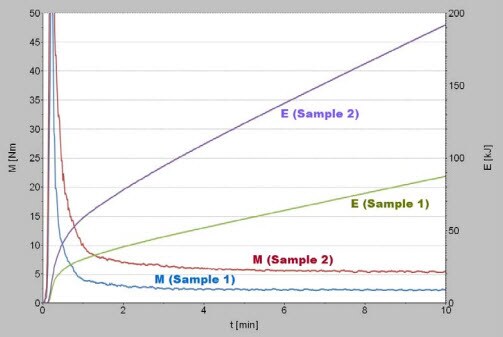
We performed testing with a torque rheometer system and an electrically heated laboratory mixer. For testing material, we used Titanium dioxide supplied by two different suppliers mixed with 40% LDPE. The mixer temperature was 150 degrees C, while the rotor speed was kept at 70 rpm, and sample weight was 45g TiO2 + 30g LDPE. The samples were thoroughly mixed at a constant temperature and constant rotor speed and Torque and Energy consumption variables were recorded.
After looking at the results we determined that although both samples had an identical proportion of polyethylene and titanium dioxide, there was a clear difference between their torque and energy consumption data. The sample which caused the problems in production showed significantly higher values.
You can see the diagram with torque curves and energy consumption of the mixer tests done with the two samples, and well as instruments used and additional details in this application note, Pigment Differentiation in Masterbatches.

Maximizing ROI Through Uptime in Labs and Production Lines
Uptime Optimization is the New ROI Metric In today’s h... Germain Siraudin
Read More
K 2025: Showcasing the Future of Sustainable, Smart, and Responsible Plastics Production
This week, more than 3,000 exhibitors and 177,000 visitors f... Keith Cornell Nimesh Khadka, PhD
Read More
The Principles and Capabilities of Powder Rheology
Powder rheology is a critical analytical technique for sever...
Read More
Monitoring the UV Cure Process of a Polymer Based Ink by FT-IR
Can the degree of cure of a polymer-based ink applied to a M...
Read More
Leave a Reply