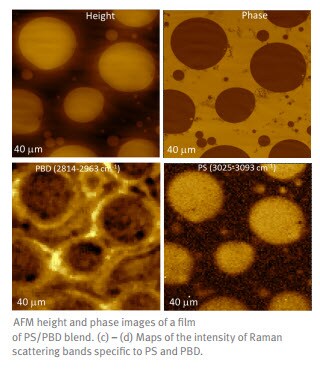
 The field of engineered polymers has become increasingly more important over the last few decades. The goal of engineering a polymer is to impart specific, desirable properties to an existing material, depending on the intended use. The goal may be to strengthen the polymer, make it less brittle, more heat tolerant, or facilitate processing and manufacturability. Mixing two polymers, or blending, is one strategy to accomplish this goal. In a polymer blend, the complex interplay between two dissimilar polymers can result in materials possessing valuable properties, exceeding those of the individual component polymers.
High Impact PolyStyrene (HIPS), for example, is an immiscible polymer blend consisting of polystyrene and polybutadiene. By blending a small proportion of polybutadiene into polystyrene, the formerly stiff and brittle polystyrene transforms into a more ductile and tough material. Mixing two different polymers is seldom complete, and phase separation or partial mixing often results when most polymers are blended. These polymer mixtures are referred to as immiscible blends. The shape made by the two phase-separated polymers and their arrangement in the blend is termed the morphology of the blend. The morphology of a particular blend will impact the properties and will be influenced by the relative amounts of polymer components and mixing conditions.
Understanding and controlling the interaction between components in these heterogeneous materials requires interrogating these materials on a micron or even submicron scale. The development of atomic force microscopy (AFM) has opened new frontiers in the study of materials at the micron, submicron and even nano scales. At these scales, AFM is used for high-resolution surface profiling and quantitative studies of local mechanical and electromagnetic properties. However, additional critical information may be obtained through the use of other analytical techniques such as extension of AFM measurements with a Raman instrument. The integration provides simultaneous, spatially coincident, and unambiguous molecular information that complements the topological, mechanical, and electromagnetic information that AFM provides.
Component distribution mapping and identification of multi-component materials becomes difficult as size begins to approach the micron and sub-micron scales. Although AFM provides highly detailed material property based information (i.e. surface topology, mechanical, electromagnetic) in the images it does not offer unambiguous identification of components and respective distribution. Component identification can be achieved with Raman microscopy, because individual polymers exhibit unique spectra, which are then used for identification and quantification. The ability to identify individual components of polymer blends in combination with AFM imaging provides valuable information that explicitly establishes the chemical-morphology-property relationship in materials. Integrated Raman-AFM instruments are capable of directly measuring chemical information that can be assigned to the features observed in the AFM images. The measurement taken by this integrated instrument is called co-localized Raman-AFM.
The complete characterization of polymer blends requires multiple techniques to understand the complex interplay between components in these mixtures. Our next article will outline a standard far field, diffraction limited, confocal Raman experiment measured at the sample. If you can’t wait, read The Characterization of Polymer Blends Using a Combined Raman-AFM Microscope to see data and spectra demonstrating how Atomic force microscopy and Raman spectroscopic mapping provide complementary topological, mechanical and chemical information that is crucial to understanding the chemical, mechanical and morphological relationship of polymer blends.

K 2025: Showcasing the Future of Sustainable, Smart, and Responsible Plastics Production
This week, more than 3,000 exhibitors and 177,000 visitors f... Keith Cornell Nimesh Khadka, PhD
Read More
Monitoring the UV Cure Process of a Polymer Based Ink by FT-IR
Can the degree of cure of a polymer-based ink applied to a M...
Read More
Advances in Analytical Technologies for Battery Manufacturing
Introduction Recent advancements in analytical technologies ... Kyle D'Silva
Read More
Battery Professionals Organization Hosts Webinar on Advanced Analytical Technologies. Here’s a Recap.
Editor’s Note: A recent webinar hosted by the Volta Fo... Kyle D'Silva
Read More
Leave a Reply