Editor’s Note: This is the first of a five-part webinar series on general extruders and mixers for characterizing and formulating your polymer materials using rheology, viscometry, mixing and extrusion technologies. Watch for a webinar every Tuesday in March.
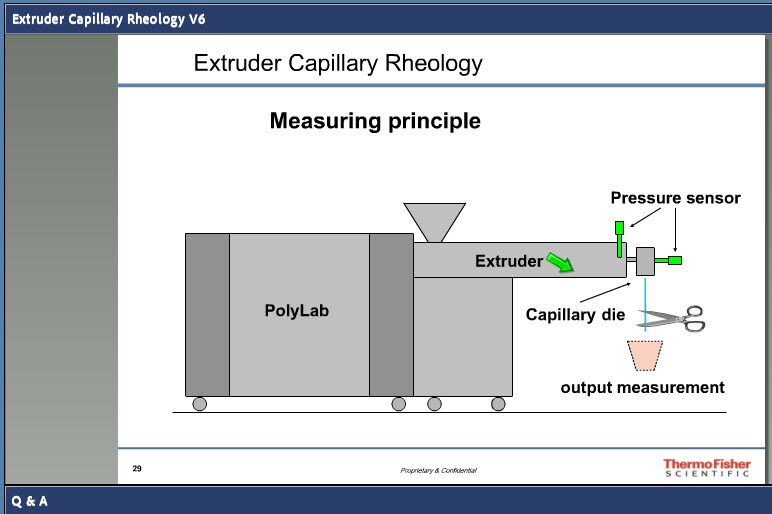
In the R&D Laboratory a new polymer is created by synthesizing small amounts of polymers or by blending existing raw materials to get the best performance for the final product. A wide range of test methods and tools are required to classify a new polymer and to allow accurate predictions of its future behavior during compounding and production. Precise tests done in the laboratory reduce costs at later stages in final product development.
Today the challenge is to develop inexpensive base materials with the properties of expensively engineered plastic. This is accomplished by blending inexpensive mass plastic material with other components and additives. The most difficult task is mixing and extruding several polymers that are immiscible by nature. Special additives have to be tested and evaluated to reduce the interfacial barriers between the blended formulations. The key to success is using appropriate instruments in the development phase to subsequently produce high-tech polymer products at a low cost with the desired characteristics (e.g., processibility, shelf-life, emulsification, etc.,). These instruments must provide a comprehensive material characterization for your polymers.
A modular torque rheometer can be equipped with different measuring sensors such as mixers, single- or twin screw extruders. Simulating industrial polymer processing on a laboratory scale, relevant process parameters such as temperature, pressure and screw speed are measured and help to understand and optimize the respective system.
We’ve developed a webinar for all newcomers and users who work with torque rheometers and laboratory extruders and use them for rheological measurements. Here extruder rheology is illustrated using a series of practical examples and linked with actual processes.
In this 50-minute webinar, you will learn about Torque rheometers, including design and applications. We will compare extruder rheology to high-pressure capillary rheology, and study the principles and applications of extruder rheology. We will go over a description of measuring procedure and interpretation of flow and viscosity curves in terms of process characteristics and processability as well as influence of processing aids, color pigments, fillers, lubricants and additives.
Whether you support research, QA/QC, product development or production, this online webinar is designed to enhance your knowledge and solve everyday challenges.
Watch the Webinar: Extrusion Rheology – Usage of the Torque Rheometer
Here are links to the full series:
- Extrusion Rheology – Usage of the Torque Rheometer
- Twin Screw Compounding – Introduction and Scale-Up
- Downstream Options for Extrusion
- Mixer Test – A Versatile Tool for Polymer Processing
- MIM/PIM Application – Mixer, Compounding, Rheology

Maximizing ROI Through Uptime in Labs and Production Lines
Uptime Optimization is the New ROI Metric In today’s h... Germain Siraudin
Read More
K 2025: Showcasing the Future of Sustainable, Smart, and Responsible Plastics Production
This week, more than 3,000 exhibitors and 177,000 visitors f... Keith Cornell Nimesh Khadka, PhD
Read More
The Principles and Capabilities of Powder Rheology
Powder rheology is a critical analytical technique for sever...
Read More
Monitoring the UV Cure Process of a Polymer Based Ink by FT-IR
Can the degree of cure of a polymer-based ink applied to a M...
Read More
Leave a Reply