Updated on Nov. 17, 2021 to reflect the launch of ESCALAB QXi XPS Microprobe.
X-ray photoelectron spectroscopy in materials research
Many problems associated with modern materials can be traced back to the surface layer and how it interacts with the external environment. The surface layer is where corrosion and catalysis occur and is what defines the appearance of an object. It can influence properties such as adhesion and water-repellency.
As the demand for high-performance materials continues to increase, researchers need better ways to investigate surface chemistry so they can design more advanced materials and avoid issues that cause materials to degrade.
Today, X-ray photoelectron spectroscopy (XPS) is a common technique for exploring surface chemistry. It provides data on both the elements present within a sample and the chemical states of those elements. By analyzing the chemical composition of the outer few nanometers of a material, scientists can improve the performance of materials needed for a broad range of applications from the non-stick coatings in frying pans to the materials needed for solar cells.
While X-ray photoelectron spectroscopy is a vital tool for analyzing surface chemistry, the technique often needs to be combined with other types of analyses to provide researchers with a complete understanding of a material.
One system for multiple surface analysis methods
The Thermo Scientific Nexsa G2 Surface Analysis System and ESCALAB QXi XPS Microprobe both meet this requirement by enabling researchers to integrate multiple analysis techniques into a single instrument to obtain the holistic insights they need without compromising data quality or sample throughput.
The Nexsa G2 System is a fully automated, high-performance X-ray photoelectron spectrometer that easily detects weak signals while producing the reliable, high-quality surface and chemistry state information researchers need. The instrument’s improved X-ray source delivers excellent sensitivity for the detection of low concentration components as well as a micro-focused spot for small feature analysis.
For researchers who need the highest spectral and spatial resolution, the new ESCALAB QXi provides the enhanced automation and flexibility needed for cutting-edge multi-technique surface analysis. The EXCALAB QXi comes with an automated sample exchange (ASE) option that speeds time to results with the ability to load a series of sample holders with multiple samples attached. It also includes a unique dual detector system that delivers both high quality spectroscopy, and superb XPS imaging with excellent spatial resolution.
Both the Nexsa G2 and ESCALAB QXi systems are integrated with the Thermo Scientific Avantage Data System, allowing for seamless instrument control and fast data acquisition, processing, and reporting for surface analyses. Likewise, both instruments come with optional upgrades that can transform the system into a complete analysis workstation to accelerate researcher productivity.
Whether you choose the Nexsa G2 or the ESCALAB QXi, you’ll be able to easily integrate your system with a variety of other surface analysis methods including:
- Ultra-violet photoelectron spectroscopy (UPS): Uses UV photons rather than X-ray photons for investigating bonding states and electronic properties
- Reflected electron energy loss spectroscopy (REELS): Provides information on electronic structure and can measure the presence of hydrogen
- Ion scattering spectroscopy (ISS): Analyzes elemental composition information from the top atomic layer of the surface
- Raman spectroscopy: Provides molecular bonding and structural information
- Auger electron spectroscopy (AES): Uses a focused electron beam to measure the surface composition (ESCALAB QXi only).
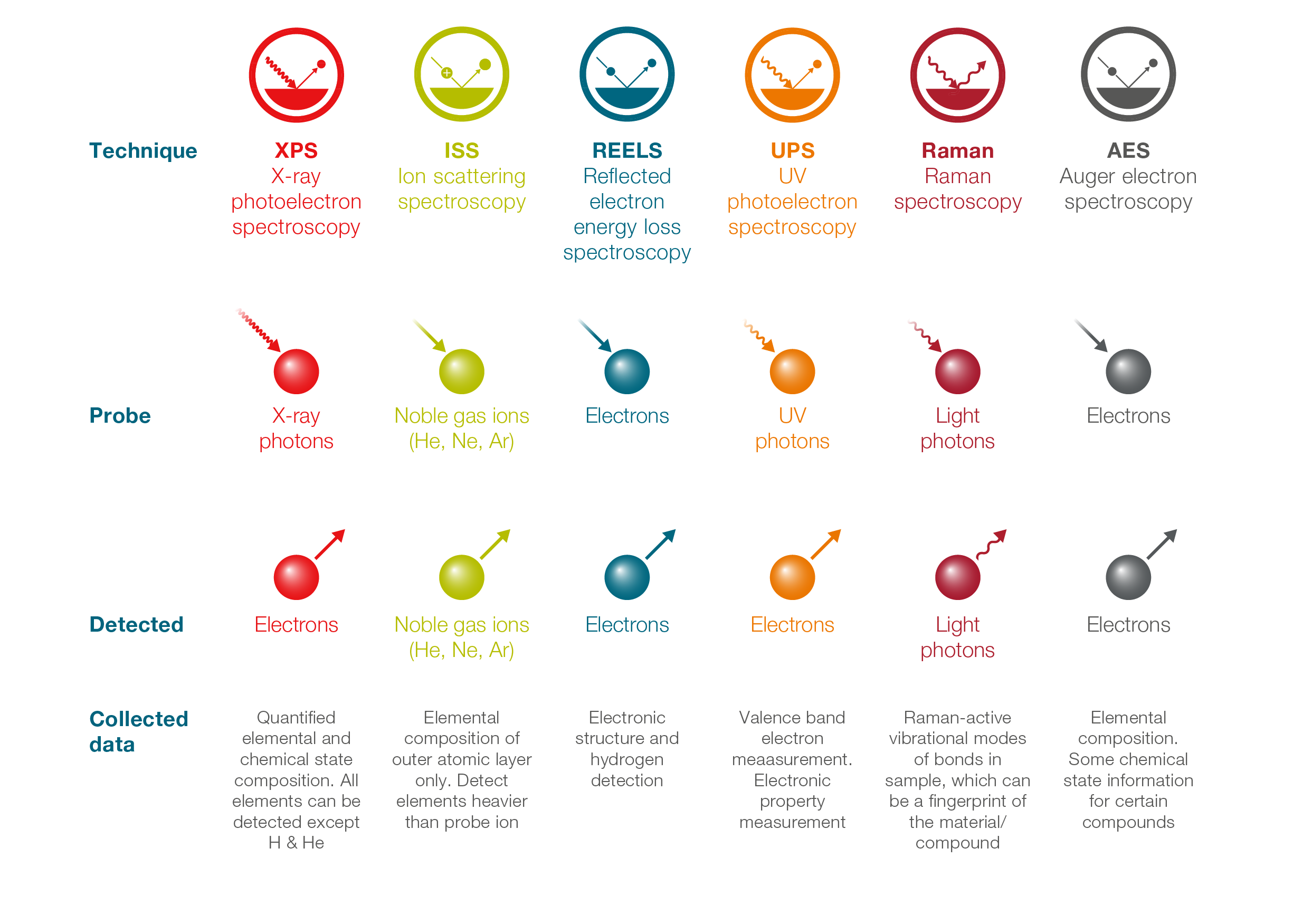
By combining X-ray photoelectron spectroscopy with other analysis techniques using a single instrument, technicians can quickly get the holistic insights they need to advance their materials surface research.
Expanding X-ray photoelectron spectroscopy analyses
By combining XPS with other surface analysis techniques, researchers can efficiently obtain the complete information they need for to solve their materials analysis problems more quickly, accelerating their productivity and the development of advanced materials.
For example, Dr. Sylvie Rangan, assistant research professor at Rutgers University, combines XPS and UPS to examine the electronic properties of cyano ionic liquids to determine how they can be used as electrolytes in applications such as fuel cells and batteries.
Likewise, Prof. John Watts at the University of Surrey leads a team of researchers who are using XPS and AES to examine the bonding of organic and metal oxide materials for adhesive applications.
With the ability to access multiple techniques from a single instrument, researchers can solve their materials analysis problems more quickly, accelerating their productivity and the development of advanced materials.
Prof. Jim Castle at the University of Surrey says “For many years, for the traditional things I’ve done in the lab, after XPS, I would have to walk the sample to a different lab, a different department, or in some cases, a different university,” By combining those techniques into one system, “I can now see everything I need in one room. Thank you for doing that. That’s great.”
To learn more, please see our Surface Analysis Techniques webpage.
Tim Nunney is an Applications and Market Development Manager at Thermo Fisher Scientific.
//

Enhancing aircraft engine performance
SEM analysis of René N5, a nickel-based superalloy for hig... Alice Scarpellini
Read More
Revolutionizing Aerospace and Defense with Electron Microscopy and Surface Analysis of Passivated Stainless Steel Landing Gear
The aerospace and defense industry is constantly evolving, d...
Read More
Advancing XPS Depth Profiling with the Hypulse Surface Analysis System
Expanding the capabilities of XPS surface analysis As materi... Tim Nunney
Read More
Why Ultra-High-Purity Gas Analysis Outperforms Conventional Methods in Semiconductor Manufacturing
As semiconductor production reaches unprecedented levels of ... Daniel Merriman
Read More
Leave a Reply